
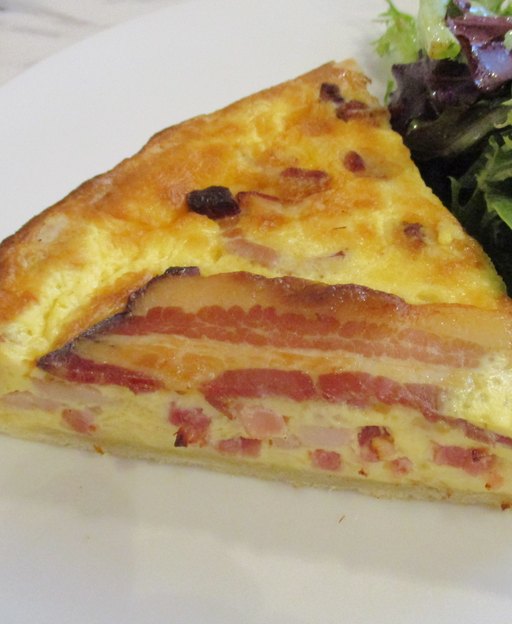
Quiche lorraine comes from Lorraine in north-eastern France, and it began as something much thinner than the deep golden tart you know. Its name probably comes from a German word for cake, its earliest records sit in the 1605 accounts of a hospice in Nancy, and to this day people in Lorraine argue that the real thing has no cheese at all. Here is how a frugal tart from the borderlands reached Paris, then America, and how to make it at home.
A Little Cake from Nancy
The word itself tells you where Lorraine sits on the map. In its history of the dish, National Geographic Traveller explains that “quiche” is probably the plural of küche in the local German dialect, a little form of the German kuchen, or cake. The French historian Guy Cabourdin traced it back as far as the 1605 accounts of the hospice of Saint-Julien in Nancy, where a quiche seems to have been something thin and crisp, made from scraps of bread dough, closer to the tarte flambée of neighbouring Alsace than to the tart we know.
The change came with pastry. The same article says bakers began to use a shortcrust or puff pastry case, which held a much more generous filling of eggs and cream and turned the quiche from a snack into a meal.
How a Border Dish Reached Paris
Lorraine’s history is a story of borders that moved, as we tell in Alsace: the region that was French, then German, then French. When the Franco-Prussian war of 1870 to 1871 sent families from the east fleeing west, National Geographic Traveller says they brought their quiche to Paris, along with the brewing traditions they used in the city’s first brasseries. Once those brasseries served a little food with the beer, quiche found a whole new audience, and the great chef Auguste Escoffier included it in his Guide Culinaire of 1903.
Bacon, Eggs and Cream: the Cheese Question
Ask in Lorraine and you will hear that a true quiche lorraine holds only three things: bacon, eggs and crème fraîche. That is the line of the Confrérie de la Quiche Lorraine, a brotherhood in aprons and medals that, according to National Geographic Traveller, holds a Fête de la Quiche every two years in the town of Dombasle-sur-Meurthe in Lorraine. France’s own food promotion site, Taste France, makes it the same way: lardons, eggs, crème fraîche and milk, “no cheese needed”. Plenty of great cooks disagree; the same article lists the late Paul Bocuse among the chefs who add cheese. We give you the Lorraine way, with cheese as an option.
How Quiche Came to America
Quiche lorraine made what King Arthur Baking calls an elegant splash in 1950s America, carried home by World War II veterans who had eaten it in France, especially in Paris after the liberation. For American cooks it was an easy step: a pie, only savory. About four decades ago, the humor book Real Men Don’t Eat Quiche made fun of it as rabbit food, which, as National Geographic Traveller points out, is unfair to a hearty peasant dish of bacon, eggs and cream.
How to Make Quiche Lorraine at Home
We make it the Lorraine way, with smoked bacon, eggs and cream and no cheese, in a store-bought or homemade crust. If you love it cheesy, the option is in the list. Bake it until the middle still has a gentle wobble.
Quiche Lorraine
Ingredients
Equipment
Method
- Heat the oven to 200°C / 180°C fan / 400°F / gas 6. Line the pan with the pastry, press it into the edges and prick the base all over with a fork. Chill it for 15 minutes.
- Line the pastry with parchment, fill with pie weights or dried beans and bake for 15 minutes. Lift out the paper and weights and bake for 5 minutes more, until the base looks dry. Lower the oven to 180°C / 160°C fan / 350°F / gas 4.
- Meanwhile fry the bacon in a dry pan over medium-high heat until golden, then drain it on paper towels.
- Whisk the eggs in a bowl, then whisk in the crème fraîche or cream and the milk. Season with the salt, pepper and nutmeg.
- Set the pastry case on a baking sheet. Scatter the bacon (and the cheese, if using) over the base and pour in the custard.
- Bake for 35 to 40 minutes, until the filling is set and golden at the edges but still has a slight wobble in the middle. A knife pushed in 5 cm (2 in) from the edge should come out clean, and the center should read 71°C / 160°F.
- Let it rest for 15 minutes before slicing. Serve warm or at room temperature.
Notes
Sources
- National Geographic Traveller (UK): Everything you need to know about quiche lorraine
- Taste France (Business France): Quiche Lorraine
- King Arthur Baking: Quiche Lorraine
- BBC Good Food: Quiche Lorraine
Frequently Asked Questions
Does quiche lorraine have cheese?
Not in Lorraine. The traditional filling is bacon, eggs and cream. Many cooks add grated Gruyère, as BBC Good Food and King Arthur Baking do; it makes a richer tart, so add it if you like.
Can I use a store-bought crust?
Yes. Taste France starts from a ready-made block of shortcrust pastry. In an American store, a refrigerated pie crust for a 9-inch pie works; pre-bake it so the bottom stays crisp.
How long does it keep?
King Arthur Baking says leftover quiche keeps up to three days, well wrapped, in the fridge, and reheats in a 350°F (180°C) oven in about 10 minutes. It does not recommend freezing it.
Tours & experiences you might love


Powered by Viator. Some links are affiliate links — we may earn a small commission at no extra cost to you.

Leave a Reply