
Most castles were built to keep people out. Chenonceau, in the Loire Valley, is remembered for the people it let through. Its long white gallery stands on arches right across the River Cher, and in the Second World War, according to the château, that gallery became the only way across from occupied France to the free zone. The château was shaped by a line of remarkable women, and France’s official tourism site calls it the “Château des Dames”, the ladies’ château. Here is its story, and how to see it for yourself.
A Gift from a King to the Woman He Loved
The château’s own history begins with a debt. In 1535 King Francis I took Chenonceau into the Crown estate as part of a debt settlement. His son, King Henry II, then gave it away, not to the Queen but to his favourite, Diane de Poitiers, “in full right of ownership”. That gift took Chenonceau out of the Crown lands, and the château says that is what saved it from the French Revolution two centuries later.
Diane built a bridge from the château across the Cher and laid out her famous garden beside it, while the Queen, Catherine de’ Medici, waited in the shadows, as the Touraine tourist board puts it.
The Queen Takes It Back
When Henry II died suddenly in 1559, the tables turned. On 10 July 1559, the château says, Catherine de’ Medici quickly deposed Diane and installed the authority of the young king, her son. The Touraine tourist board adds that Diane was made to exchange Chenonceau for the château of Chaumont-sur-Loire, and that Catherine laid out her own garden opposite her rival’s.
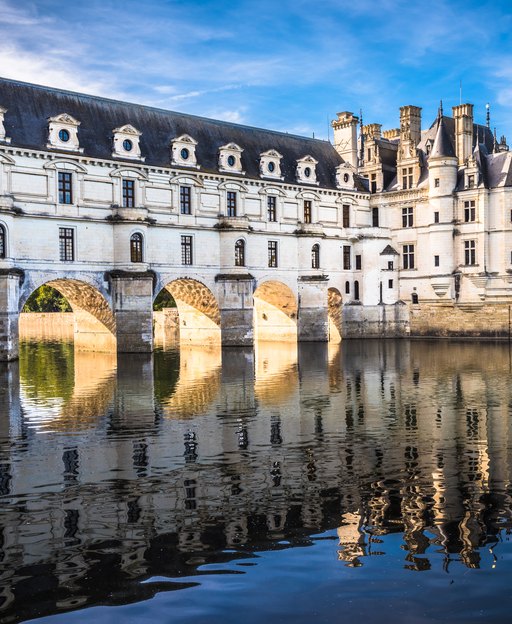
Catherine also gave Chenonceau the gallery you see in the photo. The tourist board says it was designed by the architect Philibert Delorme and built in 1576 on top of Diane’s bridge: a ballroom 60 metres long, lit by 18 windows, with a black-and-white floor that recalls the Florentine palaces of Catherine’s childhood. She held lavish parties there, and the château says she ran the Kingdom of France from her small study, the Green Cabinet.
A Salon, a Scandal and a Hospital
The women kept coming. Louise de Lorraine, widow of King Henry III, moved in to mourn him. In the 18th century Louise Dupin turned Chenonceau into a famous literary salon for scholars and philosophers. The château says she was the first to draft a code of women’s rights, helped by her secretary, Jean-Jacques Rousseau, who wrote about his happy time there. In the 19th century the château was the stage for the success of Madame Pelouze, born Margaret Wilson, until a financial scandal ruined her. Her brother Daniel Wilson’s embezzlement case also brought down his father-in-law, Jules Grévy, the fourth president of the French Republic, who resigned.
In 1913 the Menier family, of the Menier chocolate company, bought Chenonceau and opened it to visitors. When the First World War came, Gaston Menier turned the château into a military hospital and paid all its running costs himself. The Touraine tourist board says the wounded were nursed in the gallery.
The Gallery That Led to Free France
From June 1940 France was cut in two by the demarcation line, and the Indre-et-Loire departmental archives explain that from Vierzon to Bléré the River Cher itself was the border between the occupied zone and the free zone. Chenonceau’s gallery spans the Cher. In the château’s words, “the Grand Gallery at Chenonceau became the sole point of access to the free zone, and the Menier family helped to smuggle out people fleeing the Nazi tyranny.” The archives add that German soldiers did not occupy the château but only patrolled along the river, and that, according to witnesses, they did not notice at first what the gallery was being used for. Catherine’s ballroom, built for masked balls, had become a way out.
There is an American chapter, too: the château says that US President Harry Truman visited Chenonceau on his first trip to France.
Planning Your Visit
Chenonceau is in Touraine, in the heart of the Loire Valley. Inside, look for Catherine’s Green Cabinet, the library where Rousseau stayed, and the gallery itself; outside, the two gardens of the rivals still face each other. The château’s website has the opening times, tickets and how to get there; check it before you go.
If the Loire’s royal stories pull you in, read why French kings kept leaving Paris for the Loire and the mystery of Chambord’s double staircase.
Sources
- Château de Chenonceau: The history of the château
- Touraine Val de Loire Tourisme: Catherine de Medici and the Château de Chenonceau
- Archives départementales d’Indre-et-Loire: La ligne de démarcation en Indre-et-Loire, exhibition panels 5-10 (Chenonceau : un château sur la ligne)
- France.fr (Atout France): The Château of Chenonceau, “the Château des Dames”
Tours & experiences you might love


Powered by Viator. Some links are affiliate links — we may earn a small commission at no extra cost to you.

Leave a Reply