
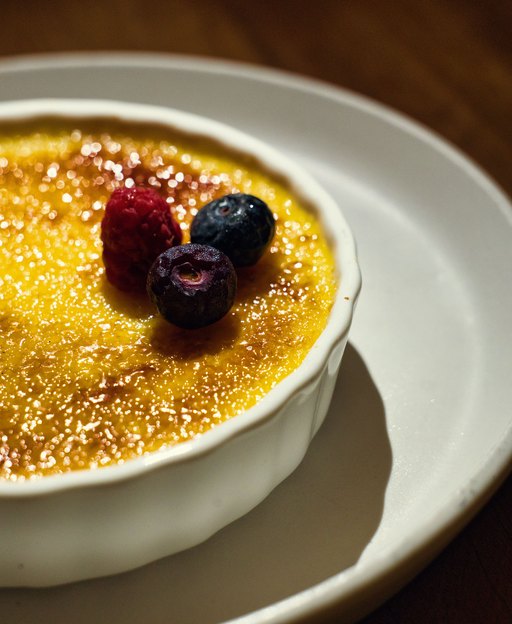
Tap the glassy sugar with the back of a spoon, hear it crack, and dig into cool vanilla custard underneath. Crème brûlée is the dessert Amélie Poulain loved in the film, and a fixture on French bistro menus. But who made it first? France, England and Catalonia all claim it. Here is its story, from a red-hot fire shovel in a 1691 French cookbook to a famous New York restaurant in the 1980s, and how to make it at home.
1691: A Red-Hot Fire Shovel
The first printed recipe for a dessert called crème brûlée appears in 1691, in Le Cuisinier roïal et bourgeois by François Massialot, a cook who, as Saveur’s history of the dish puts it, cooked at Versailles. France’s official tourism site links him to the household of the Duke of Orléans, and calls 1691 the first official mention in France. His custard of egg yolks and milk was not far from today’s. The big difference was the tool. There were no blowtorches at Versailles, so Massialot told the cook to take the fire shovel, heated red-hot, and burn the top of the cream with it until it turned a fine golden colour. The food historian Christianne Muusers has transcribed and translated the 1691 recipe, and it starts much like ours: “four or five egg yolks, depending on the size of your dish”.
Three Countries, One Custard
France has the oldest recipe under the French name, but not the only claim. In England, the food historian Colin Spencer found a “burnt cream” much earlier, as far back as the 15th century, made in spring when the milk was richest and “topped with sugar that’s been burnt with a hot iron” (quoted in the same Saveur history). Trinity College, Cambridge, is often named as the birthplace, but the college itself says the story that crème brûlée was invented there “almost certainly has no basis in fact”. It has served its own Trinity burnt cream since the later 19th century, and still does.
Then there is Catalonia. Its crema catalana, a custard under caramelized sugar, goes back at least to medieval times, and France’s tourism site traces its first recipe to the 14th-century Catalan cookbook Llibre de Sent Soví, with the cream made above all for the feast of Saint John. The same page tells one more story, and we give it to you as a story: that Massialot first tasted crema catalana in Perpignan, the French Catalan city near the Spanish border. Nobody can prove who was first, and that is half the fun of serving it.
How New York Made It Famous Again
Here is the twist. The pastry chef Pierre Hermé, who ran the pastry kitchen at Fauchon in Paris for 11 years, told Saveur’s Gabriella Gershenson that he first tasted crème brûlée not in France but in New York, at the restaurant Le Cirque, in the 1980s. Its owner, Sirio Maccioni, had eaten crema catalana in Spain in the early 1980s and wanted a version on his menu. His pastry chef, Dieter Schorner, baked the custard in a shallow fluted dish with a thinner sugar crust, and gave it its French name. When the great French chef Paul Bocuse visited, Schorner recalled, he called it the best dessert he had eaten that year, and “then of course it became popular also in France”. Americans had met it before: Saveur notes records of Thomas Jefferson serving crème brûlée at the White House. But it was Le Cirque’s version that every restaurant copied.
If you visit the palace where Massialot’s world of royal cooks began, our Versailles day trip from Paris has everything you need. And for the Christmas table, try our bûche de Noël.
How to Make Crème Brûlée at Home
You need only cream, egg yolks, sugar and vanilla, plus a roasting pan for the water bath. Bake the custards the day before, then crack out the torch at the table and let everyone hear the sugar snap.
Crème Brûlée
Ingredients
Equipment
Method
- Heat the oven to 180°C / 160°C fan / 350°F / gas 4. Set the ramekins in the roasting pan and put a kettle of water on to boil.
- Pour the cream into a saucepan. Scrape the seeds from the vanilla bean into it and add the pod too. Heat until bubbles appear around the edge, then take it off the heat. (Using paste or extract? Stir it in at step 4.)
- Whisk the egg yolks and sugar in a bowl for about a minute, until paler and a little thick.
- Pour the hot cream onto the yolks a little at a time, whisking all the time. Strain through the sieve into a jug, stir in the paste or extract if using, and skim off the foam.
- Fill the ramekins, then pour hot water into the pan to come halfway up their sides.
- Bake for 30 to 35 minutes, until the custards are set at the edges but still wobble a little in the middle when you nudge the pan.
- Lift the ramekins out, let them cool for a few minutes, then chill for at least 2 hours, or overnight.
- Just before serving, wipe the rims and spread about 1½ teaspoons of sugar in a thin, even layer over each custard. Caramelize it with the torch, moving the flame all the time, until deep golden. Or slide them under a hot broiler and watch closely. Let the sugar harden for a minute or two and serve within an hour or two.
Notes
Sources
- Saveur: Crème de la Crème, the origins of the world’s most popular custard dessert (Gabriella Gershenson, 2012)
- France.fr (Atout France): Amélie Poulain, Filippo II d’Orléans e la crème brûlée
- Coquinaria (Christianne Muusers): Massialot’s 1691 crème brûlée, transcription and translation
- Trinity College, Cambridge: Trinity burnt cream
- BBC Good Food: Ultimate crème brûlée
- King Arthur Baking: Classic crème brûlée
Frequently Asked Questions
Do I need a blowtorch?
A small kitchen torch gives the most even crust and does not warm the custard underneath. No torch? Put the sugared custards under a hot broiler and watch them every second: sugar goes from golden to burnt very fast.
Why bake it in a water bath?
The hot water keeps the heat gentle, so the eggs set smooth and silky instead of curdling. Take the custards out while the middle still wobbles a little; they firm up as they chill.
Can I make it ahead?
Yes. Bake the custards the day before and keep them in the fridge overnight. Add the sugar and caramelize it just before serving, and serve within an hour or two so the crust stays crisp.
Tours & experiences you might love


Powered by Viator. Some links are affiliate links — we may earn a small commission at no extra cost to you.

Leave a Reply