
The tarte fine aux pommes has no tin, no custard and almost no ingredients: a sheet of puff pastry, a fan of very thin apple slices, a little butter and sugar, and a brush of apricot jam. It is the apple tart you can make on a weeknight and still serve to guests. Here is what the name means, which apple to buy, and the apple with a surprising French-crab-apple story behind it.
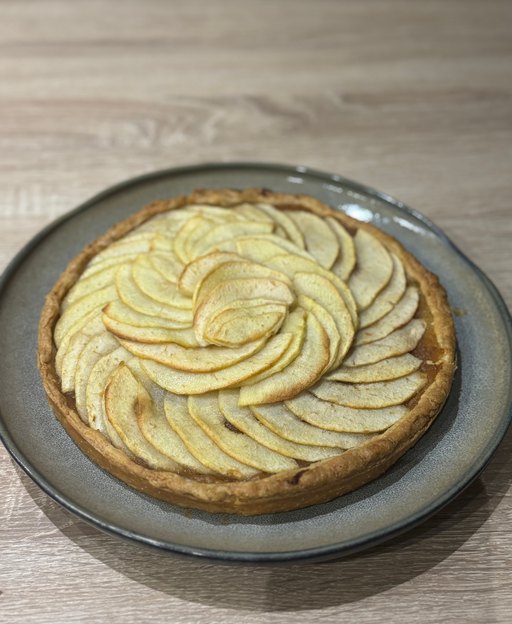
What “Fine” Means
Fine is French for thin. Pastry chef Aoife Noonan, writing in The Irish Times, calls it a simple rustic tart of puff pastry, almond frangipane and thinly sliced apples, and says that when it is thin, “it really is thin”. She notes the apples are traditionally sliced about 2 mm thick. The food blog Pardon Your French calls it a French bakery staple in the fall, with a pastry base that has no raised border and needs no tart pan.
We could not find a documented origin for the tarte fine itself, and we would rather say so than invent one. What the recipes agree on is the method: puff pastry, apples sliced as thin as you can manage, butter and sugar to caramelize the edges, and a glaze afterwards. Pardon Your French notes that the French word for that last step is abricoter, brushing the baked fruit with apricot jam thinned with a little water. The glaze gives a shine and keeps the apples from drying out or darkening.
The Apple: An English Settler, a Seedling and French Crab Apples
Three of the recipes we compared use or recommend the same apple: Granny Smith. Its story begins in Australia. The New South Wales government says that in 1868 Maria Ann Smith, a settler who had emigrated from England, found a chance seedling in her orchard at Eastwood. It had grown from the remains of French crab apples she had been cooking with and tossed out. The apple is named after her, and the state calls it suitable for both cooking and eating raw.
Cooks like it for tarts because it keeps its shape. Pardon Your French says firm, crisp apples such as Granny Smith, Honeycrisp or Braeburn will not turn to mush, nor make the pastry soggy, and suggests sticking to one variety per tart.
Puff Pastry Is Allowed
Nobody expects you to laminate your own dough. Aoife Noonan admits that most people would buy it ready-made and suggests all-butter puff pastry, and Emma Duckworth Bakes recommends a good-quality store-bought sheet as well. Look for all-butter puff pastry in the freezer aisle of your American grocery store.
Planning a trip to Normandy? Start with our Normandy travel guide. Our French recipes collection has more dishes with a story, such as our quiche Lorraine.
How to Make Tarte Fine aux Pommes at Home
Five ingredients and about 20 minutes of work. Slice the apples as thinly as you can, fan them over the pastry, and let the oven do the rest. Serve it the day you bake it, while the pastry is still crisp.
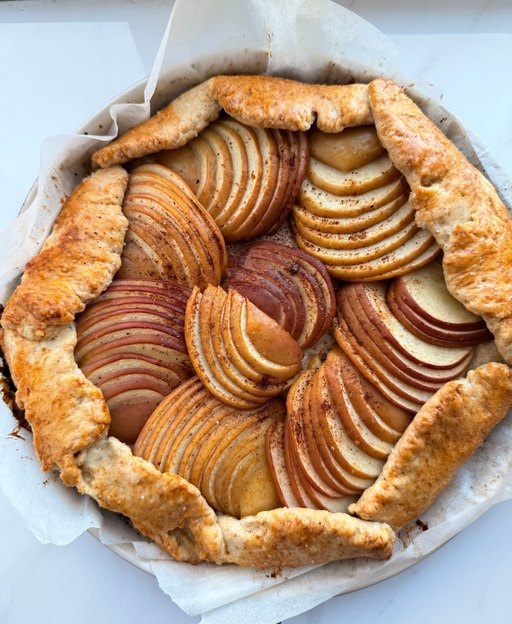
Tarte Fine aux Pommes (French Thin Apple Tart)
Ingredients
Equipment
Method
- Heat the oven to 200°C / 180°C fan / 400°F / gas 6. Line a baking sheet with parchment paper.
- Unroll the puff pastry onto the parchment. Trim it into a circle about 25 cm (10 in) across, or leave it as a rectangle. Prick it all over with a fork and chill it while you slice the apples.
- Peel and core the apples. Slice them very thinly, about 2 to 3 mm (⅛ in), by hand or with a mandoline.
- Take the pastry from the fridge and fan the apple slices over it in overlapping circles, from the outside in. You do not need to leave a border.
- Brush the apples with the melted butter and sprinkle the sugar over the top.
- Bake for 25 to 30 minutes, until the pastry edges are deep golden brown and the apples look slightly caramelized at the edges.
- While the tart bakes, stir the jam and water together in a small bowl until loose (warm it for a few seconds if it is stiff). Brush it over the apples as soon as the tart comes out. Let it cool a few minutes and serve warm or at room temperature.
Notes
Sources
- The Irish Times (Aoife Noonan): An apple tart with a fine French twist
- Pardon Your French: Classic French thin apple tart (tarte fine aux pommes)
- Emma Duckworth Bakes: Easy French apple tart (tarte fine aux pommes)
- Mad About Macarons: French apple tart with puff pastry and Calvados cream
- BBC Good Food: French apple tart (apple varieties and apricot glaze)
- NSW Government: The beloved Granny Smith apple
Frequently Asked Questions
Which apples are best for a tarte fine?
Firm, crisp baking apples that hold their shape. Granny Smith is the one most of our sources name; Pardon Your French also lists Honeycrisp, Jonagold, Braeburn, Mutsu, Golden Delicious and Northern Spy, and Emma Duckworth adds Pink Lady. Use a single variety.
Do I have to make my own puff pastry?
No. Store-bought all-butter puff pastry is what most of the recipes we read use. Keep it cold until it goes in the oven.
Can I make it ahead?
It is best eaten the day it is made, because puff pastry loses its crispness as it sits. Emma Duckworth says it keeps in an airtight container at room temperature for up to 3 days and can be re-crisped in a 180°C (350°F) oven, but fresh is better.
Tours & experiences you might love


Powered by Viator. Some links are affiliate links — we may earn a small commission at no extra cost to you.

Leave a Reply