
The Hospices de Beaune is a medieval hospital in Burgundy that still pays its way with wine. Nicolas Rolin, chancellor of Burgundy, founded it in 1443 to care for the poor. Today its vineyards raise money at a famous charity auction each November.
We think it is one of the most surprising buildings in France. It looks like a fairy-tale palace. Yet it began as a refuge. People came here to be fed, nursed and prayed over.
Why Nicolas Rolin Built a Hospital in 1443
Burgundy had a hard time in the 1430s and 1440s. The Hundred Years’ War had left the land ruined. Armed bands roamed the roads. Harvests failed, prices rose and plague came back. In Beaune, many families had nothing to eat.
Nicolas Rolin saw it from the top. He served as chancellor to Philip the Good, Duke of Burgundy. He was one of the richest and most powerful men in the duchy. In 1443 he and his wife, Guigone de Salins, set up a hospital for the poor of Beaune.
One story credits King Louis XI with a sharp remark. Rolin had made so many poor, he said, that he should house them. Nobody can prove the remark. It shows how people saw the chancellor, though. Rolin gave money to the poor, but he also wanted to be remembered, and to be forgiven.
The name tells you the purpose. Hôtel-Dieu means “hostel of God”. The sick, the old and the hungry came here for a bed, a meal and a priest. Hospital sisters cared for patients for centuries, and the hospital stayed open until the early 1970s, when a modern hospital replaced it. Since 1988 the Hôtel-Dieu has been open to visitors only.
The Roof That Made the Hôtel-Dieu Famous
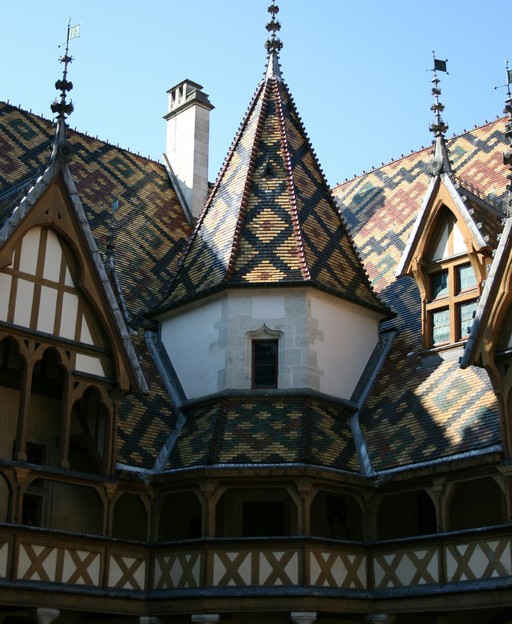
Most visitors stop in the courtyard and stare upwards. The roof is a patchwork of glazed tiles in green, red, yellow and black. They form diamonds and zigzags that glitter after rain.
Glazed roofs like this belong to Burgundy. Tilers fired the colours into the tiles, so they last. The pattern also tells you something about the owner. A roof this bright said the building mattered.
Below the roof, carved timber galleries run round the courtyard. Pointed dormer windows rise above them. Slim spires with little metal flags top the gables. The whole scene looks more like Flanders than eastern France, and the link is real. Burgundy’s dukes also ruled much of the Low Countries, so builders and artists travelled between the two.
The Hôtel-Dieu has been a listed historic monument since 1862, and the look you see today follows the medieval idea.
Inside the Great Hall of the Poor
The heart of the hospital is the Great Hall, also called the Hall of the Poor. It is a long, high room, about 50 metres from end to end. A timber vault covers it like the hull of an upturned ship.
Painted beams cross the ceiling, and multicoloured dragons seem to breathe out the crossbeams. Under them, rows of beds stand along both sides, with red hangings drawn around each one. A chapel closes the far end.
The layout had a purpose. From every bed, a patient could see the altar. The sick joined Mass without leaving their pillows. Care of the soul mattered as much as care of the body.
Other rooms in the building add to the picture. You can see the old kitchen with its huge fireplace. You can see the pharmacy with its rows of jars. These rooms show how a medieval hospital ran day by day.
🇫🇷 Enjoying this? 7,000 France lovers get stories like this every week. Subscribe free →
The Last Judgement by Rogier van der Weyden
Rolin also ordered a great altarpiece for the chapel. He chose Rogier van der Weyden, one of the leading painters of the Flemish school. The Hospices date the work to 1445 to 1450.
It is a polyptych, a set of hinged panels. In the centre, Christ sits in judgement above the saved and the damned. The archangel Michael weighs the souls below. On the outer panels, Rolin and Guigone kneel in prayer.
Before its restoration in 1875 to 1878, the altarpiece could be taken down, and it opened only on the great religious feasts. The rest of the year, patients saw the closed panels. It normally hangs in its own room in the Hôtel-Dieu. The Hospices announced in December 2025 that from September 2026 the work would go to the C2RMF, the French museums’ research and restoration centre, for study and restoration. The official pages we checked on 26 November 2026 do not say whether it is back in the room, so ask the Hôtel-Dieu before you plan around it.
Look at the faces. Van der Weyden painted real fear and real hope. A patient in the Great Hall, facing death, would have understood every figure. If you enjoy medieval judgement scenes, compare it with the stone version at Autun Cathedral.
How Wine Paid for the Sick
A hospital needs money every year. Rolin left an endowment, and others copied him. Gifts soon came in, and many were vines. Grateful families, nobles and merchants gave plots of vineyard to help the poor.
Over the centuries the gifts added up. The estate now covers around 60 hectares. The plots sit in some of the best-known villages of the Côte de Beaune. The vines come from bequests and donations by people of the region.
The system worked for a simple reason. Vines last for decades, and good Burgundy sells. The hospital did not rely on the Duke or on passing charity. It owned land, and the land paid. For more on the region’s wine villages, read our Burgundy travel guide.
The Hospices de Beaune Wine Auction
Every year the Hospices sell the new vintage at a charity auction. It usually takes place on the third Sunday of November. The 2025 sale was the 165th, and it draws buyers from around the world.
Bidders buy by the barrel. A Burgundy barrel holds 228 litres. Each lot carries the name of its cuvée. One special lot, the charity barrel, raises money for other good causes. A guest of honour often presides.
The result matters beyond the Hospices. Wine merchants read the prices as a first sign of how the new Burgundy vintage will sell. Beaune fills with tasting events, dinners and visitors that weekend.
The money goes back to the work Rolin began. It pays for medical care and for the upkeep of the old buildings. For the exact date and the latest news, check the official Hospices de Beaune site.
Visiting Beaune Today
Beaune sits about 45 kilometres south of Dijon, at the heart of the Côte d’Or. The old town is small and easy to walk. Medieval ramparts circle it, and the Hôtel-Dieu stands near the main square.
Plan at least half a day for the Hospices. Go early if you can. The courtyard looks best in morning light, and the crowds build later. Opening times and ticket prices change, so check the official site before you go.
Add the Beaune tourist office to your list too. It has maps, tasting tips and details of cellar visits in the old town. Auction weekend in November is lively, so book rooms and tables early.
Beaune also works well as a base for Burgundy’s great medieval churches. Cluny, Autun and Sens all lie within reach. Read about Cluny Abbey and Fontenay Abbey to see how monks shaped the region.
A Link to Your Own Family Story
Many French-Canadians, Americans and others trace roots to Burgundy. If your family came from the Beaune area, the Hospices may touch your own history. Hospital records can sometimes name patients, donors and staff.
Start with the departmental archives for the Côte-d’Or, and ask what survives for the hospital. Our step-by-step guide to French ancestry explains the first steps.
Sources
- Hôtel-Dieu des Hospices de Beaune, the museum page: founding in 1443, the hospital’s use until the early 1970s, the Last Judgement polyptych (checked 26 Nov 2026).
- Hôtel-Dieu des Hospices de Beaune, restoration of the polyptych: dates of the altarpiece, its earlier restoration and the plan from September 2026 (checked 26 Nov 2026).
- Domaine viticole des Hospices de Beaune: the 60 hectares, the wine auction on the third Sunday of November, the 228-litre charity barrel (checked 26 Nov 2026).
- Beaune tourist office, Discover the Hospices de Beaune: the visit, the wine auction weekend and the Hall of the Poor (checked 26 Nov 2026).
- Beaune tourist office, visitor FAQ for the Hospices: the Hall of the Poor and its upturned-hull ceiling (checked 26 Nov 2026).
Hospices de Beaune: Frequently Asked Questions
Who founded the Hospices de Beaune?
Nicolas Rolin, chancellor of Burgundy, and his wife Guigone de Salins founded it in 1443. They built it to care for the poor of Beaune after years of war, hunger and plague.
Is the Hospices de Beaune still a hospital?
No. The Hôtel-Dieu stayed in use until the early 1970s, when a modern hospital replaced it, and since 1988 it has been open to visitors only. The hospital organisation still exists, and the wine estate still raises money for it.
When is the Hospices de Beaune wine auction?
It usually takes place on the third Sunday of November. Check the official Hospices de Beaune website for the exact date each year.
Why is the roof of the Hôtel-Dieu so colourful?
The roof uses glazed tiles in green, red, yellow and black, laid in diamond patterns. It follows a Burgundian tradition and shows the wealth and status of the founder.
How long should I allow to visit?
Allow at least half a day in Beaune. That gives you time for the Hôtel-Dieu, the Last Judgement altarpiece and a walk through the old town.
You Might Also Enjoy
Sens Cathedral: The Burgundy Church Where Gothic Began and Becket Hid
The French Vendange: Why the Grape Harvest Is France’s Greatest Annual Ritual
Autun Cathedral: The Sculptor Who Signed His Last Judgement
Plan Your France Trip
Ready to build a trip around Burgundy? Our planning hub gathers routes, seasons and practical advice in one place.
Join 7,000+ France Lovers
Every week, get France’s hidden gems, seasonal guides, local stories, and the art of la vie française — straight to your inbox.
Subscribe free — enter your email:
Free forever · One email per week · Unsubscribe anytime

Leave a Reply