
Darkness. The smell of fermenting dough. A baker’s hands moving by habit alone. Most of France won’t wake for another four hours, but here, behind a flour-dusted door on a quiet street, the work that defines the country has already begun.
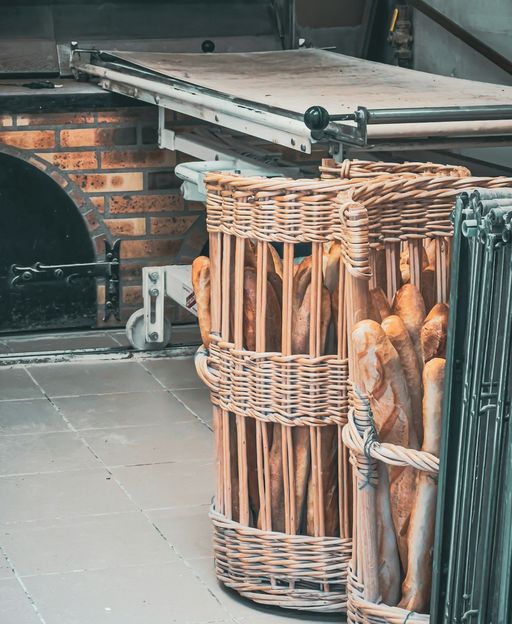
The French boulangerie is one of the most recognised institutions in the world. But what happens inside it, in the hours before most visitors are even awake, is something far fewer people have stopped to consider.
The Night Before: A Starter That Never Sleeps
Every good French baker keeps a levain — a wild sourdough starter made from nothing but flour, water, and the microorganisms in the air. Some boulangers have kept the same starter alive for decades. A few claim theirs is over a century old.
The night before baking, the baker feeds the levain. They add fresh flour and water in precise ratios, then leave it to ferment overnight. By the time they return at 3:30 in the morning, it will be active, bubbling, and ready to leaven the day’s bread.
This is not the same yeast you buy in a packet. Wild fermentation is slower, less predictable, and harder to control. It is also the reason a real French sourdough tastes nothing like an industrial loaf.
3:30 AM: When the Work Begins
Most French boulangers arrive before 4 AM. The first task is mixing the dough — flour, water, salt, and the levain — in a large spiral mixer. But mixing is only the start. The dough then needs time.
French baking uses a process called autolyse: a rest period that lets the flour fully absorb the water before kneading starts. This short pause — sometimes just 20 minutes — changes everything. It develops gluten naturally and gives the bread a lighter, more open crumb.
After mixing, the dough ferments again at room temperature. The baker watches it closely. Too warm and it overproofs. Too cold and it won’t rise. This is not a science you learn from a book. It is a skill passed down through years of repetition.
The Art of the Score
Shaping comes next. The baker hand-rolls each baguette into its long, tapered form and places it in a canvas-lined tray called a couche. The shaped loaves then proof for a final time before going into the oven.
Just before baking, the baker scores each loaf with a razor-sharp blade called a lame. Those diagonal slashes on a baguette are not decorative. They control exactly where the bread expands in the oven’s heat. Without them, the loaf bursts randomly and loses its shape.
Every baker develops their own scoring pattern over time. Some use five slashes. Some use seven. A few score in a herringbone pattern on wider loaves. The marks are as personal as a signature.
The oven runs at around 230°C. Baguettes bake for roughly 20 to 25 minutes. Steam injected during the first minutes creates that thin, crackling crust. Tap a good baguette and it sounds hollow, like a drum.
Enjoying this? 7,000 France lovers get stories like this every week.
Thinking about it for retirement? If you’ve started thinking seriously about retiring there, our complete our full Retire in France guide covers the visa, healthcare, cost-of-living, and the regions worth shortlisting.
What the Law Says About Bread
In 1993, France passed a decree that defined exactly what a baguette de tradition française must contain: wheat flour, water, yeast, and salt. Nothing else. No additives. No improvers. No shortcuts.
A baker who adds ascorbic acid or flour treatment agents cannot legally call the result a tradition. The distinction matters. France fought hard to protect its bread from industrial shortcuts, and the 1993 decree came from decades of lobbying by artisan boulangers watching their trade get quietly hollowed out.
In 2022, UNESCO added the French baguette to its intangible cultural heritage list. France did not celebrate with indifference.
The Queue at Seven
By 7 AM, the first customers appear. In villages and city neighbourhoods alike, the morning queue outside a good boulangerie is a ritual. People don’t send a text or order online. They walk. They wait. They exchange a few words with the baker.
This small act of buying bread is social in a way supermarket shopping can never be. The boulangerie is a fixed point in French daily life — the place where neighbours see each other, where the week’s rhythm becomes visible.
Many French families buy bread twice a day. A baguette from the morning has gone stale by evening, and a fresh one appears at dinner as naturally as a glass of water. Eating in France is never incidental — even buying bread is a deliberate act.
What to Look For in a Good Boulangerie
If you want to find a genuinely great boulangerie in France, look for a few signs. The best ones display a Meilleur Ouvrier de France award — a prestigious national competition for artisan craftspeople. Not many boulangers earn it.
Look for hand-scoring on the baguettes. Machine-cut loaves have perfectly uniform, symmetrical scores. Hand-scored loaves are slightly irregular — and that irregularity is the point.
Smell the bread before you buy. A real sourdough-leavened baguette has a faint tang. An industrial baguette smells of almost nothing at all.
If the baker is covered in flour and looks tired, you are probably in the right place. For help planning the rest of your time in France, our complete France planning guide covers everything from getting around to where to eat.
Frequently Asked Questions
What time do French boulangeries open in the morning?
Most French boulangeries open between 6:30 AM and 7:30 AM. Bakers start work between 3:30 AM and 4 AM so the first bread is ready before the morning rush.
What is the difference between a baguette and a baguette de tradition?
A baguette de tradition française contains only flour, water, yeast, and salt — no additives. It uses traditional fermentation and hand-shaping. A standard baguette may include approved improvers that speed up production.
Can you watch bread being baked at a French boulangerie?
Some artisan boulangers at smaller village bakeries allow early visitors to see the baking area. Arriving around 7 AM means the first batch is fresh from the oven — you’ll smell and hear the process even if you can’t see it directly.
Are there regional bread traditions in France beyond the baguette?
Yes. Alsace bakers produce dense rye loaves influenced by German tradition. Normandy has the enriched pain brié. The Auvergne favours dark pain de seigle. The baguette is a national icon, but France’s bread culture runs much deeper.
By 8 AM, the baker has already worked four and a half hours. The shelves are full. The queue has thinned. Somewhere nearby, someone is cutting their first baguette of the day — still warm, crackling slightly at the touch.
That moment, repeated a million times across France every morning, is not just about bread. It is about what it means to make something well, and to make it again tomorrow.
Join 7,000+ France Lovers
Every week, get France’s hidden gems, seasonal guides, local stories, and the art of la vie française — straight to your inbox.
Subscribe free — enter your email:
📲 Know someone who’d love this? Share on WhatsApp →
Love more? Join 65,000 Ireland lovers → · Join 43,000 Scotland lovers → · Join 29,000+ Italy lovers →
Free forever · One email per week · Unsubscribe anytime
Tours & experiences you might love


Powered by Viator. Some links are affiliate links — we may earn a small commission at no extra cost to you.

Leave a Reply