
Most visitors to Provence follow the same well-worn path. They tick Avignon off the list, photograph the Pont du Gard, then head straight to Nice or Marseille. The result is that dozens of extraordinary villages sit almost empty, waiting for the rare traveller who bothers to turn off the main road. The hidden villages of Provence are not secret — they appear in every guidebook. What keeps them quiet is that people plan to visit but never slow down long enough to actually stop. This guide is for those who want to stop.
Love France? Join 7,000+ readers on our free newsletter → lovetovisitfrance.substack.com
The Luberon Villages: A Secret Worth the Detour
The Luberon is a long ridge of limestone hills running east to west through the Vaucluse department. On its slopes and summits sit some of the finest villages in France. Most visitors to Provence never make it this far inland. That is their loss — and your gain.
Gordes is perhaps the most dramatic. Stone houses pile up the cliff face in tight layers, each one built directly on top of the next, with the old castle tower rising above them all. Below the village, the valley is full of olive groves and scrubland. The best view is from the D15 road heading south — pull over before you reach the village and look back. You will see why Gordes regularly appears on lists of the most beautiful villages in France. It earns the description.
Roussillon is different in character but equally striking. The entire village and the cliffs beneath it glow in seventeen distinct shades of ochre — burnt orange, deep red, pale gold, dusty yellow. The colour comes from the ochre deposits in the rock, which local workers mined commercially until the 1950s. Today, the Sentier des Ocres is a 45-minute walking trail through the old quarries, and it is one of the most unusual walks in France. The rock formations are genuinely extraordinary, and the contrast between the coloured stone and the blue Provencal sky is hard to describe without sounding as though you are exaggerating.
Bonnieux sits higher than the others, terraced up a steep hillside with a cedar forest rising above the upper village. The views from the top stretch across the Luberon valley to the north and south. Bonnieux is quieter than Gordes and Roussillon, which makes it easier to enjoy the narrow streets and the old marketplace at a proper pace.
Lourmarin is the most accessible of the four, sitting at the southern foot of the Luberon on the D943. It has a lively Tuesday market that fills the village with locals from across the valley — the sort of market where you buy cheese and olives and eat them standing up. The Renaissance castle on the edge of the village is open to visitors. Albert Camus, who lived here in the last years of his life, lies in the village cemetery. His grave is simple and often has flowers left on it by visitors who have made the trip specifically to find it.
The four villages form a natural circuit. The Luberon wine route links them in a 36-kilometre loop: Bonnieux to Lourmarin to Roussillon to Gordes and back. The route passes through cherry orchards, lavender fields, dry-stone walls, and small AOC vineyards where the rose wine is local and excellent. Allow a full day to do the circuit properly — most people try to rush it in three hours and see nothing.
🇫🇷 Free: The Perfect Provence & South of France Road Trip
A free 10-day itinerary covering Avignon, the Luberon villages (Gordes, Roussillon, Bonnieux), Marseille, Cassis, Aix-en-Provence, and the Camargue — with practical route notes most travel guides leave out.
Get the Free Itinerary →The Pont Julien: Rome’s Gift to Provence
Between Apt and Bonnieux, on the D108 road, stands one of the most remarkable things in France — a Roman bridge built in 3 BC that is still standing, still intact, and still open to walkers. The Pont Julien crosses the Calavon river on three elegant stone arches. It carried traffic for approximately two thousand years before it was finally closed to vehicles in 2005. That it survived is remarkable. That it looks so complete is extraordinary.
Romans built this bridge on the Via Domitia, the road that connected Rome to Spain through southern Gaul. Julius Caesar used this road. Roman legions marched across this bridge. The same stones are still there, worn smooth by centuries of feet, wheels, and hooves. You can walk across them today for free.
The engineering is precise. The three arches have openings in the piers to allow floodwaters to pass through — a Roman flood-relief system that proved remarkably effective over two millennia. The stones fit together without mortar. The whole structure is held by the weight and precision of the cutting.
There is a small pull-in area on the side of the road near the bridge where you can park. Most drivers heading between Apt and Bonnieux pass the Pont Julien at speed without stopping. Allow twenty minutes to walk across and around it. Early morning is best, when the light is low and the bridge stands out clearly against the valley behind it. There is almost never a queue.
Lavender: Getting the Timing Right
The lavender of Provence is real. The fields genuinely look the way they do in photographs. But the timing matters more than most people realise, and the location matters too.
The main lavender plateau runs above the towns of Sault and Apt, in the Vaucluse. The fields here bloom between roughly 15 July and 15 August. Peak colour usually falls in the last week of July. If you arrive in early July, the lavender will be green. If you arrive in late August, it will have been harvested and the fields will be grey stubble.
The Plateau de Valensole, further south towards the Alpes-de-Haute-Provence, blooms slightly earlier — typically late June to mid-July. This makes it a better choice if you are visiting in the first half of summer.
Reading the colour is straightforward. Deep, intense purple means peak bloom. Fading to a silvery lilac means past peak. If the tips of the flowers are browning, harvest is coming within days. Check local tourism sites for the current year’s bloom report before planning your visit — the dates shift by one to two weeks depending on the spring weather.
The village of Sault, sitting at 765 metres on the edge of the plateau, makes an excellent base. It is a working town rather than a tourist village, with a Thursday market and a few good restaurants. Apt, in the valley below, is larger and more practical. From either base, you can drive the lavender route through Banon and the village of Simiane-la-Rotonde, a small medieval settlement on a hilltop with a spectacular circular keep and views across the plateau.
One practical note: arrive before 10am. The lavender fields attract tour coaches from Avignon and Marseille that typically arrive mid-morning. If you are there at dawn or just after, you may have the fields almost to yourself.
How to Visit Without the Crowds
The Luberon and the lavender country are popular. That is not a reason to avoid them — it is a reason to plan when and how you visit.
The best markets in Provence are the Tuesday markets in Lourmarin and Apt. Both draw local producers selling cheese, honey, soap, herbs, olives, and seasonal produce. The Apt market is particularly large and runs from early morning. These are working markets, not tourist showcases, which is precisely what makes them worth the trip.
Gordes at 6am is a different place from Gordes at 11am. Before the coach parties arrive, you can walk the upper streets almost alone. The light at that hour is also far better for photographs. The village has a cafe that opens early, and the morning is cool enough to be genuinely pleasant.
Parking in Roussillon requires a plan. There is a pay car park on the edge of the village — follow the signs rather than trying to drive into the centre. From the car park, it is a ten-minute walk into the village. In peak season, the car park fills quickly after 10am. Arrive early or late in the afternoon.
The back roads connecting these villages are part of the experience. The D2, D36, and D60 wind through cherry orchards in spring, sunflower fields in summer, and dry-stone walls year-round. These roads are narrow and occasionally unsigned, but they are straightforward with a paper map or GPS. Driving the main N roads and D7 through the valley is faster but far less rewarding.
The best seasons are spring (April to May) and early autumn (September to October). Temperatures are cooler, the markets are still running, and the villages are noticeably quieter. Summer brings the lavender and the heat — both are worth experiencing, but they also bring the majority of the year’s visitors.
One thing most visitors do not account for: Provencal villages close properly for lunch. Between 12:30pm and 2:30pm, most shops, many restaurants, and some visitor attractions shut entirely. Plan your driving for these hours and your exploring for the morning and late afternoon.
Where to Stay
The Luberon villages themselves have very limited accommodation. Gordes and Bonnieux have a handful of hotels and chambres d’hotes, but they fill quickly in summer and are not cheap. The practical approach is to stay in a larger town and make day trips from there.
Apt sits in the centre of the Luberon and is an ideal base. It has a good range of accommodation at reasonable prices, an excellent Saturday market, and direct road access to all four villages. It is also close enough to the lavender plateau to combine both in the same trip.
L’Isle-sur-la-Sorgue, roughly 30 kilometres west of Gordes, is the antiques capital of Provence. The Sunday antiques market draws dealers and buyers from across France. The town sits on a network of canals and is genuinely attractive. From here, Gordes, Roussillon, and Bonnieux are all under an hour by car.
Avignon works as a city base. It has excellent rail connections from Paris (TGV, 2 hours 40 minutes), a wide range of hotels, and its own historic quarter around the Palais des Papes. The Luberon villages are 45 minutes to an hour by car. Avignon is the right choice if you want city amenities alongside your village exploration.
Getting There from Major French Cities
- From Paris: TGV to Avignon (2 hours 40 minutes), then hire a car. This is the most practical route.
- From Marseille: Approximately 1.5 hours by car via the A51 to Aix-en-Provence, then north through the Luberon.
- From Nice: Approximately 2.5 hours by car along the A8 motorway to Aix, then north.
Don’t Miss These Details
Beyond the main villages, a few specific sites reward the curious visitor.
The Village des Bories sits about two kilometres south of Gordes on the D15. A borie is a dry-stone shepherd’s hut, built without mortar using flat limestone slabs stacked into a domed structure. They look ancient — and some are, though most were rebuilt as recently as the 18th century. The Village des Bories holds about twenty of these structures, kept exactly as they stood when last used. Walking among them on a quiet morning is one of the stranger and more memorable things you can do in Provence.
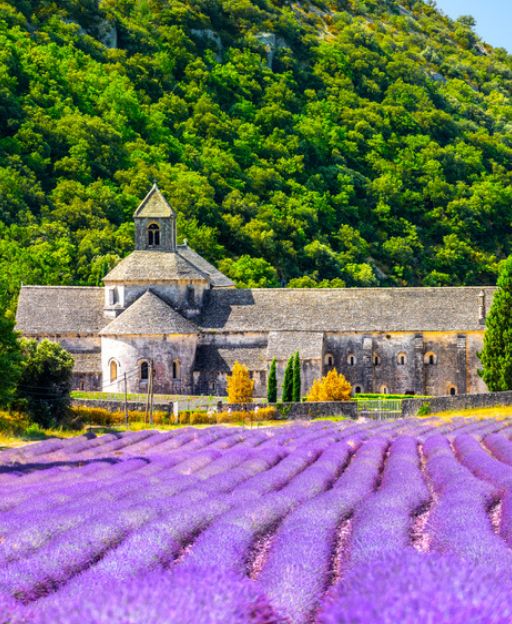
The Abbaye de Senanque stands in a small valley north of Gordes, reached by a narrow road through the hills. Cistercian monks founded the abbey in 1148, and it still functions as an active monastery today. In July, the lavender field in front of the abbey is in full bloom — this is the image that appears on more postcards than any other in Provence. Check opening times before visiting; the monks allow visitors at certain hours only, and the schedule changes seasonally.
The cherry orchards of the Luberon come into season in May and early June. Cherry trees crowd around Bonnieux and the surrounding villages, and during the harvest period many farms sell cherries directly from roadside stalls. A paper bag of fresh Luberon cherries, bought from a farm gate for a few euros and eaten in the car on a back road through the hills, is a genuinely Provencal experience. No queue, no booking, no tour guide required.
You Might Also Enjoy
- Loire Valley Road Trip: The Complete Guide to France’s Chateau Country
- Avignon Travel Guide: Everything You Need to Know Before You Visit
- French Pyrenees Travel Guide: Mountains, Villages and What to See
Plan Your France Trip
Ready to plan your visit to Provence and beyond? Our France Trip Planning Hub covers everything from when to visit to getting around the regions.
What is the best time to visit the hidden villages of Provence?
Late June to mid-August brings the lavender in bloom on the plateau above Sault, though this is also the busiest period. Spring (April to May) and early autumn (September to October) offer cooler temperatures, fewer crowds, and the markets are still running.
How far is Gordes from Roussillon in Provence?
Gordes and Roussillon are roughly 10 kilometres apart by road, about a 15-minute drive through the Luberon countryside. Together with Bonnieux and Lourmarin, they form a natural circuit of around 36 kilometres — a half-day or full-day drive depending on how long you spend in each village.
Is the Pont Julien Roman bridge free to visit?
Yes, the Pont Julien costs nothing to visit and walkers can cross it year-round. It sits just off the D108 road between Apt and Bonnieux. There is a small pull-in area to park nearby, and the bridge takes around 20 minutes to explore properly.
Can you visit Provence without a car?
A car is strongly recommended for visiting the Luberon villages — public transport between them is extremely limited and infrequent. From Avignon or Apt, there are occasional bus connections to larger villages, but the flexibility to stop at viewpoints, roadside lavender fields, and Roman bridges really requires a hire car.
Join 7,000+ France Lovers
Every week, get France’s hidden gems, local recipes, and travel inspiration — the kind you won’t find in any guidebook.
Subscribe free — enter your email:
Love more? Join 64,000 Ireland lovers → · Join 43,000 Scotland lovers → · Join 30,000 Italy lovers →
Free forever · One email per week · Unsubscribe anytime
Thinking about it for retirement?
If you’ve started thinking seriously about retiring there, our complete our full Retire in France guide covers the visa, healthcare, cost-of-living, and the regions worth shortlisting.
Tours & experiences you might love


Powered by Viator. Some links are affiliate links — we may earn a small commission at no extra cost to you.

Leave a Reply