
In 1849, a French government committee voted to demolish Carcassonne. The medieval walled city had fallen into such disrepair that local authorities considered the walls a liability — dangerous, expensive, and beyond saving.
An architect named Eugène Viollet-le-Duc disagreed. His fight to save the city lasted three decades and sparked a debate about what restoration actually means — a debate that continues to this day.
Two Cities, One Hill
Carcassonne is not one place — it is two. The medieval Cité sits on the hill, its towers visible for miles around. Below it, the Ville Basse — the lower town — spreads across flat ground beside the River Aude.
Most visitors see only the Cité. They walk through the main gate, take photographs of the towers, eat a cassoulet from the tourist strip, and leave. The lower town rarely features in their plans.
La Cité served as the fortress — a military stronghold occupied continuously since Roman times, then by Visigoths, Franks, Cathars, and the French Crown. Commerce and daily life happened in the Ville Basse: markets, guilds, and merchants conducting business on flatter ground.
When French forces defeated the last Cathar resistance in the 13th century, they pushed the remaining townspeople down the hill as punishment. The lower town grew because its residents had nowhere else to go.
The Walls That Nearly Came Down
By the 1840s, the Cité had suffered two centuries of neglect. After Louis XIV decided France’s real border lay in the Pyrenees rather than at Carcassonne, the fortress lost its military purpose. Soldiers stripped the walls for building materials. Locals built houses against them and stored supplies in the towers.
The city lost its medieval appearance piece by piece.
A writer named Prosper Mérimée — better remembered as the author of the novella that became the opera Carmen — visited in 1835 as France’s first Inspector General of Historic Monuments. He sent urgent reports to Paris: the walls needed saving immediately.
His reports reached a young architect who had spent his career studying medieval buildings in obsessive detail. That architect was Eugène Viollet-le-Duc.
The Restoration That Divided France
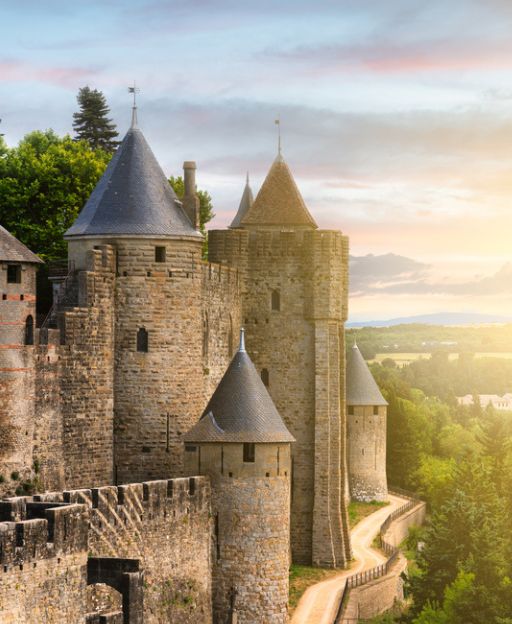
Viollet-le-Duc began work at Carcassonne in 1853. Over the next 26 years, he rebuilt sections of the outer walls, reconstructed towers, and — most controversially — added pointed slate roofs to the towers.
Medieval towers in southern France traditionally had flat roofs, not pointed ones. Viollet-le-Duc argued the pointed style would have existed in an earlier period but was removed over the centuries. His critics argued he was inventing a past that never existed.
Architectural historians still argue about which elements are authentic and which are Viollet-le-Duc’s imagination. Some call it one of the greatest restoration projects in European history. Others call it the most influential piece of historical fiction ever built in stone.
What nobody disputes is this: without him, the walls would not be standing.
Enjoying this? 7,000 France lovers get stories like this every week.
Thinking about it for retirement? If you’ve started thinking seriously about retiring there, our complete our full Retire in France guide covers the visa, healthcare, cost-of-living, and the regions worth shortlisting.
What You See Today
The Cité de Carcassonne now holds UNESCO World Heritage status, granted in 1997. Around two million visitors arrive every year.
The double walls — inner and outer rings — stretch for three kilometres. Between them runs the lices, a wide corridor where defenders could mass. Walking the full circuit takes around 45 minutes.
The Château Comtal at the heart of the Cité was the seat of the Trencavel viscounts — the ruling family who lost the city to the French Crown in 1209 following the Albigensian Crusade against the Cathars. Entry to the Cité itself is free. The Château Comtal charges admission and is worth every cent — the interior shows Roman, medieval, and Viollet-le-Duc construction side by side.
The Basilique Saint-Nazaire inside the Cité deserves a dedicated visit. It combines Romanesque solidity with Gothic light-work in a way that makes the shift in building fashions between the 11th and 14th centuries visible in a single interior.
The Lower Town Most Visitors Miss
Walk down the hill to the Ville Basse and the tourist crowds thin immediately. The lower town has its own medieval walls, its own market square, and a daily rhythm that belongs to people who actually live here.
The Place Carnot market runs on Tuesday, Thursday, and Saturday mornings. Stalls sell local cheese, honey from the Montagne Noire hills above the city, and Minervois wine from vineyards just to the east.
Languedoc is the birthplace of cassoulet — the slow-cooked bean stew that has sparked centuries of rivalry between Carcassonne, Castelnaudary, and Toulouse. Read our feature on why three French towns have been fighting over the same bean stew for centuries.
For the wider story of the Cathar faith that shaped this landscape, see our feature on the forbidden faith that left ruined castles across the south of France.
Start building your full French itinerary at the France travel planning hub.
Frequently Asked Questions About Carcassonne
What is the best time to visit Carcassonne, France?
April to June and September to October offer warm weather without the peak-summer crowds. July and August bring two million visitors to the Cité — queues at the main gates grow long and the streets inside are packed from mid-morning.
What is the difference between La Cité and Ville Basse in Carcassonne?
La Cité is the medieval hilltop walled fortress that most visitors come to see. Ville Basse is the lower town beside the River Aude, where local daily life happens. Both have historic interest, but most visitors spend all their time in the Cité and miss the lower town entirely.
How long do you need to explore Carcassonne properly?
One full day covers the Cité comfortably, including the Château Comtal and a full circuit of the walls. Add a morning or afternoon to explore the lower town and the Basilique Saint-Nazaire. Two days allows a slower pace and time for day trips to Cathar ruins in the surrounding countryside.
There is a version of Carcassonne that exists entirely for photographs — the towers at sunset, the pointed roofs against a pale sky, the clean medieval silhouette. That version is fine. But the more interesting version understands that what you are looking at almost did not survive, and that one architect’s stubbornness is the reason you can walk those walls at all.
Join 7,000+ France Lovers
Three times a week, get France’s hidden gems, seasonal guides, local stories, and the art of la vie française — straight to your inbox.
Subscribe free — enter your email:
📲 Know someone who’d love this? Share on WhatsApp →
Love more? Join 65,000 Ireland lovers → · Join 43,000 Scotland lovers → · Join 29,000+ Italy lovers →
Free forever · Unsubscribe anytime
🇫🇷 You Might Also Love
Tours & experiences you might love


Powered by Viator. Some links are affiliate links — we may earn a small commission at no extra cost to you.

Leave a Reply