
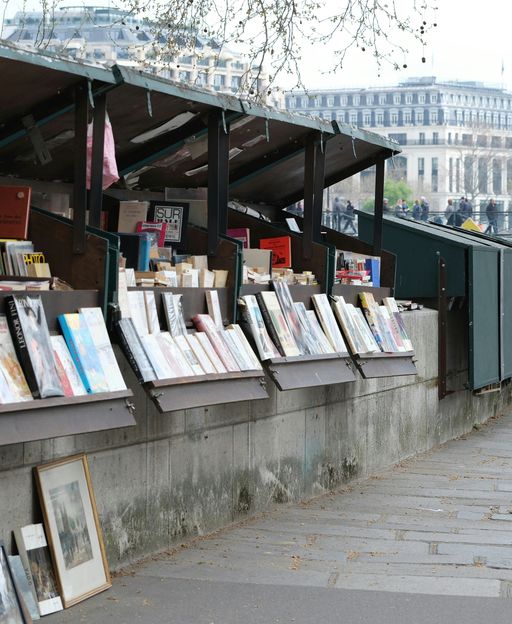
Walk along the Seine on any dry morning in Paris and you will notice them. Green metal boxes, bolted to the stone parapets of the riverbank, propped open to reveal rows of old books, vintage prints, and yellowed postcards. The bouquinistes have stood on these quays longer than most Paris landmarks — and nearly every government since 1530 has tried to move them on.
Five Centuries on the Riverbank
The first bouquinistes appeared in Paris around 1530. They were itinerant sellers, unlicensed and peripatetic, peddling books, pamphlets, and etchings across the city’s bridges. City authorities accused them regularly of distributing seditious literature — which, for the most part, they were.
In 1649, the municipality banned them outright. The sellers returned within the decade. Through the Revolution, the Empire, and two republics, they came back each time. By the 19th century they had become so fundamental to Parisian life that the city granted them permanent licences and a fixed home along the river.
Today, around 240 bouquinistes operate along three kilometres of quays. Their green boxes hold an estimated 300,000 books and prints at any one time. The city of Paris now classifies them as a core part of its urban heritage.
The Rules Behind Every Green Box
Each bouquiniste holds a city licence covering four green boxes, each measuring no more than 2.10 metres wide. City rules require sellers to open at least four days per week, weather permitting.
Up to a quarter of each box can hold tourist items — postcards, prints, and calendars. The rest must carry books, periodicals, or printed documents. Inspectors enforce this distinction. These are not souvenir stalls with books as decoration.
Licences stay with individual sellers and pass through an informal network of recommendation and waiting. New applicants can wait several years. The city keeps fees deliberately low so the trade stays accessible to people who love books, not just those with money.
What You Will Actually Find
Each box reflects the personality of its owner. One might hold 19th-century French novels, their spines soft from decades of handling. Another overflows with vintage Paris-Match magazines from the 1960s. A third specialises in Belle Époque sheet music, hand-coloured engravings, or military maps from a war nobody living remembers.
Some sellers focus on first editions. Others collect regional newspapers from specific decades. Prices run from a single euro for a damp paperback to several hundred for something genuinely rare.
Browsing takes time. No search bar, no catalogue, no algorithm tells you what each box contains. You find what you were not looking for — or you move on. Planning a wider Paris trip? Our first-time Paris itinerary covers five days of the city’s best, including quieter corners most visitors miss.
Enjoying this? 7,000 France lovers get stories like this every week.
Thinking about it seriously? If you’ve started actually planning a move, our complete our complete Moving to France guide walks through every step, every cost, and the paperwork that catches most people out.
UNESCO Recognition and What It Changed
In December 2024, UNESCO added the bouquinistes to its Intangible Cultural Heritage list. The designation recognised the practice itself — outdoor bookselling along a river, keeping physical knowledge visible and available in a city that increasingly moves indoors and online.
The city responded by strengthening licence terms and shortening the waiting list for new applicants. UNESCO status also brought a new wave of visitors who come specifically to browse, not just to photograph. For Paris, this recognition confirmed what residents already knew: the bouquinistes are not a curiosity. They are infrastructure.
The bouquinistes share a similar spirit with another overlooked Paris institution — the city’s 19th-century covered passages, vaulted glass arcades where small specialist shops have survived for nearly two centuries.
How to Visit the Bouquinistes
The Left Bank quays hold the highest concentration of serious sellers. Walk from Quai de Montebello past Notre-Dame toward Quai Voltaire and you cover the densest stretch. The Right Bank’s Quai de la Mégisserie mixes books with tourist prints and attracts a slightly more casual crowd.
Go on a weekday morning. Sellers open from 9am in spring and summer, and the crowds stay thin until mid-morning. Most bouquinistes close when it rains — the boxes bolt shut against the parapet and the quay goes quiet.
Carry cash. Most sellers do not accept card payments. You can negotiate on higher-priced items, but small purchases carry a fixed price. A few words of French — combien, merci, c’est magnifique — go a long way with sellers who have spent decades on the same stretch of river.
Ready to plan the full trip? Our France planning guide covers everything from when to go to where to stay across the regions.
Where exactly are the bouquinistes in Paris?
The bouquinistes line both banks of the Seine through central Paris. The densest stretch runs from near Notre-Dame along the Left Bank to Quai Voltaire, and along the Right Bank on Quai de la Mégisserie. The total distance covered is approximately three kilometres.
Are the bouquinistes open every day?
Most bouquinistes open four to five days per week, though not necessarily fixed days. They close in heavy rain and during cold winter spells. Weekday mornings from March to October give you the best chance of finding most stalls open and sellers willing to talk.
What do the bouquinistes sell besides books?
City rules allow each box to devote up to 25 per cent of its space to tourist items such as prints, postcards, and maps. The remainder must carry books or printed documents. In practice, you will find old novels, vintage magazines, music scores, hand-coloured engravings, and occasional first editions.
How much do items cost at the bouquiniste stalls?
Prices vary considerably. A paperback in rough condition might cost one euro. A vintage print of Paris might run to twenty or thirty. Rare books and first editions carry higher prices, and sellers negotiate on those. Carry cash — most bouquinistes do not accept card payments.
The bouquinistes have outlasted every era that declared them finished. They survived banning orders, two world wars, the rise of the internet, and the slow disappearance of physical bookshops from city centres everywhere else. Walk along the Seine on a clear morning and their green boxes will still be there — propped open, pages showing, the river moving steadily below.
Join 7,000+ France Lovers
Three times a week, get France’s hidden gems, seasonal guides, local stories, and the art of la vie française — straight to your inbox.
Subscribe free — enter your email:
📲 Know someone who’d love this? Share on WhatsApp →
Love more? Join 65,000 Ireland lovers → · Join 43,000 Scotland lovers → · Join 29,000+ Italy lovers →
Free forever · Unsubscribe anytime
🇫🇷 You Might Also Love
Tours & experiences you might love


Powered by Viator. Some links are affiliate links — we may earn a small commission at no extra cost to you.

Leave a Reply