
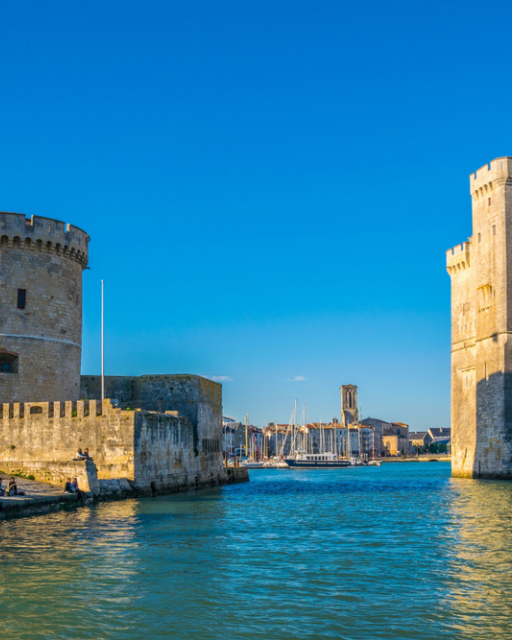
La Rochelle sits on France’s Atlantic coast, roughly halfway between Nantes and Bordeaux. The city has a well-preserved old harbour, lined with restaurants and sailing boats. But what draws history lovers here are the three medieval towers guarding the harbour entrance — Tour de la Chaîne, Tour Saint-Nicolas, and Tour de la Lanterne. They stood through one of the most dramatic events in French history: the Great Siege of 1628, when Cardinal Richelieu blockaded this port for over a year, bringing a powerful Protestant city to its knees.
The towers are among the best-preserved medieval harbour fortifications in France, and the story behind them is one of religious conflict, political strategy, and extraordinary human suffering. If you are visiting La Rochelle, these towers are the reason to come.
The Three Towers of La Rochelle
Each tower has its own history and character, and together they tell the story of how this city controlled — and lost control of — one of France’s most important Atlantic ports.
Tour Saint-Nicolas was built between 1373 and 1382 on the south side of the harbour entrance. It is the largest of the three, with a distinctive square base and a complex interior of vaulted chambers and spiral staircases that seems deliberately designed to confuse any attacker who made it inside. When it was first built, it served as both a defensive tower and a lighthouse. It also held prisoners — sailors, smugglers, and later Huguenots during the religious wars. Climb to the top and you get unobstructed views across the harbour to the Île de Ré.
Tour de la Chaîne stands on the north side of the harbour mouth, directly opposite Tour Saint-Nicolas. Its name comes from the heavy iron chain stretched across the water between the two towers at night. The chain blocked the harbour entrance to any vessel that had not paid its dues or received permission to pass. The tower was built in 1382 and later served as a gunpowder store — a fact that contributed to a serious explosion in 1458 that damaged the upper section. What you see today is partly a 15th-century rebuild.
Tour de la Lanterne stands a short walk inland from the harbour. It is the tallest of the three and dates from the 15th century. Its octagonal upper section was used as a lighthouse to guide ships into the port. The tower’s inner walls are extraordinary: covered in engravings made by prisoners over several centuries — ships in extraordinary detail, coats of arms, religious symbols, names, dates, and prayers in English, Spanish, and French. Most were English and Dutch sailors imprisoned here during the 16th and 17th centuries. Some carvings are remarkably detailed works of art, made by men who had nothing but time and a sharp object.
France has 5,000 years of stories, and we cover a new one every week. Join the Love to Visit France newsletter — practical travel information, history, and the places most visitors miss.
La Rochelle Before the Siege
To understand the siege of 1628, you need to know what La Rochelle was. By the early 17th century, it was one of the wealthiest cities in France — a thriving Atlantic trading port with a strong merchant class and a large Huguenot population. The Huguenots were French Protestants, and La Rochelle had become one of their most significant strongholds, a city where they wielded genuine political and military power.
The Edict of Nantes, signed in 1598 by Henri IV, had given Huguenots significant rights within Catholic France. But it also gave cities like La Rochelle the status of places de sûreté — Protestant strongholds with their own garrisons and fortifications. La Rochelle took this seriously. The city was fortified, independent-minded, and had already resisted royal authority more than once. For Cardinal Richelieu, chief minister to King Louis XIII, this could not continue.
The Siege of 1628: A Year That Changed France
Richelieu launched his campaign against La Rochelle in August 1627. His approach was methodical and total. Rather than attempt a costly frontal assault on a well-fortified city, he ordered the construction of a massive dyke across the harbour mouth — a stone and timber barrier more than 1,400 metres long — designed to cut off all supply by sea. The project was completed in remarkable speed by the standards of the time and proved effective almost immediately.
England, then still nominally Protestant in its foreign policy sympathies, sent relief expeditions twice. The first, under the Duke of Buckingham in 1627, failed to dislodge French forces from the nearby Île de Ré and retreated with heavy losses. A second expedition in 1628 could not penetrate Richelieu’s sea barrier. The city was on its own.
Inside the walls, conditions deteriorated from uncomfortable to catastrophic. When the siege began, La Rochelle had roughly 28,000 inhabitants. By the time the city surrendered in October 1628, approximately 22,000 of them had died — the vast majority from starvation and disease rather than fighting. The mayor, Jean Guiton, had publicly vowed at the start of the siege to drive a dagger into anyone who spoke of surrender. Even he eventually had to concede. The city opened its gates on 28 October 1628.
Richelieu entered La Rochelle personally and supervised the dismantling of the city’s walls and fortifications. He was careful not to massacre the survivors or abolish Protestant worship — the Edict of Nantes still stood, at least on paper. But La Rochelle’s days as an independent Huguenot stronghold were over. The political consequences rippled through France for the next several decades, culminating eventually in Louis XIV’s revocation of the Edict of Nantes in 1685, which sent hundreds of thousands of Huguenots fleeing to England, the Netherlands, and Prussia.
Planning a trip to France? The Love to Visit France newsletter covers the best places to visit, the history behind them, and the practical details you actually need.
Visiting the Towers Today
All three towers are open to the public and managed by the Centre des monuments nationaux. A combined ticket covers all three and offers the best value. Individual entry has been priced at around €8 per tower, with the combined ticket at approximately €18. Prices are subject to change, so check the Centre des monuments nationaux website before you visit.
Opening hours vary significantly by season. In summer (July and August), the towers are typically open from 10:00 to 19:00 daily. In spring and autumn, closing time is generally 17:30. Winter hours are more limited. The towers can be busy in July and August — arriving before 11:00 avoids the worst of the queues.
A word of warning: the staircases inside all three towers are steep, narrow, and uneven. There are no lifts. They are not accessible to visitors with limited mobility. Wear flat, non-slip shoes. Children need supervision — the drops inside some of the vaulted chambers are significant.
Plan for at least two hours across all three towers if you are reading the information panels. Tour de la Lanterne alone deserves an unhurried visit — the prisoner engravings take time to take in properly, and there is more of them than most visitors expect.
The Old Town and What Else to See
La Rochelle’s old town is compact and walkable. The arcaded streets running through the centre were designed with Atlantic weather in mind — they keep you dry when it rains, which it does fairly often on this coast even in summer. The Marché Central runs every morning except Monday, selling regional produce including the oysters La Rochelle’s coast is known for.
The Musée du Nouveau Monde, housed in an 18th-century mansion a few streets from the harbour, covers La Rochelle’s role in the Atlantic slave trade. The city was a major departure point for slaving voyages to the Americas throughout the 18th century — a history that the city has acknowledged more honestly in recent years than many French port cities. The museum is well worth visiting alongside the towers to get a fuller picture of what this harbour meant economically and morally.
The Aquarium de La Rochelle draws around 850,000 visitors a year and is one of the most visited in France. It sits a five-minute walk from the towers and has strong coverage of Atlantic and tropical species. Worth considering if you are visiting with children.
Getting to La Rochelle
La Rochelle is straightforward to reach by train. From Paris Montparnasse, TGV services run in approximately two and a half hours. There are also direct trains from Bordeaux (around 1 hour 45 minutes) and Nantes (around 1 hour 30 minutes). The old town and harbour are a 15-minute walk from the station, or you can take the free shuttle bus that runs between the station and the town centre in summer.
If you are driving, La Rochelle sits on the A10/A83 motorway route and is well signed. Parking in the old town is limited and expensive in summer — use the park-and-ride facilities on the edge of the city and take the free bus in.
La Rochelle operates a public bicycle hire scheme called Yélo, with docking stations across the city. Day passes are inexpensive and the cycling infrastructure is genuinely good. The Île de Ré, a long flat island connected to the mainland by toll bridge, makes for an excellent full-day cycling trip. The island has a network of dedicated cycle paths and several villages worth stopping in.
When to Visit
Summer is popular. La Rochelle is a major French holiday destination, particularly for families, and the harbour area in July and August can be very crowded. Prices for accommodation rise sharply from mid-June. If you prefer quieter streets and easier access to the towers and restaurants, May, June, or September are noticeably better choices.
The Atlantic coast climate is milder than inland France. Summers are warm but rarely hot enough to be uncomfortable. Winters are mild but frequently wet and windy. Spring can bring brilliant light and relatively empty streets — good conditions for photography around the harbour.
La Rochelle is also worth considering as a base for exploring the wider Charente-Maritime department. Rochefort, Saintes (with its Roman amphitheatre and medieval architecture), and the Île d’Oléron are all within an hour’s drive.
The towers stood for nearly 700 years before the tourists arrived. They are not polished or theatrical. The stone is worn, the staircases are awkward, and the prisoner carvings are harder to read than any museum would allow. That is exactly why they are worth visiting.
If you enjoyed this, the Love to Visit France newsletter covers French history, travel, and the places worth going to — with practical information rather than hype. Free to subscribe.
Photo: Shutterstock
Thinking about it for retirement?
If you’ve started thinking seriously about retiring there, our complete our full Retire in France guide covers the visa, healthcare, cost-of-living, and the regions worth shortlisting.
Tours & experiences you might love


Powered by Viator. Some links are affiliate links — we may earn a small commission at no extra cost to you.

Leave a Reply