
Most people fly into Paris, then perhaps head south to Nice or Marseille, and call it a France holiday. Lyon sits squarely in the middle of that route, yet a significant number of travellers still bypass it. That is a shame, because Lyon becomes a firm favourite the moment you stop treating it as a connection point.
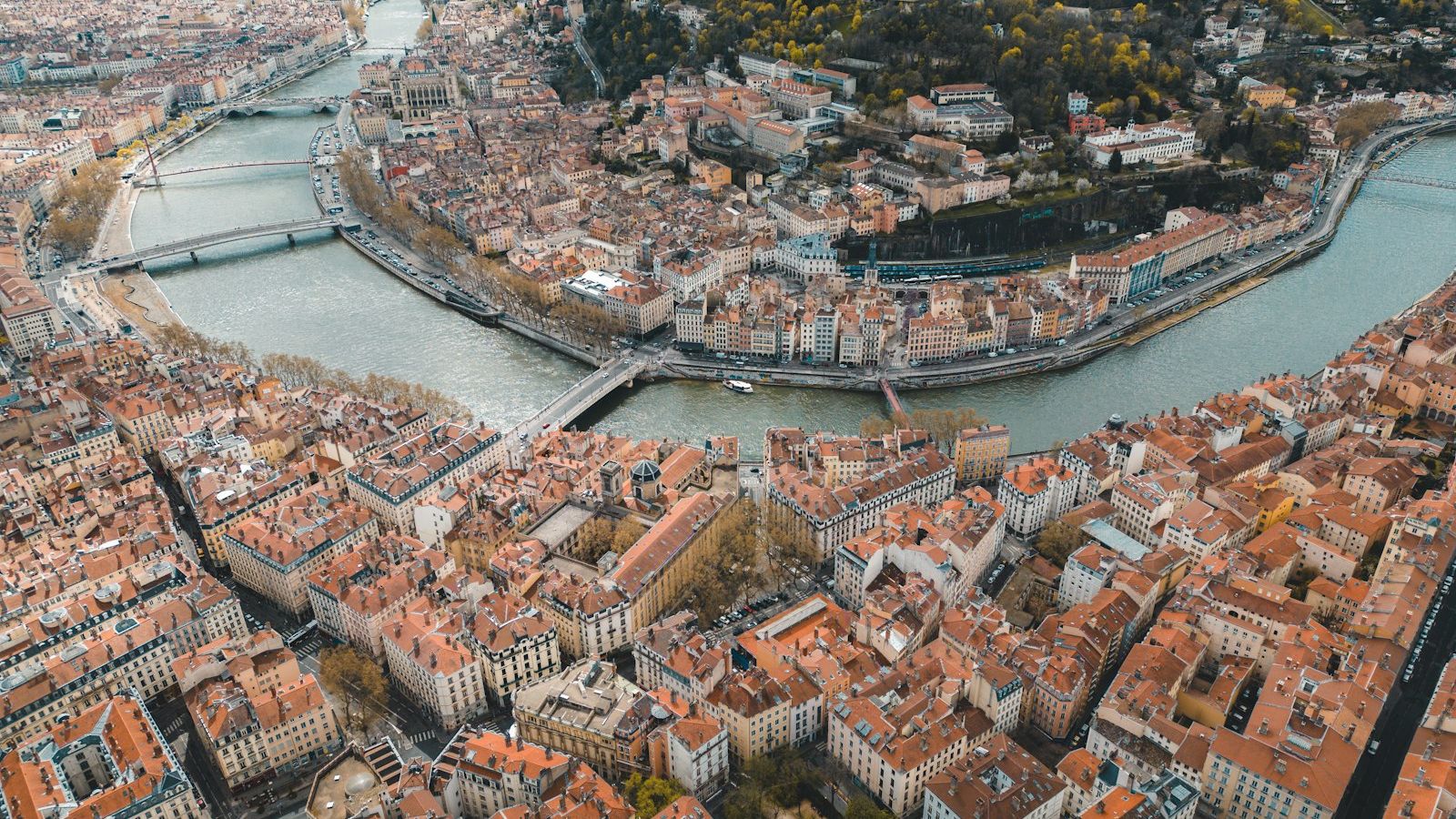
The city offers two rivers, a Roman hilltop, a UNESCO-listed old town packed with hidden passageways, and one of the most respected food cultures in Europe. Lyon does not try to compete with Paris. It does not need to.
Want more stories like this from France? Our free weekly newsletter covers cities, regions, food, and travel tips from across the country. Subscribe to the In Love With France newsletter here.
Two Rivers and One Very Walkable City
Lyon sits where the Rhône and the Saône meet, and that geography shapes everything about how the city feels. Along the western edge of the old town runs the Saône, while the Rhône cuts through the eastern side. Between them lies the Presqu’île, a long peninsula that holds most of the shops, restaurants, and everyday city life.
One of the city’s more photographed spots is the Passerelle du Collège — a red footbridge crossing the Saône where the old town meets the peninsula. Early in the morning, when the light turns soft and the crowds have not yet arrived, it looks genuinely striking. Cross it and you step straight into Vieux-Lyon, the oldest part of the city. (We cover this crossing in more detail in our guide to Lyon’s red footbridge.)
Walking along either riverbank costs nothing and rewards patience. Benches, weekend market stalls, and long quiet stretches follow the water, and often the only sound comes from the current moving past. Locals treat the Rhône-side embankments as a social space rather than a thoroughfare, which makes them particularly good in the evening.
The Presqu’île itself deserves a morning. Place Bellecour ranks among the largest open squares in France and works as a natural meeting point. From there you can wander north towards the Hôtel de Ville and the Opéra de Lyon, or south towards the confluence where the two rivers finally join. Flat and easy on foot, the whole area suits an unhurried stroll.
The Traboules of Vieux-Lyon
This is what most visitors miss. From the street, Vieux-Lyon looks like a fairly ordinary medieval old town — stone facades, narrow cobbled lanes, the occasional café spilling out onto the pavement. Behind many of those doors, though, hide the traboules: covered passageways that cut through the interiors of buildings and connect one street to another.
Roughly 40 traboules open to the public in Vieux-Lyon, with more again in the Croix-Rousse district to the north. They date back to the 15th and 16th centuries, when Lyon thrived as a major silk-weaving city. Silk workers used the traboules to move fabric through the city quickly without exposing it to rain.
During the Second World War, the French Resistance moved people and messages through these passageways to avoid detection. Some of them run through multiple courtyards and link streets two or three blocks apart.
Many stay unmarked from the outside, and the doors look private. If a traboule appears on the free map available from the Lyon tourism office, though, it welcomes the public during daytime hours. Push the door. Walk through. Most visitors stride straight past them.
A few of Vieux-Lyon’s best-known passageways are worth seeking out first:
- La Longue Traboule — running between 54 Rue Saint-Jean and 27 Rue du Bœuf, this is the longest and most famous, threading through four courtyards.
- Cour des Voraces — in Croix-Rousse, celebrated for its dramatic seven-storey open staircase.
- Traboule du 24 Rue Saint-Jean — a shorter, easy introduction right in the heart of the old town.
Want more stories like this from France? Our free weekly newsletter covers cities, regions, food, and travel tips from across the country. Subscribe to the In Love With France newsletter here.
The Roman Hill Above the City
The Romans founded Lyon as a colony in 43 BC. On the western side of the Saône, the hilltop now called Fourvière marks where the original settlement stood. Two well-preserved Roman theatres still stand up there today. The larger one seats around 10,000 people and continues to host performances during the summer Nuits de Fourvière festival, which runs from June through August. For a wider sense of the era that shaped this hill, our piece on the Gauls and France before the Romans offers useful background.
You can climb up from the old town in around 20 minutes on foot, though most people take the funicular from the Saint-Jean station at the base. It drops you near the Basilica of Notre-Dame de Fourvière, a late 19th-century building far more elaborate than its age might suggest. From the esplanade outside, the views stretch across the city, the two rivers, and, on a clear day, the Alps in the distance.
Next to the theatres, the Gallo-Roman Museum sits built into the hillside. Largely underground, it tends to stay quiet. The collection traces Lyon’s history from the pre-Roman period through to late antiquity, and it gives you enough context to make the ruins outside considerably more interesting. If you have a couple of hours, the entry rewards them.
Where to Eat in Lyon
Lyon carries a serious food reputation and largely lives up to it. The local restaurant tradition centres on the bouchon — a small, informal eating house serving traditional Lyonnais dishes. Expect to see a familiar cast of specialities on most menus:
- Quenelles — a light fish dumpling, traditionally pike, served in a rich sauce.
- Salade lyonnaise — frisée lettuce with lardons and a poached egg.
- Gratin dauphinois — sliced potatoes baked slowly in cream.
- Cervelle de canut — a herbed fresh cheese spread whose name nods to the city’s silk weavers.
Bouchons vary considerably. Some cater specifically to tourists and disappoint. The ones on the official Bouchons Lyonnais association register tend to prove more reliable. Stepping away from the main tourist drag and into the side streets usually yields better results than following the foot traffic.
Les Halles de Lyon Paul Bocuse, the city’s covered market, takes its name from the chef who did more than almost anyone to put French cuisine on the international map — and who based himself in Lyon. It opens every day except Monday and rewards a visit even if you plan to buy nothing. Cheeses, charcuterie, pastries, chocolate, and fresh produce fill the well-laid-out stalls. Arrive in the morning, when everything looks at its freshest.
Getting to Lyon and Getting Around
Lyon runs two main stations. Lyon Part-Dieu serves as the principal TGV hub, roughly two hours from Paris by high-speed train and around an hour and forty minutes from Marseille. Lyon Perrache, the older station, handles some regional routes. Both connect directly to the city’s metro network.
Comfortable walking distance covers most of what tourists want to see — the old town, the Presqu’île, the Croix-Rousse district, the riverbanks. For longer distances the metro does the work, the funicular carries you up the Fourvière hill without the climb, and trams reach the eastern parts of the city. Day passes for public transport pay off if you move around a lot.
A two-night stay covers the basics. Three nights let you slow down, eat properly, and explore the districts beyond the obvious tourist circuit. Croix-Rousse in particular rewards a half-day — it keeps a strong local identity, a good morning market, and a different feel from the rest of the city. If you fancy pairing the city with a wider swing through the south, our guide to the hidden villages of Provence makes a natural next stop.
When to Visit
Spring and autumn make the most practical times to visit. Temperatures stay comfortable, crowds remain manageable, and hotel prices sit below their summer peak. Summer turns warm and lively — the Nuits de Fourvière festival draws large audiences to the Roman theatres — but the city grows noticeably busier.
The Fête des Lumières, Lyon’s festival of lights, takes place over four days in early December. Lyon has celebrated it in some form since the 19th century. Large-scale light installations go up across public spaces throughout the city, and the event draws around two million visitors over the four days. If you plan to go during that period, book accommodation several months in advance.
Winter outside the lights festival turns cold but quiet, and prices drop significantly. Lyon does not shut down in the off-season the way some smaller French towns do — a working city with a substantial local population, it keeps its restaurants and markets busy year-round.
Want more stories like this from France? Our free weekly newsletter covers cities, regions, food, and travel tips from across the country. Subscribe to the In Love With France newsletter here.
The Honest Verdict
Lyon does not need a sales pitch. Good transport links, a genuinely layered history, food worth planning a trip around, and an old town that takes more than a day to explore all speak for themselves. Whether you spend two nights or five, the more time you give it, the more it gives back.
It is not a secret, exactly. But it remains the French city that most visitors have not quite got around to yet — and for the ones who do, it tends to move quickly to the top of the list.
Frequently Asked Questions
How many days do you need in Lyon?
Two nights cover the essentials — Vieux-Lyon, Fourvière, and the Presqu’île. Three nights give you room to slow down, eat well in a bouchon or two, and explore Croix-Rousse away from the main tourist circuit.
What is Lyon famous for?
Lyon is famous as France’s gastronomic capital, home to the bouchon tradition and to the late chef Paul Bocuse. It is also known for its Roman heritage at Fourvière, its silk-weaving history, and the hidden traboule passageways of Vieux-Lyon.
How do you get from Paris to Lyon?
The fastest route is the TGV high-speed train, which reaches Lyon Part-Dieu from Paris in roughly two hours. Trains run frequently throughout the day, so booking on the day is usually possible, though advance fares cost less.
What food should you try in Lyon?
Order the classics: quenelles, salade lyonnaise, gratin dauphinois, and cervelle de canut. For produce, cheese, and charcuterie, head to Les Halles de Lyon Paul Bocuse, the city’s covered market.
Thinking about it for retirement?
If you’ve started thinking seriously about retiring there, our complete our full Retire in France guide covers the visa, healthcare, cost-of-living, and the regions worth shortlisting.
Tours & experiences you might love


Powered by Viator. Some links are affiliate links — we may earn a small commission at no extra cost to you.

Leave a Reply