You’ve just sat down in a small restaurant in Lyon. The waiter brings menus, a basket of bread, and then — without ceremony — a golden retriever pads past your table and settles at the feet of the couple beside you. Nobody looks up. Nobody says a word. Welcome to France.
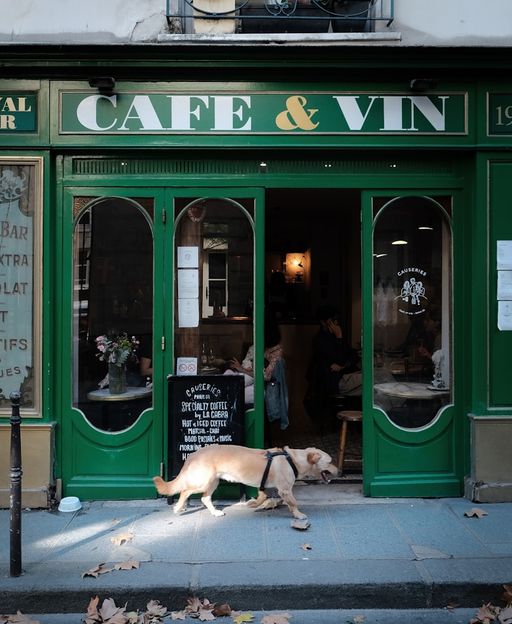
France Has More Dogs Per Person Than Almost Anywhere in Europe
France is home to roughly 7.5 million domestic dogs — one of the highest rates of pet ownership in Europe. But the number isn’t the point. It’s where those dogs go.
In Britain or America, a dog at a restaurant usually means a sign on the door saying “well-behaved dogs welcome on the terrace” and a bowl of water placed firmly outside. In France, the terrace is just the beginning. Many restaurants, cafés, and brasseries welcome dogs inside without a second thought — not as a special favour, but as a normal part of daily life.
You will see dogs in bakeries. Dogs at café counters. Dogs sitting patiently beside their owners at a Saturday lunch that runs until three in the afternoon. Nobody asks them to leave. Nobody gives them a second glance.
It Starts With French Law — or Rather, the Absence of It
French law does not specifically ban dogs from restaurants or food establishments. That decision is left entirely to the individual owner. But the cultural default is inclusion, not exclusion.
A quiet, well-behaved dog is assumed to belong wherever its owner belongs. This isn’t sentiment. It’s a thoroughly French outlook: if the dog is causing no problem, there is no problem. The French instinct to leave well enough alone — to let people and their animals get on with things — extends naturally to pets.
Compare this to countries where the assumption runs the other way: animals are excluded unless explicitly welcomed. In France, the logic is reversed. A dog is welcome unless someone has decided otherwise.
The Dog Under the Table Is Always the Well-Behaved One
French dogs in public spaces tend to be extraordinarily well-mannered. This is not accidental. French owners understand that the privilege of bringing a dog anywhere depends entirely on that dog behaving everywhere.
A dog that barked or begged in a café would be an embarrassment — not a quirk, not endearing, an embarrassment. So the training happens early. French dogs learn that a restaurant is a calm place. They settle under the table, they wait, they do not approach strangers uninvited.
There is a quiet social contract at work. The dog holds up its end. The restaurant holds up its end. And the other diners, who have seen this a thousand times before, simply get on with their meal. Understanding this dynamic is part of understanding how French public life actually works — which is often less about written rules and more about what people have silently agreed.
Enjoying this? 7,000 France lovers get stories like this every week. Subscribe free →
A Tradition That Goes Back to the Brasseries
The French dog in public spaces is nothing new. In the great brasseries of Paris, Lyon, and Strasbourg, dogs have been part of the scene for generations — beside market workers, tradesmen, and artists who lingered over a single coffee for half an afternoon.
In villages across France, certain dogs have territories as well-known as the postman’s route. They know the boulangerie, the tabac, the square. They trot in, wait for someone to acknowledge them, and trot out again. They are greeted by name. They are occasionally slipped something they shouldn’t have. They belong.
This has its roots in the French relationship with le quotidien — daily life as something worth protecting and enjoying. The dog at the café is not a statement about animal rights. It is simply what the morning looks like in a country that has never seen any reason to make it otherwise.
What This Actually Tells You About France
The dog under your restaurant table isn’t a policy. It’s an expression of something deeper: the French insistence on living your life in public without unnecessary interference.
France takes pleasure seriously. Long lunches, slow evenings, the unhurried ritual of an apéritif — these are not indulgences, they are the point. In that context, asking you to leave your dog outside feels, to the French mind, unkind for no good reason. The French also have strong ideas about food and how it should be shared — rules that begin in childhood and last a lifetime. But “no dogs allowed” has never been one of them.
If you are planning a trip to France and you own a dog, you may find that more doors stay open than you expect. Not all — fine dining establishments and some formal restaurants draw a quiet line — but far more than you are probably used to back home.
Not Every Door Is Open — But Many More Than You Think
To be fair: this isn’t every restaurant. Some display a small sign. Some have a house rule. High-end establishments in Paris will politely indicate that the dog should wait outside. It is always worth a glance at the door or a quick word with the waiter.
But in the neighbourhood bistro, the village café, the corner brasserie where everyone knows each other? The dog at the next table is rarely a surprise. It is simply another regular, settling into its usual place.
Next time a dog pads over and settles quietly beside you in a French café, resist the urge to check if it’s supposed to be there. It almost certainly is. That dog has been coming here for years.
Join 7,000+ France Lovers
Three times a week, get France’s hidden gems, seasonal guides, local stories, and the art of la vie française — straight to your inbox.
Subscribe free — enter your email:
Free forever · Unsubscribe anytime
🇫🇷 You Might Also Love
Tours & experiences you might love


Powered by Viator. Some links are affiliate links — we may earn a small commission at no extra cost to you.

Leave a Reply