
Somewhere along the Dordogne river, a light is on inside the rock. Not behind a cave entrance, exactly — behind a proper window, with a painted shutter and a geranium in a pot on the ledge. The cliff is the wall. The family inside has lived this way for generations.
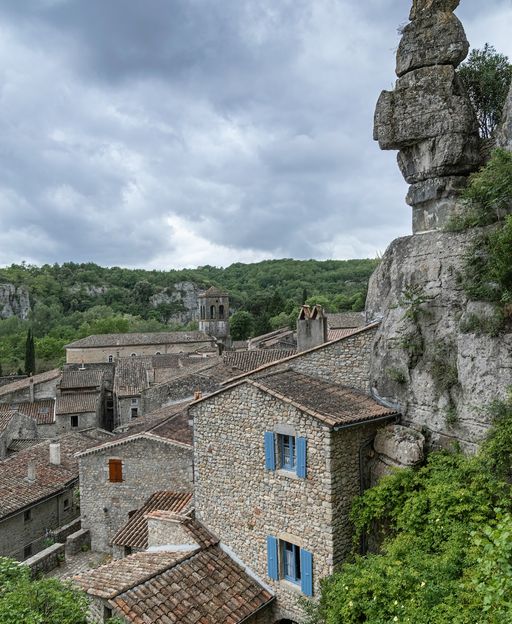
France has a handful of places where the line between building and landscape dissolves entirely. These are the troglodyte villages — carved, built, and wedged into limestone cliffs — and many of them are still home.
How a Cliff Becomes a House
The word troglodyte comes from the Greek for “cave dweller,” but France’s cliff villages are rarely dark or primitive. In the soft tufa limestone of the Loire Valley and the golden rock of the Dordogne, generations of French families quarried their homes directly from the cliff face.
The stone came out as building material for local churches and manor houses. The cavity left behind became a dwelling. Walls were added at the front. Windows were cut. Chimneys were bored upward through the rock above.
The result is a house that never needs insulation. The temperature inside stays at around 12–14°C year-round — cool in summer, warm in winter, without a single radiator.
La Roque-Gageac: A Village Against the Cliff
Few places in France look quite like La Roque-Gageac. It sits on a narrow strip of land between the Dordogne river and a towering limestone overhang. The cliff doesn’t loom behind the village — it is part of it.
Houses are pressed so tightly against the rock face that the cliff provides the back wall of many buildings. The village has a microclimate warm enough for palm trees and exotic plants, sheltered from the north wind by several hundred metres of solid limestone.
It has been named one of France’s most beautiful villages, and it is. But more than the view, it is the strangeness — the intimacy between stone and house — that stays with visitors.
The Troglodyte Caves of Saumur
The Loire Valley around Saumur contains the highest concentration of troglodyte dwellings in Europe. Estimates put the number at over 3,000. Around 500 are still inhabited today.
These are not temporary shelters or curiosities. They are proper homes — with electricity, plumbing, kitchens, and gardens cut into the slope above. Some have been in the same family for more than ten generations.
Others have become wine cellars, where the constant cool temperature is ideal for ageing Saumur-Champigny. A few have been turned into restaurants, where you eat inside the rock and somehow it doesn’t feel unusual at all.
Enjoying this? 7,000 France lovers get stories like this every week. Subscribe free →
Rocamadour: Built Into the Cliff Face
Rocamadour takes the concept further. This is not a village that leans against a cliff — it is a village constructed vertically, tier by tier, up a sheer rock face in the Lot.
At the bottom, the river. Then a line of houses. Above them, a terrace of chapels and shrines that have drawn pilgrims for over a thousand years. Higher still, a castle crowning the summit.
It is absurd and magnificent. The whole settlement climbs 150 metres of cliff, connected by a grand staircase of 216 steps. Medieval pilgrims climbed them on their knees. Today, visitors climb them in trainers and still feel the effort.
Why the Cliffs Made Perfect Sense
Before heating, before insulation, before transport could bring materials cheaply, the cliff was the practical choice. Tufa limestone carves easily when freshly quarried, then hardens in the air.
A family with simple tools could hollow out a room in a few weeks. The cliff kept out the cold. The south-facing aspect — typical of these sites — meant sun all winter. The river below provided water, fish, and transport.
These were not people making do. They were people building intelligently with what was around them.
Where to Find France’s Cliff Villages
The best-known cluster is around Saumur, Amboise, and Vouvray in the Loire Valley. Look for cliff faces with shuttered windows and woodpiles stacked against the rock — sure signs that someone is home.
In the Dordogne, La Roque-Gageac is the most visited, but Beynac-et-Cazenac and the troglodyte shelters near Les Eyzies offer something quieter. The forgotten villages along France’s most beautiful river are close neighbours, well worth adding to any route through this region.
Rocamadour in the Lot is worth a night — arriving after the day-trippers leave, when the cliff face glows at dusk and the silence settles in.
For those planning a trip to this part of France, the France trip planning guide covers the key routes and best bases. And if you’re curious about the rules that protect these extraordinary places, the strict criteria a village must meet to be called beautiful sheds light on how France guards what makes it remarkable.
Somewhere along the Dordogne, a light still burns inside the rock. Long after the tourists have gone and the road is quiet, someone is home in there — keeping warm, as families have done for centuries, with nothing but stone between them and the world.
Join 7,000+ France Lovers
Three times a week, get France’s hidden gems, seasonal guides, local stories, and the art of la vie française — straight to your inbox.
Subscribe free — enter your email:
Free forever · Unsubscribe anytime
🇫🇷 You Might Also Love
Tours & experiences you might love


Powered by Viator. Some links are affiliate links — we may earn a small commission at no extra cost to you.

Leave a Reply