
Most people driving through Brittany have heard of Mont Saint-Michel. Many have heard of Saint-Malo. Almost nobody has heard of Fougères — which is strange, because Fougères has one of the most complete medieval fortresses in all of Europe, rising from the valley floor in the middle of a small Breton town that most tourists never reach.
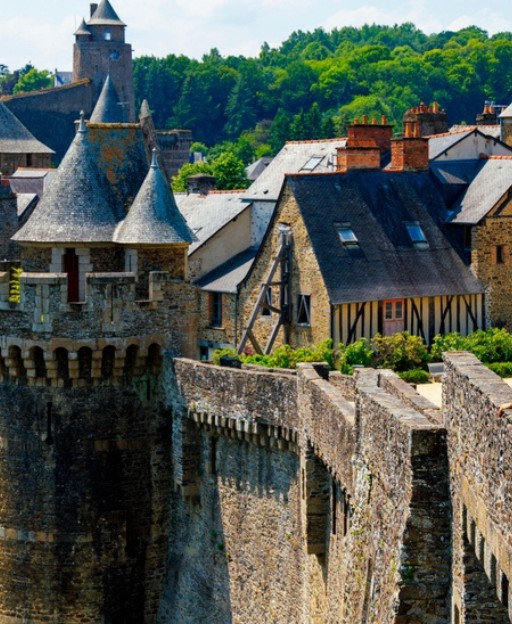
It is not a small oversight. The castle at Fougères is one of the largest medieval fortresses in Western Europe. And the town around it — all cobbled lanes, half-timbered houses, and a river looping quietly through the lower valley — looks very much as it did five hundred years ago.
The Castle That Shouldn’t Still Be There
Fougères Castle began in the 12th century and was expanded and reinforced over the following four hundred years. Today it stands with 13 towers, three sets of defensive walls, and a moat fed by the River Nançon — all of it still largely intact, which is in itself extraordinary.
Most great medieval fortresses were damaged in the Wars of Religion, destroyed in the Revolution, or simply lost to centuries of neglect and redevelopment. Fougères was largely overlooked during each of those upheavals. It was never fully captured in battle, never dramatically rebuilt, and never turned into something else.
Writers noticed it, though. Victor Hugo visited in 1836 and called it “the greatest marvel of military architecture in Europe.” Balzac set part of a novel here. The Romantic painters followed. And then, somehow, the tourist crowds didn’t.
A Town Built on Two Levels
Fougères works on two planes. The castle sits in the lower town, enclosed in a natural bowl carved by a loop in the Nançon river. The old town sits on a rocky bluff above, connected by steep lanes and stairways that have barely changed in centuries.
From the upper town, the view down to the castle is properly theatrical — towers, ramparts, and river all arranged below you as if laid out for inspection. The Church of Saint-Sulpice sits at the top of the rise, with a quiet square in front of it and a café that serves very good cider through the afternoon.
In the lower streets, there are half-timbered medieval houses, a traditional tannery district that still attracts craftspeople, and a market held three times a week with no particular concession to tourism. The locals are friendly in the direct way of Breton towns that aren’t used to visitors asking obvious questions.
Why Almost Nobody Goes There
Fougères sits in eastern Brittany, inland, away from the coast. It has no TGV station. It’s not on the route between any two places that most visitors are trying to reach. And so it simply gets missed.
The population is around 20,000 — enough to support a real town with real bakeries and real hardware shops — but not large enough to generate the kind of infrastructure that draws package tours. There is no famous chef who trained here. There are no Fougères-branded products in gift shops elsewhere in France.
There is just the castle. And the view. And the Tuesday market.
🇫🇷 Discover the France Most Tourists Never Find
Get our free guide to 25 hidden villages of France — then join 7,000+ readers for weekly stories about places most guidebooks never mention.
Get Your Free Village Guide →If you’ve started thinking seriously about retiring there, our complete our full Retire in France guide covers the visa, healthcare, cost-of-living, and the regions worth shortlisting.



Leave a Reply