
They were the most powerful fighting monks in history. For nearly two centuries, the Knights Templar shaped France, fought for Jerusalem, and built one of the world’s first banking systems. Then, in a single dawn raid, a French king destroyed them forever.
Their story begins in France. It ends there too — with flames on a Paris river island and a curse that echoed for centuries.
Here is the full story of the Knights Templar in France: who they were, what they built, and why France still carries their legacy today.
Who Were the Knights Templar?
The Knights Templar were founded in 1119 by a French knight from Champagne named Hugues de Payens. He and eight companions made a proposal to the King of Jerusalem. They would protect Christian pilgrims travelling to the Holy Land. In return, they would live as monks — celibate, obedient, and sworn to poverty.
The King gave them headquarters inside Al-Aqsa Mosque on Temple Mount. They took their name from this location. “Temple” became their identity.
At first, they had little money and few members. Bernard of Clairvaux changed that. Bernard was from Burgundy, in eastern France. In 1129, he championed the Templars at the Council of Troyes — held on French soil — and wrote their official rule of life. His support was a turning point. Donations flooded in from across Christendom.
Within a generation, the Templars had become an army. By the mid-12th century, they fielded hundreds of knights and thousands of supporting troops. They were exempt from local taxes and answered only to the Pope. No king or bishop could order them around.
They were untouchable — until they weren’t.
The Templars in France: Power, Property, and Banking
France became the Templars’ home base. They built preceptories — fortified farming estates — across the country. These funded their military operations in the Holy Land. From Normandy to Provence, Templar properties appeared across the landscape.
Their European headquarters stood in Paris. The Temple — a massive fortified complex with a great tower — dominated the north of the city. It held the Templar treasury. The Kings of France came here to borrow money in times of need.
This is where the Templars made history beyond warfare. They created an early system of letters of credit. A pilgrim could deposit gold in a Paris Templar house and withdraw it in Acre or Jerusalem, using a coded document. They could not be robbed on the road because they carried no money. This was one of the world’s first banking systems. Without the Templars, modern banking looks very different.
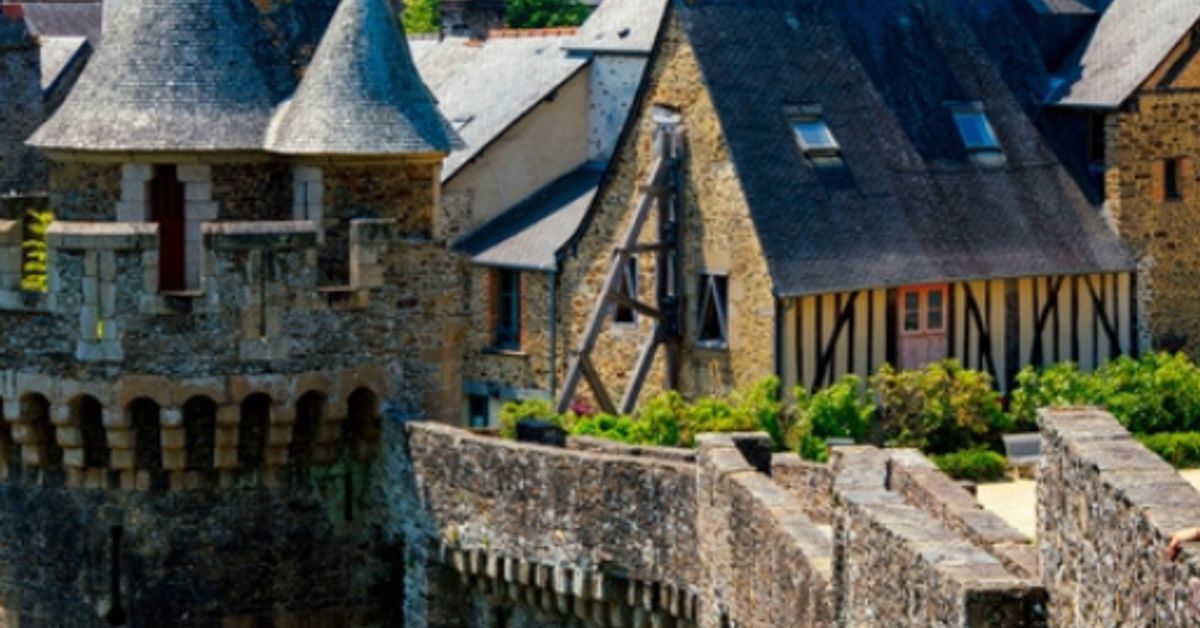
La Couvertoirade in the Aveyron region of southern France stands as the best-preserved Templar village in the world. Its stone walls still ring the old settlement. Its church and castle still stand. Walking its streets today feels like stepping into the 12th century. If you are planning a French heritage trip, this is one site you should not miss.
By 1300, the Templars controlled vast wealth. They owned land across France, Spain, Portugal, England, and the Crusader states. They had perhaps 20,000 members. They were, in every sense, a state within a state.
🇫🇷 Enjoying this? 7,000 France lovers get stories like this every week.
Thinking about it seriously? If you’ve started actually planning a move, our complete our complete Moving to France guide walks through every step, every cost, and the paperwork that catches most people out.
Why King Philip IV Wanted Them Gone
By the late 13th century, the Crusades had collapsed. The Templars lost Jerusalem in 1187 and the last Christian stronghold of Acre in 1291. They retreated to Cyprus, then to France. Without a war to fight, their purpose looked weak. Their critics grew louder.
Philip IV of France — known as Philip the Fair — had a more personal problem. The French crown owed the Templars a great deal of money. He had borrowed heavily to fund wars with England and Flanders. The Templars were rich, powerful, and owed no taxes to the French throne. They answered only to the Pope.
Philip wanted that money. And he wanted the Templars’ land.
He needed an excuse. Heresy would do.
In 1305, Philip pressured Pope Clement V — a Frenchman from Gascony, based at Avignon — to investigate the order. The Pope agreed. Philip gathered accusations: that Templars denied Christ during their initiation ceremonies, spat on the cross, and worshipped a mysterious idol called Baphomet. Historians today believe most of these charges were invented or extracted under torture.
Philip moved fast. He drew up secret arrest warrants. He told nobody. He waited for the right moment.
Friday, 13 October 1307: The Day the Templars Fell
Before dawn on Friday, 13 October 1307, royal officers across France broke down Templar doors at the same moment. They arrested every Templar they could find — perhaps 2,000 men across France alone. The Grand Master, Jacques de Molay, was seized in Paris. He had been a guest of honour at a royal funeral just days before.
This date is why Friday the 13th carries its dark reputation today. The mass arrest of the Templars burned itself into European memory. The superstition spread across Christendom over the following centuries. It persists to this day.
The arrested Templars faced brutal interrogation. Under torture, many confessed to the charges Philip’s men had invented. Jacques de Molay himself confessed — and then recanted. He told his captors that he had only spoken under duress. He denied the charges entirely.
This proved fatal.
A Templar who recanted his confession was guilty of relapsing into heresy. The punishment for that was death. No appeal was possible.
The Burning of Jacques de Molay — and the Templar Curse
On 18 March 1314, Jacques de Molay stood on a small island in the Seine in Paris. The Île aux Juifs was a narrow sandbank used for executions. That evening, he burned at the stake.
He was around 70 years old. He had led the Templars for over 20 years. He faced death standing.
As the flames rose, de Molay called out from the pyre. He summoned both Philip IV and Pope Clement V to face God’s judgement within a year.
Pope Clement died 33 days later.
Philip IV was dead within eight months.
History offers no clear explanation for either death. The Pope suffered from a stomach illness. Philip died after a hunting accident, possibly a stroke. But the speed of both deaths astonished medieval Europe. The legend of the Templar curse spread immediately and never fully faded.
The Order of the Knights Templar was officially dissolved by Pope Clement at the Council of Vienne in 1312. Their lands passed to the rival Knights Hospitaller. Their members scattered, retired, or faced the stake. In France, the most powerful religious order in medieval history vanished in just seven years.
The burning of Jacques de Molay echoes through history much like the execution of Joan of Arc more than a century later. Both were burned on French soil by French institutions. Both became legends that would not stay buried.
Where to Find the Templars in France Today
The Templars left stone marks across France. Most visitors never know they are walking past them. These are the best places to encounter their history:
La Couvertoirade, Aveyron — The finest surviving Templar village in France. Its stone walls, 12th-century church, and fortified layout remain largely intact. The village sits on the Causse du Larzac plateau in southern France. Walk the ramparts and imagine a community built for God and war. It is one of Les Plus Beaux Villages de France — the most beautiful villages in France.
Richerenches, Vaucluse — A Templar commandery in Provence, founded around 1136. The old preceptory walls still stand in the village centre. The village holds a truffle market every winter in the ancient Templar square. It is one of the quietest and most atmospheric Templar sites in France.
The Marais, Paris — The Tour du Temple once stood here. Napoleon demolished the great Templar tower in 1808, fearing it would become a pilgrimage site. The square du Temple, the Rue du Temple, and the entire quartier du Temple still carry the name. Nothing stands above ground today. But the history is everywhere beneath the surface.
Arville, Loir-et-Cher — The commandery of Arville is one of the best-preserved Templar sites in France. Its 12th-century chapel, dovecote, and tithe barn still stand in the Perche countryside. A small museum tells the story of the order from inside the original buildings.
Carcassonne, Occitanie — The great walled city of Carcassonne was a Crusader stronghold. It overlaps with the world of the Cathars — another group destroyed by the French monarchy in the same century. The Templars were active throughout this region. Walking the ramparts today, the medieval world feels very close.
The Templar Legacy That Won’t Die
The Templars have fascinated people for 700 years. They appear in Dan Brown’s The Da Vinci Code, in countless films, and in the mythology of Freemasonry. Conspiracy theories claim they hid the Holy Grail, that they secretly survive today, or that they founded modern banking to control the world’s money.
The real story needs no embellishment.
The Templars built some of the first banking infrastructure in the Western world. They created financial instruments that still shape how money moves today. They left fortresses, chapels, and entire villages across France that you can walk through right now.
They were not saints. They were soldiers who happened to be monks. They fought brutal wars. They gathered vast wealth in the name of poverty. They were imperfect men serving an imperfect institution.
But they were also betrayed. Destroyed by a king who wanted their money. Accused of crimes they almost certainly did not commit. Tortured into confessions. Burned alive.
Jacques de Molay died on a Paris island for refusing to repeat a lie. That story — of power, betrayal, and defiance — sits alongside the Normans who built medieval Europe and the Revolution that remade it. France made the Templars. France destroyed them. And France still carries their memory.
Frequently Asked Questions About the Knights Templar in France
Were the Knights Templar really guilty of the crimes they were accused of?
Historians overwhelmingly believe the charges were fabricated or extracted under torture. The confessions were inconsistent and most Templars recanted once freed from interrogation. King Philip IV had strong financial and political motives to destroy the order, and the accusations served his interests precisely.
Why is Friday the 13th considered unlucky?
The mass arrest of the Knights Templar on Friday, 13 October 1307 is widely cited as the origin of this superstition. The date lodged itself in European memory as a day of catastrophe. Over the following centuries, the specific event blurred into a general belief that Friday the 13th brings misfortune.
Where is the best place to see Templar history in France?
La Couvertoirade in the Aveyron is the finest surviving Templar village in France, with intact medieval walls and a 12th-century church. The commandery at Arville in Loir-et-Cher offers another excellent site with original buildings and a small museum. The Marais district in Paris preserves the memory of the Templar headquarters, though the great tower no longer stands.
What happened to the Templar treasure?
Philip IV expected to seize a vast Templar fortune but was reportedly disappointed by what he found. The Paris Temple treasury may have been moved before the October 1307 arrests. No definitive Templar treasure has ever been found. Most historians believe the wealth had already been dispersed across the order’s many properties before the raids took place.
Did the Knights Templar really curse King Philip IV?
Multiple contemporary sources recorded that Jacques de Molay called on God to judge Philip IV and Pope Clement V within a year as he burned. Both men died within eight months. Whether this was coincidence, illness, or something else is not known. The story became one of the most enduring legends in French medieval history.
You Might Also Enjoy
- Joan of Arc: Why France’s National Hero Still Matters — another French icon who faced flames and became a legend
- The Cathars of Languedoc: France’s Forgotten Heresy — the religious group destroyed by France in the century before the Templars
- The Normans Who Changed the World: From France to England to Sicily — the other great medieval story that began in France
Plan Your France Trip
Ready to visit France and walk in the footsteps of the Templars? Start with our complete France travel planning guide — everything you need to plan your trip, from where to go first to how to find the hidden sites most visitors never find.
Join 7,000+ France Lovers
Every week, get France’s hidden gems, seasonal guides, local stories, and the art of la vie française — straight to your inbox.
Subscribe free — enter your email:
Love more? Join 64,000 Ireland lovers → · Join 43,000 Scotland lovers → · Join 30,000 Italy lovers →
Free forever · One email per week · Unsubscribe anytime
Tours & experiences you might love


Powered by Viator. Some links are affiliate links — we may earn a small commission at no extra cost to you.

Leave a Reply