
Louis XIV ruled France for 72 years. No other French monarch came close to that record. He built Versailles into the most famous palace on earth. He made France the cultural heart of Europe. And one of his decisions drove hundreds of thousands of French people to scatter across the globe forever.
If you have French heritage — or a French surname in your family tree — Louis XIV almost certainly touched your ancestors’ lives.
Who Was Louis XIV?
Louis XIV was born on 5 September 1638 at the Château de Saint-Germain-en-Laye. His father, King Louis XIII, died in 1643 when young Louis was just four years old. His mother, Anne of Austria, became regent. Cardinal Mazarin, the chief minister, ran the country.
France nearly fell apart during Louis’s childhood. A series of civil wars called the Fronde tore the kingdom apart between 1648 and 1653. Nobles rebelled. Paris rioted. Young Louis fled the capital twice. He watched his world become dangerously unstable.
That experience shaped everything that followed.
When Cardinal Mazarin died in 1661, Louis took personal control of France. He was 22 years old. He told his ministers he would be his own first minister. No one else would hold that power again. He kept that promise for 54 more years.
🇫🇷 Free Guide: How to Trace Your French Ancestry
Step-by-step: Archives Départementales, état civil records, parish registers, Acadian roots, DNA testing, and planning a heritage trip to France. Completely free.
Get the Free Guide → Subscribe free at the guide page to receive weekly France storiesThe Sun King: Why Louis Chose the Sun as His Symbol
Louis XIV chose the sun as his personal symbol around 1653, during a royal ballet. He was still a teenager. He appeared on stage in a costume representing the rising sun.
The image stuck.
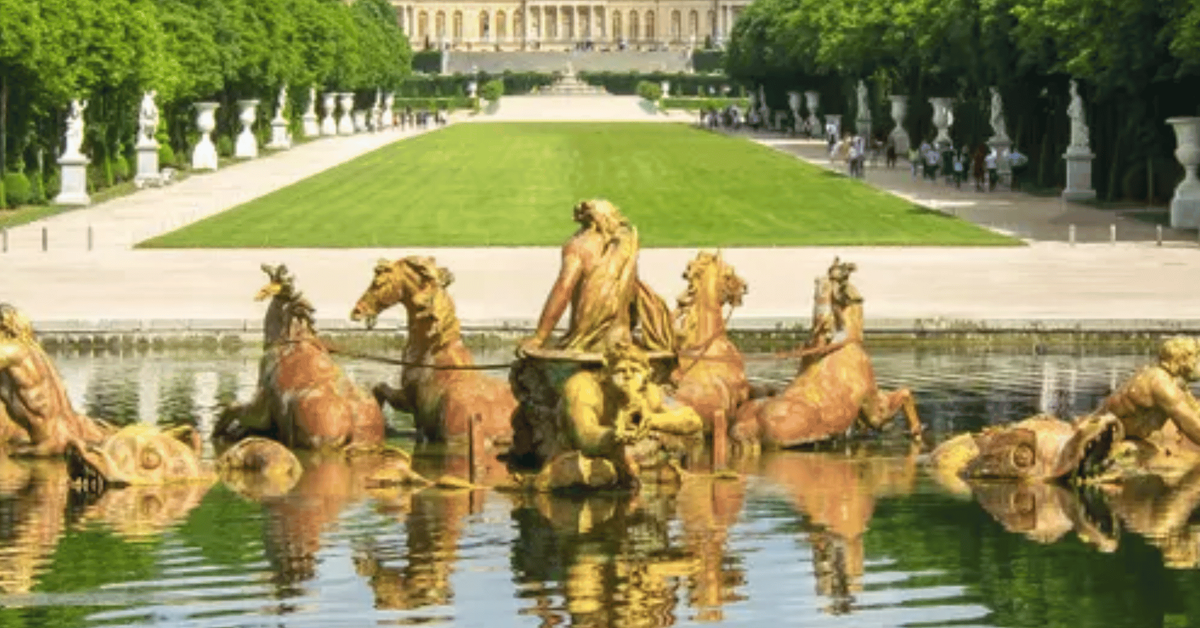
He styled himself as Apollo, the ancient god of the sun. He used solar imagery throughout Versailles. The Apollo Fountain in the palace gardens shows this most clearly. The sun god rises from the water on his chariot, dragged upward by four horses. It is Louis himself, ascending to bring France into a new age.
The title “Sun King” was not just flattery. It was a political message. France would orbit around one man, as the planets orbit the sun.
Building Versailles: A Palace for the Age
Louis XIV did not like Paris. The Fronde had shown him how dangerous the city could be. He wanted a seat of power away from the mob and the nobles who might challenge him.
He chose his father’s hunting lodge at Versailles, 20 kilometres southwest of Paris. Then he turned it into the greatest palace in the world.
Construction began in earnest in the 1660s under the architect Louis Le Vau. The landscape architect André Le Nôtre designed the gardens. The painter Charles Le Brun directed the interior decoration. At its peak, around 36,000 workers and soldiers laboured on the site. They drained swamps, redirected rivers, and planted entire forests.
The finished palace had around 700 rooms and 2,000 windows. The Hall of Mirrors — 73 metres long, lined with 357 mirrors — reflected the light of 20,000 candles. The gardens stretched across 800 hectares of geometric perfection.
Louis moved his court permanently to Versailles in 1682. The palace became the centre of French government and the symbol of royal power. No building on earth said more clearly: this king is different.
Life at the Court of Versailles
Louis did something clever with Versailles. He invited the most powerful nobles in France to live there.
This was a trap. And the nobles walked right into it.
Living at court cost a fortune. Nobles spent enormous sums on clothing, carriages, and gifts. They competed for the honour of attending the king’s daily rituals. The lever happened each morning when Louis rose and dressed. The coucher came at night when he retired.
These ceremonies were packed with meaning. To hold the king’s candle was an honour. To help him into his coat was a privilege. A duke who missed his turn fell from favour.
By keeping the nobles occupied with court ceremony, Louis kept them away from their estates. A marquis who spent his days fussing over royal etiquette had no time to plot rebellion in the provinces.
Meanwhile, French culture spread across Europe. French fashion set the standard on every continent. French cuisine became the model for fine dining. The French language became the language of diplomacy, science, and high society. Louis turned France’s cultural strength into direct political power.
🇫🇷 Enjoying this? 7,000 France lovers get stories like this every week. Subscribe free →
Wars, Borders, and the Making of Modern France
Louis XIV fought wars for most of his reign. He wanted to push France’s borders outward and establish France as the dominant power in Europe.
He fought the War of Devolution from 1667 to 1668. He fought the Franco-Dutch War from 1672 to 1678. He fought the War of the League of Augsburg from 1688 to 1697. He fought the War of the Spanish Succession from 1701 to 1714.
France gained significant territory. Alsace came fully under French control. France took Franche-Comté from Spain. Parts of Flanders came into French hands.
But the later wars drained the treasury badly. France spent more than it earned. By the time Louis died, the kingdom was deep in debt. The wars had cost more lives and money than France could afford.
His successor, Louis XV, inherited a brilliant but financially exhausted kingdom. The bills Louis left behind eventually contributed to the crisis that sparked the Revolution of 1789. To understand that revolution, you need to understand the debts Louis XIV created. Read more in our guide to the French Revolution and how it changed the world.
The Revocation of the Edict of Nantes: Louis’s Most Consequential Decision
This is the decision that changed France — and the French diaspora — forever.
In 1598, King Henri IV had signed the Edict of Nantes. It gave French Protestants, known as Huguenots, the legal right to practise their faith. For nearly a century, Huguenots had lived alongside Catholics across France.
Louis XIV was a devout Catholic. He believed France needed one king, one law, and one faith. On 18 October 1685, he signed the Edict of Fontainebleau. It revoked the Edict of Nantes entirely.
The consequences were enormous.
Between 200,000 and 400,000 Huguenots left France. They went to England, the Dutch Republic, Prussia, South Africa, Ireland, and the American colonies. These were skilled people: weavers, clockmakers, silversmiths, merchants, bankers, and doctors. They took their skills, their capital, and their knowledge with them. France lost an entire productive class of citizens in a matter of years.
The countries that received the Huguenots flourished. England’s silk industry expanded. Prussia gained experienced soldiers. South Africa’s Cape Colony gained skilled farmers. Their surnames — Du Plessis, De Villiers, Le Roux, Joubert, Malherbe — remain among the most common in South Africa today.
Do you have a French surname in your family tree? If your ancestry leads to South Africa, the United Kingdom, or North America, this moment may be part of your story. Our full guide to the Huguenots and their global legacy explores where they went and what they built.
The Legacy of Louis XIV
Louis XIV died on 1 September 1715. He was 76 years old. He had been king for 72 years.
His legacy sits uncomfortably between greatness and damage.
He built Versailles, the most admired palace in history. He made French culture the dominant force in Europe. He expanded France’s borders and created the modern French state. He turned Paris into a true capital city, filling it with grand institutions that survive today.
But he also drove hundreds of thousands of his own people into exile. He crushed religious freedom. He burdened France with debts that would haunt his successors for generations. The seeds of the French Revolution grew, in part, from the financial chaos of Louis’s reign.
Louis believed he was France. “L’état, c’est moi” — the state is me — may or may not be a direct quote, but it captures his view of power perfectly.
He shaped France more deeply than any other monarch. He also damaged it more deeply than most. Both things are true at once.
Planning a Visit to Versailles
The Palace of Versailles sits 20 kilometres southwest of Paris. It is one of the most visited sites in all of France.
You can reach it by RER Line C from Paris. The journey takes about 35 minutes. Trains run regularly from major Paris stations including Saint-Michel–Notre-Dame and Invalides.
Book your tickets in advance through the official Versailles website. Queues at the palace can be very long in summer. A timed entry ticket saves hours of waiting.
Allow at least half a day for the main palace and gardens. To see the Grand Trianon and Petit Trianon — smaller palaces in the grounds — plan a full day.
From spring to autumn, the Musical Fountain Shows (Grandes Eaux Musicales) run on certain weekends. Hundreds of fountains play in sequence to Baroque music. The Apollo Fountain rises from the water just as Louis intended.
Stand at the top of the garden steps and look south. You will see what Louis XIV saw: a world built to his exact design, stretching to the horizon in perfect symmetry.
Frequently Asked Questions About Louis XIV and Versailles
How long did Louis XIV reign as King of France?
Louis XIV reigned for 72 years, from 1643 until his death in 1715. He became king at age four when his father died, and took personal control of the kingdom in 1661 at age 22. No French monarch ruled for longer.
Why did Louis XIV build the Palace of Versailles?
Louis XIV built Versailles to move the French government away from Paris, a city he distrusted after the Fronde rebellions of his childhood. He also used the palace to control the nobility. Keeping powerful lords at Versailles made it harder for them to challenge him from their distant estates.
What was the Revocation of the Edict of Nantes?
The Revocation of the Edict of Nantes in 1685 was Louis XIV’s decision to strip French Protestants (Huguenots) of their religious freedoms. It caused between 200,000 and 400,000 Huguenots to flee France. Their descendants include millions of people across South Africa, the United Kingdom, the United States, and Canada who carry French surnames today.
What does “Sun King” mean?
The title “Sun King” referred to Louis XIV’s personal symbol: the sun. He chose it because the sun gives life and light to everything around it. Louis wanted the same relationship with France — everything in the kingdom would orbit around him. He styled himself as Apollo, the god of the sun, and placed solar imagery throughout Versailles.
How do I get from Paris to Versailles?
The easiest way to reach Versailles from Paris is by RER Line C. The journey takes about 35 minutes and trains run regularly from central Paris. Alight at the Versailles-Château-Rive Gauche station. Book your palace tickets online in advance to avoid long queues, especially in summer.
You Might Also Enjoy
- Napoleon’s France: The Man Who Remade Europe — The next great French ruler after Louis XIV, and how he transformed everything Louis had built
- The Huguenots: France’s Great Exodus and Its Global Legacy — The full story of the Protestant diaspora that Louis XIV set in motion
- Joan of Arc: Why France’s National Hero Still Matters — Another defining figure who shaped French identity before the Sun King’s time
Plan Your France Trip
Ready to explore France’s history in person? Our France trip planning guide covers everything from when to visit to where to stay, helping you make the most of your time in the country Louis XIV made famous.
Join 7,000+ France Lovers
Every week, get France’s hidden gems, seasonal guides, local stories, and the art of la vie française — straight to your inbox.
Subscribe free — enter your email:
Love more? Join 64,000 Ireland lovers → · Join 43,000 Scotland lovers → · Join 30,000 Italy lovers →
Free forever · One email per week · Unsubscribe anytime
Tours & experiences you might love


Powered by Viator. Some links are affiliate links — we may earn a small commission at no extra cost to you.

Leave a Reply