French Surnames of Alsace-Lorraine: Origins, Meanings and Family Heritage
Few regions in France carry as much history in their family names as Alsace-Lorraine. This northeastern corner of France changed hands between France and Germany four times in less than a century. Each change left its mark on the landscape, the architecture, the language — and the surnames that families passed down through the generations. If your ancestors came from this borderland, their name alone tells a story that spans two nations, two languages, and centuries of upheaval.
What’s your name in French? 🇫🇷
Your French Name — type any first name for the French equivalent, with meaning and regional notes.
A Region That Was Never Just French
Alsace-Lorraine’s identity has always been shaped by its position. The Rhine River forms the natural boundary with Germany. For centuries, the region sat at the crossroads of two great European cultures, and its people developed a distinct identity that borrowed from both.
France controlled Alsace from 1648 and Lorraine from 1766. Then, after the Franco-Prussian War, Germany took both regions in 1871. They became the Reichsland Elsaß-Lothringen — part of the German Empire. France reclaimed them in 1918 after the First World War. Germany occupied them again from 1940 to 1944. Since the liberation, they have been firmly French.
This back-and-forth shaped everything. German officials changed French names into German forms in 1871. French officials reversed those changes in 1918. Families who appeared in records as “Müller” in 1890 might appear as “Muller” by 1920. Some families carry both versions in their family trees, depending on which era the records were made.
Understanding this history is the key to reading Alsace-Lorraine surnames correctly. A name that looks German does not mean a German ancestor — it may simply mean a French ancestor recorded during a German administration. If you are tracing your French ancestry, this distinction matters enormously.
The Languages That Shaped Alsatian Names
Most Alsace-Lorraine surnames draw from one of three main linguistic roots.
Alsatian — a Germanic dialect spoken locally for centuries — produced the largest share of regional surnames. It sits between standard German and Swiss German, with its own distinct vocabulary and pronunciation. Many names that appear German in spelling were in fact Alsatian in origin, rooted in a dialect that pre-dates both modern French and modern German.
French shaped the surnames of Lorraine more deeply than Alsace. The Lorraine region had a longer history of close ties with France, including the rule of the Dukes of Lorraine and the eventual annexation under Louis XV. French occupational names, religious names, and topographic names are more common in Lorraine than in Alsace proper.
Latin underpinned the earliest recorded names, especially in parish records from the medieval period. Many names that appear French today — Martin, Laurent, Simon — entered the region through Latin Christian tradition.
Alsace also had one of the most significant Jewish communities in France, concentrated in towns like Strasbourg, Colmar, Sélestat, and hundreds of rural villages. The 1808 Napoleonic decree required all Jewish families to adopt hereditary surnames for the first time. The names Alsatian Jewish families chose — Lévy, Bloch, Dreyfus, Weill — became some of the most recognisable surnames associated with the region and its diaspora.
🇫🇷 Enjoying this? 7,000 France lovers get stories like this every week. Subscribe free →
Germanic and Alsatian Surnames: The Occupational Names
The largest category of Alsace-Lorraine surnames describes what an ancestor did for a living. These occupational names tell you how your family earned its place in the community.
Schneider — from the German verb schneiden, meaning to cut. The Schneider was the tailor, the man who cut cloth. This became one of the most common surnames across Alsace and into neighbouring German-speaking regions. You will find it anglicised as Snyder or Snider in Pennsylvania German communities, where many Alsatian emigrants settled in the 1700s.
Müller / Muller — the miller, the man who ground grain into flour. Milling was essential to every community, which is why Miller-equivalent names appear at the top of surname lists across all of Europe. The Muller form (without the umlaut) became standard during French administration periods.
Meyer / Mayer / Maier — from the Middle High German meier, meaning an overseer, steward, or prosperous tenant farmer. The Meyer family managed land on behalf of a lord. This name spread across the region in every spelling variant, and ranks among the most common surnames in Alsace today.
Wagner — the wagon maker or cartwright. The Wagner family built and repaired the vehicles that moved goods through medieval towns and villages. You will find this name throughout Alsace and the Upper Rhine.
Weber — the weaver. Alsace developed a significant textile tradition, and weaving families spread the Weber name across the region. The Alsatian textile industry later became a major part of the Industrial Revolution in France.
Becker — the baker, from the German backen (to bake). Not to be confused with the French Boucher (butcher). The Becker family ran the village bakery, one of the central institutions of any medieval community.
Zimmermann — the carpenter or timber worker. From Zimmer (room or timber) and Mann (man). The Zimmermanns built the iconic half-timbered colombage houses that still define Alsatian villages today.
Koch — the cook. Simple and direct. The Koch family cooked, whether in a noble household, a monastery, or a tavern.
Characteristic and Topographic Surnames
A second large group of Alsace-Lorraine surnames describes the physical appearance of an ancestor, or the landscape where they lived.
Schwartz / Schwarz — black. The Schwartz family ancestor had dark hair or a dark complexion. One of the most common characteristic names in the region.
Roth — red. The Roth ancestor had red hair. This simple colour name became embedded across Alsace and Lorraine, with variants appearing as Rot and Rotte.
Klein — small. The ancestor was short in stature. Klein is one of the most common Alsatian surnames, with thousands of Klein families recorded in the departmental archives.
Gross / Groß — large or tall. The physical opposite of Klein. Gross families often appear alongside Klein families in old parish records, the contrast reflecting the community’s habit of describing people by what they looked like.
Wolff / Wolf — wolf. Some characteristic names derived from animals, either as nicknames for fierce or cunning individuals, or as totemic family names with roots in the pre-Christian Germanic naming tradition. Wolf was one of the most common animal names in the region.
Stein — stone, often topographic. The Stein family lived near a prominent rock or stone feature. Berg (mountain or hill) follows the same pattern — the Berg family lived near a hill.
French-Origin Surnames in Lorraine
Lorraine sits slightly west of Alsace and absorbed more French cultural influence over the centuries. Its surname landscape reflects this difference. Where Alsace skews Germanic, Lorraine shows a stronger French profile — though the two traditions blend across the region.
Martin — from the Latin Martinus, connected to Saint Martin of Tours, the most beloved saint of early France. Martin became the most common surname in all of France, and Lorraine was no exception. If your ancestor bore this name from Lorraine, they shared it with a vast community of people who all honoured the same patron saint.
Laurent — from the Latin Laurentius, meaning a man from Laurentum. Saint Lawrence, martyred in 258 AD, gave his name to thousands of French families. Laurent is especially common in Lorraine.
Lefevre / Lefebvre — from the Latin faber, meaning craftsman or blacksmith. The Lefevre family worked metal. This name spread across northern France and into Lorraine with the French administrative tradition.
Claudel — a French diminutive derived from the Latin Claudius. This name carries a particular resonance in Lorraine: Paul Claudel, the poet and playwright, was born in Villeneuve-sur-Fère on the Lorraine border. His sister Camille Claudel, the sculptor, made the name famous across the world. If you carry the Claudel surname, you share it with one of France’s most remarkable artistic families.
Collin / Colin — a French diminutive of Nicolas, from the Greek meaning “victory of the people”. Saint Nicholas was enormously popular in Lorraine — the Basilica of Saint-Nicolas-de-Port, near Nancy, was one of the great pilgrimage sites of medieval France. Colin surnames are particularly dense in Lorraine for this reason.
Jewish Alsatian Surnames: A Distinct Heritage
Alsace had one of the largest and most historically rooted Jewish communities in France. Jews lived in the region under various legal restrictions for centuries before Napoleon’s 1808 emancipation decree required all Jewish families to adopt hereditary surnames. Before this, Jewish families typically used patronymics — the son of Abraham was Abraham ben Moshe, not a fixed family name.
The names Alsatian Jewish families adopted in 1808 became some of the most recognisable surnames associated with the region and with the French Jewish diaspora.
Lévy — from the tribe of Levi, one of the twelve tribes of Israel. Lévy families descended from or claimed association with the Levites, who served in the Temple. This became the most common Jewish surname in Alsace and in France generally.
Dreyfus — from the German Dreifuss meaning “three feet” or tripod. Alfred Dreyfus, the French army officer wrongly convicted of treason in the famous Dreyfus Affair of 1894, came from an Alsatian Jewish family from Mulhouse. The case shook France to its foundations and put Alsatian Jewish identity on the world stage.
Bloch — likely derived from a German place name. The Bloch family is one of the most prominent Alsatian Jewish surnames, with significant communities in Strasbourg and the surrounding villages.
Weill / Weil — from the German town of Weil. Many Alsatian Jewish families took names from their towns of origin or the towns where they had lived. The Weill family produced a remarkable diaspora, including the composer Kurt Weill, who took his Alsatian family name to the stages of New York.
When the Border Changed, So Did the Names
One of the most unusual aspects of Alsace-Lorraine surname research is the question of spelling variants. Unlike other French regions, where a name stayed relatively stable over centuries, Alsace-Lorraine names shifted depending on which government held power.
Between 1871 and 1918, German administration often Germanised French names. A family recorded as “Lefevre” before 1871 might appear under a German equivalent in the records of 1900. After 1918, many families reclaimed French spellings. Some kept the German form. Others switched back immediately. The result is that family trees from Alsace-Lorraine can show the same family under two or three different name spellings across just two generations.
When searching archives, always search for both the French and German forms of your ancestral name. A family named Hoffmann in German records may appear as Hofmann or Huffman in earlier or later French records. The heritage trip planning guide covers how to approach this kind of dual-language research in person.
Where Alsace-Lorraine Names Went: Migration Routes
Alsace-Lorraine produced one of Europe’s most remarkable diasporas. Three main waves of emigration carried the region’s surnames across the world.
The Louisiana “German Coast” — In the 1720s, the Company of the Indies recruited thousands of settlers for the Mississippi Delta. Alsatians and Rhinelanders formed a significant portion of this group. They settled along a stretch of the Mississippi north of New Orleans that became known as the Côte des Allemands — the German Coast. Over time, German and Alsatian names were absorbed into French Louisiana culture. The Alsatian name Zweig became Leboeuf. Huber became Oubre. Weber became Vèbre. If you have a Louisiana Creole family tree with these names, Alsace may be where your story began.
Quebec and New France — Alsatian emigrants reached Quebec as early as the 1680s. Alsatian settlers appear throughout the St. Lawrence valley records, often with names that have been partially adapted to French Quebec pronunciation. If you have a Quebec family with a Germanic-sounding surname alongside French neighbours, Alsatian origin is worth investigating.
Pennsylvania and the Midwest — The “Pennsylvania Dutch” are largely Pennsylvania German, a group that includes significant numbers of Alsatian families who emigrated in the 18th century. Names like Schneider became Snyder. Zimmermann became Zimmerman. If your American ancestor bears a German-sounding name and your family traces to Pennsylvania or the Ohio Valley, Alsace-Lorraine is worth investigating alongside other Rhineland origins. The Huguenot exodus also sent some Alsatian Protestant families to the same communities in the 17th century.
Planning a Visit to Alsace-Lorraine to Trace Your Roots
Alsace-Lorraine rewards heritage travellers in a way that few French regions can match. The region is small enough to cover in a week, yet rich enough to fill a month. And the records — both online and in the physical archives — are among the best-preserved in France.
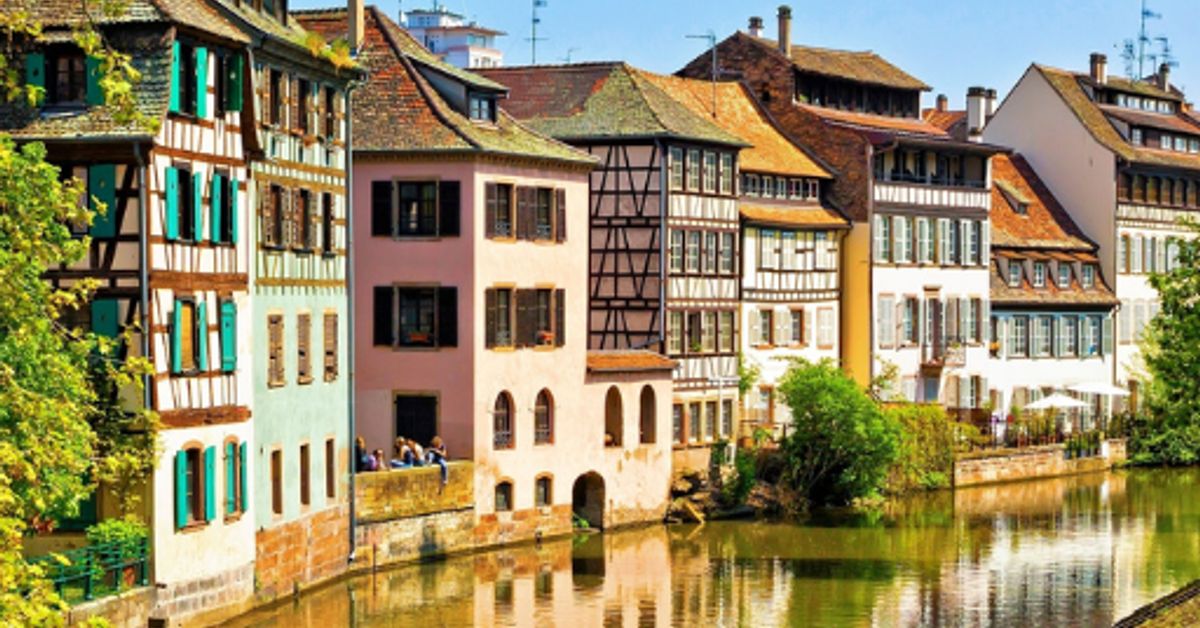
Strasbourg is the natural starting point. The capital of Alsace holds the Archives du Bas-Rhin, where civil records from 1792 onwards and earlier parish records are held. The city itself is one of Europe’s most beautiful, with its Gothic cathedral, the Petite-France canal district, and the distinctive colombage architecture that gives Alsace its visual identity. Walking through Petite-France feels like stepping into a painting — the half-timbered houses crowding the water’s edge look exactly as they did when your ancestors walked these streets.
Colmar is the archive hub for Haut-Rhin. The Archives du Haut-Rhin are based here, with substantial records available. The town’s canals and medieval streets earned it the nickname “the Venice of Alsace”.
Nancy anchors Lorraine heritage. The spectacular Place Stanislas — one of the finest baroque squares in Europe — was built by the Duke of Lorraine, and it reminds you that Lorraine was once an independent duchy with its own royal court.
If you plan a heritage trip to the region, the France trip planning hub has practical guidance on preparing your visit, including how to contact archives in advance. The dedicated Alsace Wine Route travel guide covers the specific towns and villages you will want to walk through if your family came from the Alsatian countryside.
Where to Research Your Alsace-Lorraine Family
The departmental archives of Alsace-Lorraine have digitised extensively. You can begin your research from home before ever booking a flight.
- Archives du Bas-Rhin (Strasbourg): archives.bas-rhin.fr — civil records from 1792, parish records from the 1600s onwards, military records
- Archives du Haut-Rhin (Colmar): archives.haut-rhin.fr — equivalent coverage for southern Alsace
- Archives de la Moselle (Lorraine): archives.moselle.fr — covers Metz and the Moselle department
- FamilySearch: Has digitised many Alsace-Lorraine civil and parish registers, available free online
- Cercle Généalogique d’Alsace: The regional genealogy society with publications, databases, and member support
- GenAmi: Specialised resource for Alsatian Jewish genealogy
One important point: because Alsace-Lorraine was under German administration from 1871 to 1918, some records from this period exist in German archives as well as French ones. FamilySearch has microfilmed many of these. If your family left before 1871, you will find their records entirely in French. If they left between 1871 and 1918, expect German-language records. Understanding this timeline is half the battle of Alsace-Lorraine genealogical research. The French surnames of Normandy guide and surnames of Brittany guide show how different the naming traditions are across France’s regions — Alsace-Lorraine is the most distinctive of all.
Frequently Asked Questions
Are Alsace-Lorraine surnames French or German?
Both — and the distinction is often less clear than it appears. Many surnames look German but belong to families who were French citizens for centuries. Others look French but were recorded in German during the period 1871–1918. Research the family’s history and location rather than assuming nationality from the surname’s appearance alone.
Why do some Alsatian surnames have different spellings in different records?
The change of government between 1871 and 1918 caused widespread variation in surname spelling. German administrators Germanised French names; French administrators after 1918 reversed this. Some families also chose to keep or change their spellings independently. Always search for multiple spelling variants when researching Alsace-Lorraine ancestry.
Where can I find Alsace-Lorraine genealogy records?
The departmental archives of Bas-Rhin (Strasbourg), Haut-Rhin (Colmar), and Moselle (Metz) all hold extensive records, many available online. FamilySearch has digitised a substantial portion of the civil and parish registers. The Cercle Généalogique d’Alsace is the specialist genealogy society for the region.
Did Alsatian families emigrate to North America?
Yes — in significant numbers. The German Coast of Louisiana was settled by Alsatian and Rhineland families in the 1720s. Alsatian emigrants also settled in Pennsylvania, Ohio, and Quebec. Many Alsatian-origin surnames were adapted to French or English sounds over time, making direct archive research necessary to confirm the connection.
What is the most common Alsatian surname?
Meyer (and its variants Mayer and Maier) ranks among the most common Alsatian surnames, alongside Müller, Schneider, Weber, and Martin. The most common surname in Lorraine, as across much of France, is Martin — a legacy of devotion to Saint Martin of Tours.
You Might Also Enjoy
- French Surnames of Normandy: Origins, Meanings and Family Heritage
- The Huguenots: France’s Great Exodus and Its Global Legacy
- How to Plan a French Heritage Trip to Your Ancestral Village
Plan Your France Trip
Ready to visit Alsace-Lorraine and walk the streets your ancestors knew? The France trip planning hub covers everything from choosing the right region to navigating the archives. Start there and let the journey begin.
Join 7,000+ France Lovers
Three times a week, get France’s hidden gems, seasonal guides, local stories, and the art of la vie française — straight to your inbox.
Subscribe free — enter your email:
Free forever · Unsubscribe anytime
🇫🇷 You Might Also Love
Tours & experiences you might love


Powered by Viator. Some links are affiliate links — we may earn a small commission at no extra cost to you.

Leave a Reply