
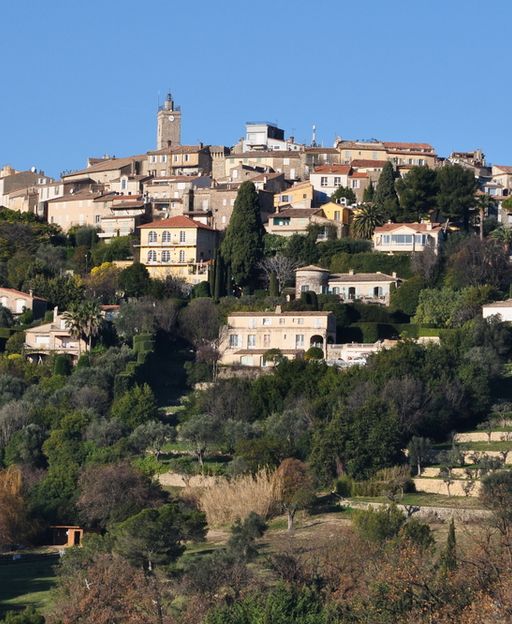
Pablo Picasso owned homes across France. He chose to end his life in Mougins — a small, perched village above Cannes where the morning light cuts through the olive trees and the stone lanes feel untouched by time.
He arrived in 1961 with his wife Jacqueline. He worked in Mougins every day until he died there in 1973, aged 91.
Who Was Picasso — and Why Mougins?
Picasso transformed 20th-century art across 70 active years. He co-created Cubism, produced Guernica, and completed more than 20,000 works in his lifetime. By 1961, no living artist came close to his fame.
He could have retired anywhere in the world. He chose a quiet hilltop village 15 minutes from Cannes.
Mougins sits on a rocky summit in the hills of the Alpes-Maritimes. Terraced olive groves cover the slopes below the old walls. Medieval towers rise above terracotta rooftops. On clear days, the Côte d’Azur glitters in the distance.
Picasso came for the light. He stayed for everything else.
The Paintings Nobody Expected
During his Mougins years, Picasso developed what critics later called his “dialogues with the masters.” He created hundreds of paintings in response to Velázquez, Rembrandt, and Manet — reworking their compositions in his own splintered, electric style. Many dismissed the work at first. Time proved them wrong.
His villa, Notre-Dame-de-Vie, still stands outside the village walls. Visitors cannot enter — it remains private property. The lane that passes the gate feels different from the rest of Mougins, quiet in a way that commands attention.
Picasso died there on 8 April 1973. He had worked until just weeks before the end.
What the Village Looks Like Today
Mougins has changed since the 1960s, but not dramatically. Narrow cobblestone lanes wind between honey-coloured stone houses. Bougainvillea climbs the walls. Artists and chefs moved in after Picasso made the village famous, and many still live here.
The Musée d’Art Classique de Mougins (MACM) houses one of France’s most surprising private collections — Greek, Roman, Egyptian, and Renaissance works displayed alongside 20th-century pieces. It costs €14 to enter and takes about two hours to explore properly.
Each September, Mougins hosts Les Étoiles de Mougins, a celebrated international food festival. Chefs from across Europe gather in the cobbled squares for three days of cooking, conversation, and street food.
Enjoying this? 7,000 France lovers get stories like this every week. Subscribe free →
Why Artists Have Always Come Here
Picasso was not the first artist to discover Mougins. Francis Picabia painted here. Man Ray spent summers in the nearby hills. The poet Jean Cocteau drove up regularly from Antibes.
The light attracted them all. Provence offers something distinct from Paris — sharp and almost fierce in summer, then warm and amber as autumn settles in. The shadows fall at unexpected angles. Painters describe it as a place where you see colour differently.
If you plan a trip through the South of France, Mougins pairs naturally with Grasse, Cannes, or Antibes. Our France travel planning guide covers the best way to build a Rivièra itinerary without the tourist crush. For context on how the coast evolved, The French Riviera Before Wealth Changed It Forever is worth reading before you go.
How to Visit Mougins
Mougins old village is walkable in about an hour. Park below the walls and climb the main gate on foot — the narrow lanes above are largely inaccessible to cars.
Several small galleries sell original work by local artists. The restaurant scene focuses on Provençal cuisine — expect lamb, tapenade, fresh herbs, and good local rosé.
The views from the ramparts reach inland across the hills and, on clear days, all the way to the sea.
What is there to see in Mougins, France?
The old village centres on its cobbled medieval streets, the 12th-century Chapel of Saint-Barthélemy, and the Musée d’Art Classique de Mougins (MACM). The village is best known for its connection to Picasso, who lived and worked here from 1961 until his death in 1973.
When is the best time to visit Mougins?
Late spring (May to June) and early autumn (September to October) offer the most pleasant conditions. Summer brings intense heat and heavy coast traffic. September hosts Les Étoiles de Mougins, an international food festival — an excellent reason to visit that month specifically.
How do you reach Mougins from Cannes or Nice?
Mougins sits about 8 kilometres north of Cannes — roughly a 15-minute drive. From Nice, expect 30 to 35 minutes by car. A local bus connects Cannes to Mougins regularly. Most visitors treat it as a half-day excursion and return to the coast by afternoon.
Did Picasso really live in Mougins?
Yes. Picasso moved to the village in 1961 with his wife Jacqueline and settled at a villa called Notre-Dame-de-Vie on the outskirts of the old village. He painted there daily for the next 12 years. He died on 8 April 1973, aged 91. The villa remains private and cannot be visited.
Mougins does not announce itself. There are no grand museums built around a single name, no roadside signs celebrating what happened here. The village simply goes on — market days, church bells, the smell of lavender and thyme drifting up from the valley.
Picasso chose this over Paris, over the sea, over every place that demands to be noticed. Spend a morning walking the old lanes and you start to understand why.
Join 7,000+ France Lovers
Three times a week, get France’s hidden gems, seasonal guides, local stories, and the art of la vie française — straight to your inbox.
Subscribe free — enter your email:
Free forever · Unsubscribe anytime
🇫🇷 You Might Also Love
Tours & experiences you might love


Powered by Viator. Some links are affiliate links — we may earn a small commission at no extra cost to you.

Leave a Reply