
In 841, Viking raiders sailed up the Seine and burned Jumièges Abbey to the ground. The monks fled. A thousand years of warfare, plague, and civil strife followed — and the abbey stood. It took a French revolutionary merchant in 1793 to nearly finish what the Vikings started.
Founded by a Saint, Attacked by Vikings
Saint Philibert founded Jumièges in 654 AD, in a wide bend of the Seine just 27 kilometres west of Rouen. For nearly two centuries, monks built it into one of the most powerful religious houses in Normandy.
Then the Vikings arrived. Raiders attacked in 841 and returned in 851. Each time, monks grabbed the relics of Saint Philibert and fled south by boat. The abbey stood empty for decades — scorched, abandoned, and stripped of its treasures.
William the Conqueror Came for the Opening
A monk named Robert Champart oversaw the rebuilding of Jumièges in the 1040s, and craftsmen raised two soaring towers above the nave — each climbing nearly 27 metres into the Norman sky. Workers completed one of the finest Romanesque church facades anywhere in Europe.
Word spread fast. Duke William of Normandy crossed the Seine to attend the consecration in person in 1067. Within a year, he launched his invasion of England and became William the Conqueror.
The abbey grew more powerful still. Royal visitors arrived across the next four centuries. In 1450, the royal mistress Agnès Sorel — the favourite companion of King Charles VII — died near Jumièges, and monks preserved her heart inside its walls.
The Revolution Found a New Use for the Stones
Enjoying this? 7,000 France lovers get stories like this every week.
Thinking about it seriously? If you’ve started actually planning a move, our complete our complete Moving to France guide walks through every step, every cost, and the paperwork that catches most people out.
In 1790, the French Revolution abolished religious orders across France. A community of Benedictine monks had called Jumièges home for over a thousand years — and then, almost overnight, they were gone.
Authorities confiscated the abbey and sold it at auction in 1793. A local merchant bought it outright with a clear plan: blast the building apart with gunpowder, extract the carved stone, and sell it cheaply for construction projects in Rouen.
Workers detonated the transept. They demolished the choir. Lead came off the roof by the cartload, and stonework left by the wagon.
Two Towers That Refused to Fall
The two massive west towers of the nave facade proved too solid to demolish cheaply. Blasting them down would have cost more than the stone fetched. The merchant stopped.
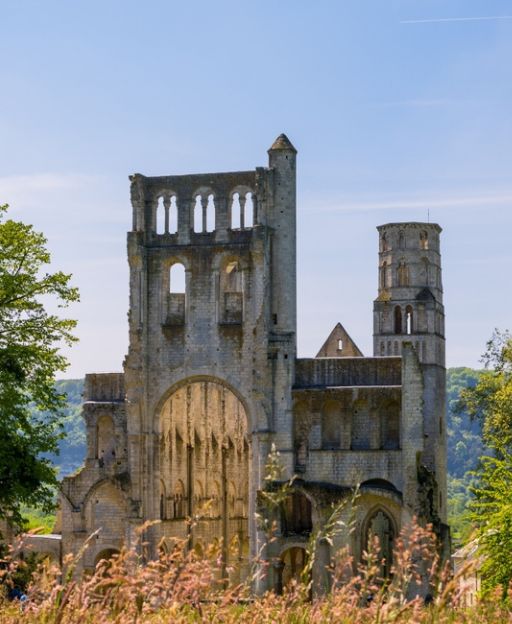
Those two towers — plus the shell of the nave walls and the smaller, older Saint-Pierre church beside them — survived the destruction.
A new owner, Alexandre Bertot, bought the property in 1853 and halted all further demolition. He cleared the rubble and opened the grounds to visitors.
The poet Victor Hugo had already visited in 1835, before the clearing. He wrote in his journal that the ruins were un magnifique cadavre — a magnificent corpse.
What You See at Jumièges Today
The two west towers dominate the site. They stand roofless but intact, rising above the Seine valley trees, visible from a distance as you approach along the river.
Between them, the tall arch of the nave stretches across empty sky. Where monks once chanted in a complete church for seven centuries, grass now grows between the stones.
The smaller Saint-Pierre church — older than the main abbey and partly intact — stands just beside it. The cloisters beyond hold a quiet garden where visitors often sit without speaking.
In summer, the Seine catches the evening light and the towers glow gold. Most visitors arrive without a plan to stay long and leave an hour later than they intended.
Plan your Normandy visit with our complete Normandy travel guide, or start with the France planning hub. For another Norman abbey with an equally dramatic story, read about Mont-Saint-Michel — the island fortress no army ever managed to take.
Is Jumièges Abbey worth visiting in Normandy?
Most visitors call it one of the most atmospheric ruins in France. The site combines dramatic medieval architecture with a quiet Seine valley setting. It draws far fewer crowds than larger Norman attractions like Mont-Saint-Michel.
How do you get to Jumièges from Rouen?
Jumièges sits 27 kilometres west of Rouen. Drivers take the D982 road along the south bank of the Seine. A small car ferry crosses the river at Duclair in summer. The journey takes around 35 minutes from Rouen city centre.
What is the best time of year to visit Jumièges Abbey?
Late spring and early autumn offer the best light and fewest visitors. The grounds open daily from April to October. Winter visits are possible but most of the site is unroofed and open air, so cold weather matters.
Can you combine Jumièges with other Normandy sites?
Yes — Jumièges sits on the Seine valley route between Rouen and the coast. Visitors often combine it with Rouen’s medieval cathedral, the Seine valley villages, or a full day driving the river loop by car.
Stand between those two towers long enough, and you stop wondering why the merchant could not bring himself to finish the job.
Join 7,000+ France Lovers
Three times a week, get France’s hidden gems, seasonal guides, local stories, and the art of la vie française — straight to your inbox.
Subscribe free — enter your email:
📲 Know someone who’d love this? Share on WhatsApp →
Love more? Join 65,000 Ireland lovers → · Join 43,000 Scotland lovers → · Join 29,000+ Italy lovers →
Free forever · Unsubscribe anytime
🇫🇷 You Might Also Love
Tours & experiences you might love


Powered by Viator. Some links are affiliate links — we may earn a small commission at no extra cost to you.

Leave a Reply