French surnames of Provence carry something you will not find in any other region of France. They hold the echo of a separate language, a separate culture, and a history that predates France itself. If your family tree points south — to lavender fields, Roman amphitheatres, and ancient port cities — this guide is for you.
Provence was not always France. For centuries, it existed as the County of Provence — an independent state with its own rulers, its own traditions, and its own language. That language was Occitan, the tongue of the troubadours, and it shaped surnames in ways that still set Provence apart today. Only in 1481 did Provence formally join the French kingdom. By then, the surnames were already fixed.
This guide explores 15 common Provençal surnames, their origins, their meanings, and where they travelled in the world. Whether you are researching your ancestry or simply curious about the south of France, these names open a door to one of Europe’s most remarkable regions.
What’s your name in French? 🇫🇷
Your French Name — type any first name for the French equivalent, with meaning and regional notes.
Why Provençal Surnames Sound Different
Walk through any village cemetery in Provence and you will notice something. The names on the graves do not sound quite like Paris. They have a warmth, a roundness, a southern rhythm that marks them as something apart.
This is the sound of Occitan. Provençal is a dialect of Occitan, the langue d’oc — the language of the south where “yes” was oc rather than the northern oïl. By the time France standardised surnames in the 16th century, most Provençal families already had names built from Occitan words, not French ones.
The influence runs deep. Latin from the Roman occupation (Provence was literally the first Roman province outside Italy — Provincia Romana). Germanic names from the Visigoths and Frankish settlers. Greek traces from the ancient Phocaean colonists who founded Marseille around 600 BC. All of these threads wove themselves into the surnames that families carry today.
If you carry a Provençal surname, you carry all of that history with you.
French Surnames of Provence: 15 Names and Their Meanings
1. Arnaud
Origin: Germanic — from arn (eagle) and wald (power or rule).
Meaning: Eagle power.
Notes: One of the most common surnames in Provence and throughout the south of France. The Arnaud family produced notable Huguenot intellectuals in the 17th century. Common variants include Arnau, Arnaudo, and Arnault. Widely found in Quebec, Louisiana, and the French Caribbean.
2. Blanc / Leblanc
Origin: Occitan and Old French — from blanc (white).
Meaning: White, or one with fair hair or a pale complexion.
Notes: A nickname surname that became hereditary across southern France. The form Leblanc (with the article) is more common in northern France; plain Blanc dominates in Provence and Languedoc. Hugely common in Quebec, where it became one of the most frequent French-Canadian surnames.
3. Bonnet
Origin: Old French and Occitan — from the personal name Bonet, derived from Latin bonus (good).
Meaning: Good, or the good one.
Notes: Also associated with the word for a type of hat or cap, suggesting an occupational link to hat-makers. Particularly strong in Provence, the Alps, and the Rhône Valley. The Swiss botanist Charles Bonnet (1720–1793) traced his roots to this region. Common in French-Canadian records.
4. Cabrol / Chabrol
Origin: Occitan — from cabra (goat), from Latin capra.
Meaning: Goat, or one who herded or resembled a goat.
Notes: A distinctly southern surname. You rarely find it north of Lyon. Goat herding was central to Provençal agriculture, and many families took the surname from the animals they tended. The variant Chabrol is associated with the French filmmaker Claude Chabrol. Found in Quebec and Louisiana as Cabrol.
5. Fabre / Favier
Origin: Latin — from faber (craftsman, blacksmith).
Meaning: Blacksmith or metalworker.
Notes: One of the most ancient occupational surnames in France. In Roman times, faber referred to any skilled craftsman working with hard materials. The naturalist Jean-Henri Fabre (1823–1915), famous for his studies of insects in Provence, bore this name. Widespread in Quebec and Louisiana as Fabre or Faber.
6. Imbert
Origin: Germanic — from Irmbert, combining irm (great, whole) and berht (bright, famous).
Meaning: Greatly renowned.
Notes: A Frankish name that took root in Provence after the Carolingian period. Common throughout the Rhône Valley and across southern France. Variants include Himbert and Humbert. Found scattered through French-Canadian baptismal registers from the 17th century onwards.
7. Laurent
Origin: Latin — from the Roman family name Laurentius, related to laurus (laurel).
Meaning: Crowned with laurel, or from the city of Laurentum.
Notes: Saint Lawrence (San Lorenzo) was one of the most venerated martyrs of early Christianity, and his name spread across Catholic Europe. In Provence, where Roman roots ran deepest, Laurent became one of the most enduring family names. Widespread in Quebec, New England, and Louisiana.
🇫🇷 Enjoying this? 7,000 France lovers get stories like this every week.
Thinking about it for retirement? If you’ve started thinking seriously about retiring there, our complete our full Retire in France guide covers the visa, healthcare, cost-of-living, and the regions worth shortlisting.
8. Martin
Origin: Latin — from Martinus, derived from Mars, the Roman god of war.
Meaning: Of Mars, or warrior.
Notes: One of the most common surnames in all of France and the French-speaking world. Saint Martin of Tours was beloved across medieval Europe, and his name spread with Christianity. In Provence, the cult of Saint Martin merged with older Roman traditions. Martin is the second most common surname in France today and enormously widespread in Quebec.
9. Pasquier / Pascal
Origin: Latin — from pascere (to graze, to pasture).
Meaning: Shepherd, or one who tends grazing land.
Notes: Pasquier referred to someone who lived near or managed pastureland. Pascal, the related given name turned surname, comes from Pascha (Easter) and often marked someone born at Easter time. Both are common across Provence, the Alps, and the Languedoc border. Blaise Pascal, the mathematician and philosopher, bore the Easter-origin form of this name.
10. Pons / Dupont
Origin: Latin — from pons (bridge).
Meaning: Bridge, or one who lives near a bridge.
Notes: Bridges were central to medieval life. The man who lived beside the bridge, or who operated the toll, often became known as Pons or Pont. The Pont du Gard, the Roman aqueduct in Provence, gave this name added weight in the region. Dupont (of the bridge) became one of the most iconic French surnames worldwide. Extremely common in Quebec.
11. Roux / Leroux
Origin: Latin — from russus (red), via Occitan ros.
Meaning: Red-haired, or ruddy-complexioned.
Notes: A nickname surname that stuck. In Occitan-speaking Provence, ros or roux described someone with red or auburn hair — a distinctive enough feature to become a family identifier. The form Leroux (with the article) is more common in northern France. Common across Quebec, Louisiana, and the French Caribbean.
12. Sicard / Sicart
Origin: Germanic — from sig (victory) and hard (brave, hardy).
Meaning: Brave in victory.
Notes: A distinctly southern French surname, strongly associated with Provence and Languedoc. The Sicard family appears in medieval charters across the region from the 11th century. The variant Sicart is more common in rural Provence. The name suggests Visigothic or Frankish ancestry — Germanic peoples who settled the south after the fall of Rome. Found in Quebec and Louisiana records.
13. Achard
Origin: Germanic — from Agihard, combining agi (edge of a sword) and hard (brave).
Meaning: Hard as a sword’s edge, or brave warrior.
Notes: A Frankish name that established itself firmly across Provence during the medieval period. Not common outside the south of France, which makes it a reliable regional marker. If you carry the name Achard, your ancestry almost certainly traces to Provence or the broader Occitan south. Rare but present in Quebec and Louisiana colonial records.
14. Besson
Origin: Occitan — from besson (twin), from Latin bis (twice).
Meaning: Twin.
Notes: Besson is one of the most distinctly Provençal surnames you can find. The word for twin in Occitan became a surname — possibly for a man who was himself a twin, or perhaps for a family known for producing twins. It is common in the Var, Vaucluse, and Alpes-de-Haute-Provence departments. The filmmaker Luc Besson traces his roots to this name. Present in Quebec records.
15. Barral / Barralon
Origin: Occitan — from barral (barrel or cask), from Late Latin barra.
Meaning: Barrel-maker, or one who made or sold barrels.
Notes: Wine and olive oil drove the economy of Provence for two thousand years. The men who made the containers for those products — the coopers and barrel-makers — often took their trade as a surname. Barral and Barralon are strongly regional names. They mark families rooted in the wine country of the Vaucluse, the Var, and the Bouches-du-Rhône. Uncommon outside the south of France.
The Occitan Language and Its Role in Shaping These Surnames
You cannot understand Provençal surnames without understanding Occitan. For centuries, the people of southern France spoke a different language from those in the north. Occitan was the tongue of the troubadours — the poets and musicians who invented courtly love in the 12th century. Kings and lords across Europe imitated their style. Eleanor of Aquitaine, one of the most powerful women of the medieval world, grew up speaking it.
When the Catholic Church launched the Albigensian Crusade against the Cathars of nearby Languedoc in 1209, it dealt a blow not just to a religious movement but to Occitan culture itself. The crusade brought northern French nobles south. It shifted power. Northern French began to replace Occitan in official documents.
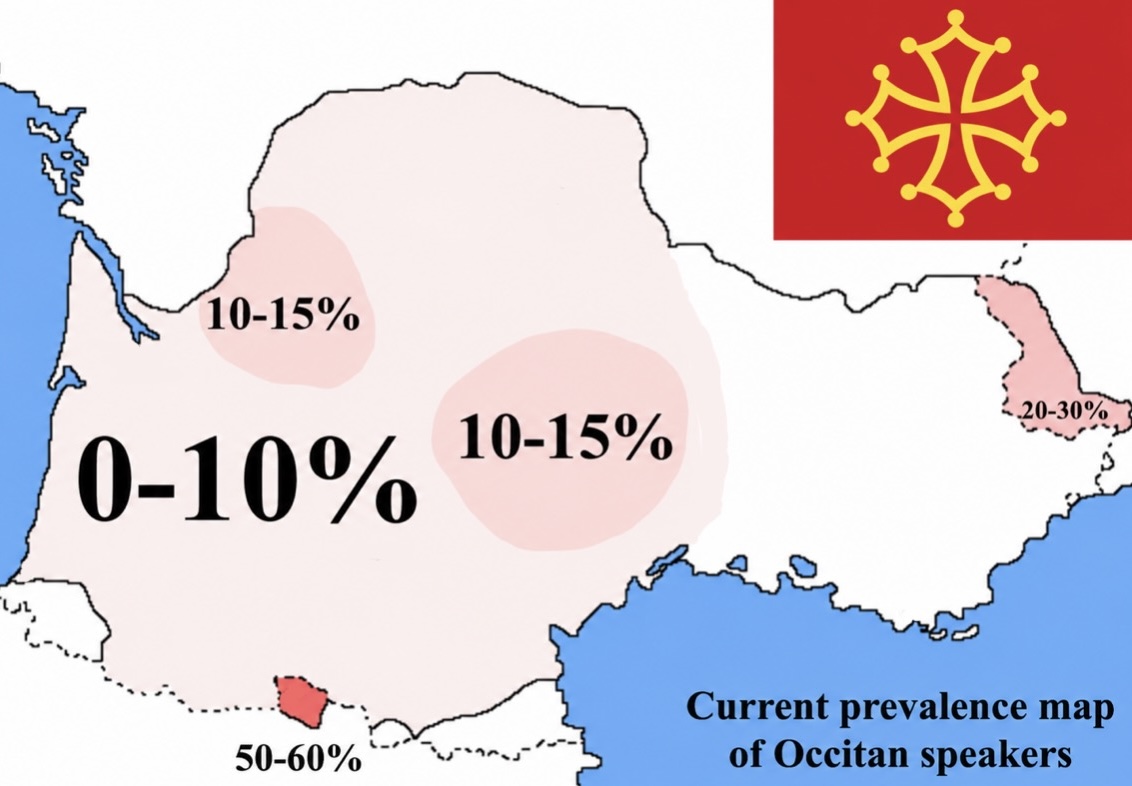
But surnames were stubborn. Families kept their Occitan names through the centuries. The language itself survived in rural areas until well into the 20th century. Today, millions of people in southern France still speak a form of it — and millions more carry its echo in their surnames.
If your surname sounds like Occitan rather than standard French, that is evidence of ancestry rooted deep in the south. It is one of the most personal connections you can have to this region’s history.
Where Provençal Families Settled Around the World
Provence sent its people across the globe. Understanding where Provençal surnames appear today helps you trace your own family’s story.
Quebec and French Canada
The great wave of French colonisation in the 17th century drew settlers from across France — including many from Provence and the Rhône Valley. Names like Arnaud, Blanc, Laurent, Roux, and Pons appear in Quebec parish records from the 1600s onwards. If your French-Canadian family carries one of these names, the trail likely leads back to the Provençal south.
Our guide to tracing your French ancestry covers the records and archives that can help you find the specific commune your family came from.
Louisiana and the French Caribbean
Louisiana received French settlers from multiple regions, including a significant contingent from the south. The colony of Saint-Domingue (modern Haiti) attracted Provençal merchants and planters through Marseille’s port trade. Names like Fabre, Martin, Besson, and Sicard appear in Louisiana colonial records and in Haitian heritage records.
The Huguenot exodus also touched Provence deeply. When Louis XIV revoked the Edict of Nantes in 1685, thousands of Protestant families fled France. Many Provençal Huguenots went to the Netherlands, South Africa, England, and Ireland. Our article on the Huguenots and their global legacy explores this story in detail.
South Africa
South Africa has a uniquely strong French-Huguenot heritage. The Cape Winelands area, centred on Franschhoek (literally “French Corner” in Dutch), was settled by Huguenot refugees from the 1680s. Many came from Provence and Languedoc. Surnames like Arnaud (anglicised to Arnold), Fabre, Laurent, and Roux survived in the Cape through generations of intermarriage with Dutch settlers. If you have an Afrikaans surname that sounds faintly French, Provence may be your ancestral home.
Where to Research Provençal Ancestry in France
If you are planning a heritage journey to Provence, these are the archives and locations that hold your family’s records.
Archives Départementales des Bouches-du-Rhône (Marseille)
The central archive for the Bouches-du-Rhône department, which includes Marseille, Aix-en-Provence, and Arles. Parish registers (before 1792) and civil records (after 1792) are held here. Many records are digitised and available online at archives13.fr. This is your first stop for Marseille and Aix family research.
Archives Départementales du Vaucluse (Avignon)
Avignon was the seat of the Papacy from 1309 to 1377. The volume and quality of medieval records here is extraordinary. The Vaucluse archives hold records for families from Avignon, Carpentras, Orange, and the surrounding villages. The city of Avignon itself has some of the best-preserved medieval urban records in France.
Archives Départementales du Var (Toulon)
For families from the eastern Provençal coast — Toulon, Draguignan, Saint-Raphaël — the Var archives are your destination. The department also holds records for many rural hill villages that sent emigrants to the Caribbean and Louisiana in the colonial era.
Sénanque Abbey and the Luberon Villages
Sénanque Abbey, a 12th-century Cistercian monastery surrounded by lavender fields near Gordes, was a centre of record-keeping and rural life in medieval Provence. While its active archives have moved to departmental repositories, visiting the abbey gives you a profound sense of the world your ancestors lived in. The Luberon villages — Gordes, Bonnieux, Lacoste, Ménerbes — preserve medieval street plans and church records that connect you directly to the past.
Read our full guide to planning a French heritage trip to your ancestral village for practical advice on visiting archives, finding church records, and making the most of your time in Provence.
Spelling Variants: Why Your Provençal Surname Looks Different
One thing confuses many family researchers: their surname looks nothing like the French original. There are several reasons for this.
Clerks and phonetics. When French settlers arrived in Quebec or Louisiana, colonial administrators wrote down what they heard. An Occitan accent sounds different from a Parisian one. A clerk who spoke northern French would transcribe an Occitan surname according to his own phonetic instincts. This produced variants that look quite different on paper but sound similar when spoken aloud.
Anglicisation. Families who moved to British colonies, or who lived in mixed French-English communities in Canada, often anglicised their names. Arnaud became Arnold. Blanc became White or Blanke. Laurent became Lawrence. Fabre became Faber or even Smith (the translation of the blacksmith meaning).
Local spelling traditions. Even within Provence itself, surnames varied by village. The letter final “d” was often silent or dropped in some communes. The “x” at the end of words is an Occitan convention that puzzles non-speakers. If you find a spelling variant, check whether it could represent the same name written in a different local tradition.
Our guide to the French surnames of Alsace-Lorraine explores a similar pattern — a region with its own language that shaped surnames in distinctive ways.
Frequently Asked Questions
What makes Provençal surnames different from French surnames in the north?
Provençal surnames were shaped by Occitan, the language of the south, rather than the Old French of Paris. This gives them a distinct sound and character — more Latin and Mediterranean, less Frankish and Germanic than northern French names. Many Provençal surnames also retain Occitan spelling conventions, such as the final “x” or the use of “ou” where northern French uses “eu”.
How do I find records for my Provençal ancestors?
Start with the Archives Départementales of the relevant department — Bouches-du-Rhône for Marseille and Aix-en-Provence, Vaucluse for Avignon and the northern Luberon, Var for Toulon and the coastal east. Many archives have digitised their holdings and offer free online access. FamilySearch also holds significant French civil records. For pre-1792 records, you will need to search the digitised parish registers (registres paroissiaux).
Did Provençal families emigrate to Canada?
Yes. Families from Provence and the wider Occitan south are well represented in Quebec colonial records from the 17th and 18th centuries. Names like Arnaud, Blanc, Laurent, Fabre, and Martin appear regularly. Many French-Canadian families with these surnames can trace their origins to the south of France. Parish records in Quebec are well-preserved and many are available through the Bibliothèque et Archives nationales du Québec (BAnQ).
Why do some Provençal surnames appear in South Africa?
After Louis XIV revoked the Edict of Nantes in 1685, thousands of Huguenot refugees fled France. A significant number came from Provence and Languedoc. Many of these families settled at the Cape Colony, brought there by the Dutch East India Company (VOC). They established vineyards in what is now the Franschhoek Valley. Their surnames — often Provençal in origin — survive in South African family trees to this day, sometimes anglicised or Afrikaanised over the centuries.
Which archives in Provence are available online?
The Archives Départementales des Bouches-du-Rhône (archives13.fr) has digitised much of its collection, including parish registers and civil records. The Archives Départementales du Vaucluse (archives.vaucluse.fr) also has an online portal. FamilySearch holds a large collection of digitised French records, including many from Provençal departments. For the Var, check archives.var.fr. All are free to access.
You Might Also Enjoy
- French Surnames of Normandy: Origins, Meanings and Family Heritage — explore the Norman surnames carried by millions in Canada and the Americas.
- French Surnames of Brittany: Origins, Meanings and Family Heritage — Celtic and Breton names with roots stretching back before France itself.
- The Lavender Harvest in Provence That Most Tourists Never Get to See — the heart of Provence, seen through the eyes of those who belong there.
Plan Your France Trip
Ready to visit the land your ancestors called home? Our complete planning hub covers everything you need — from choosing the right region to finding your family’s village. Start here: planning your trip to France →
Join 7,000+ France Lovers
Three times a week, get France’s hidden gems, seasonal guides, local stories, and the art of la vie française — straight to your inbox.
Subscribe free — enter your email:
🇫🇷 Tracing Your French Ancestry?
Get our free step-by-step guide to French genealogy research — from departmental archives to parish records. Plus join 7,000+ France lovers for weekly stories.
Get the Free Ancestry Guide →Love more? Join 65,000 Ireland lovers → · Join 43,000 Scotland lovers → · Join 30,000 Italy lovers →
Free forever · Unsubscribe anytime
🇫🇷 You Might Also Love
Tours & experiences you might love


Powered by Viator. Some links are affiliate links — we may earn a small commission at no extra cost to you.

Leave a Reply