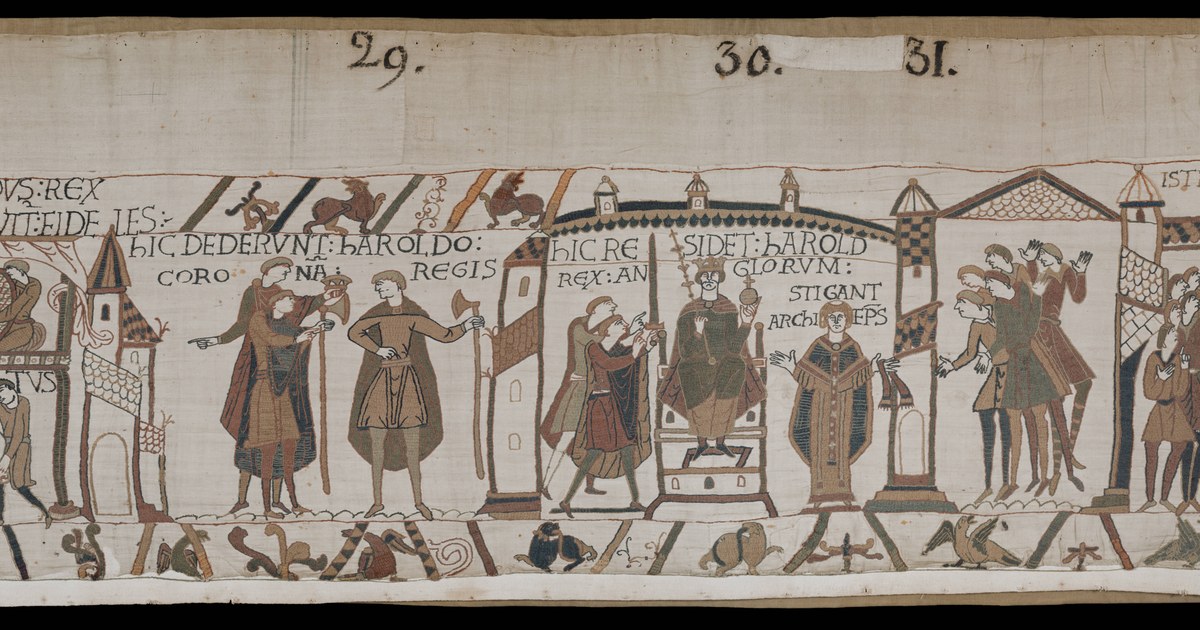
The Bayeux Tapestry is a strip of linen about 70 metres long. It tells the story of 1066 in thread. A Norman duke wins the English crown, and the cloth shows how.
Strictly, it is not a tapestry at all. Embroiderers stitched it. They did not weave it. The name stuck anyway. Nearly a thousand years on, it still draws visitors to the Normandy town of Bayeux.
What the Bayeux Tapestry Is
The cloth is about 70 metres long and half a metre tall. Nine linen panels are sewn into one long strip. Wool thread in several colours makes the pictures.
Two stitches do most of the work. A stem stitch draws the outlines. A laid and couched stitch fills the large areas. The result looks like a medieval comic strip.
The strip shows more than 600 people. It shows almost 200 horses, plus dozens of ships and buildings. Latin captions run along the top. They name people and places and explain each scene.
Narrow borders run above and below the main story. Some show animals and scraps of fable. Others show soldiers, the dead and the wounded. In places the borders comment on the scene above.
Who Made It and Why
Nobody signed the cloth. Historians still debate who ordered it. Most point to Odo, Bishop of Bayeux. Odo was the half-brother of Duke William.
Odo appears in the story himself. He carries a club and rallies the young soldiers at Hastings. A patron who put himself in the picture is easy to imagine.
Many historians link the work to Bayeux Cathedral. The cathedral was consecrated in 1077. William of Normandy took part in the ceremony. The cloth may have hung in the nave that day.
Where did the work happen? Most historians think English embroiderers made it, probably in Kent. English needlework was famous across Europe at the time. Odo held great lands in Kent after the conquest. So a Norman bishop used English hands to tell a Norman victory.
The Story the Tapestry Tells
The tale starts before the invasion. Edward the Confessor, king of England, sends Harold Godwinson across the Channel. Harold lands on the French coast. A local count seizes him, and William wins his release.
Next comes a campaign in Brittany. Harold rides with William’s army against Conan of Brittany. On the way, the army passes Mont Saint-Michel. The cloth shows Harold pulling soldiers from quicksand. You can still see the abbey on its rock in our Mont Saint-Michel guide.
Then comes the key scene. Harold swears an oath on holy relics. Norman sources said he promised William the crown. Back in England, Edward dies and Harold takes the throne.
A comet blazes across the sky next. The caption says the men marvel at the star. Historians link it to Halley’s Comet, which shone in the spring of 1066.
William builds a fleet and sails. The cloth shows trees felled, ships built and horses loaded. Then comes the Battle of Hastings on 14 October 1066. Horsemen charge a wall of shields. Arrows fly. A caption tells us Harold is killed.
The cloth ends abruptly. Its last scene shows English soldiers in flight. Most historians think a final panel is lost. It may have shown William’s coronation.
🇫🇷 Enjoying this? 7,000 France lovers get stories like this every week. Subscribe free →
Details to Look For in the Cloth
Look for the comet in the upper border. Look for the ships, which are among the most graceful shapes on the cloth. Look for the fallen soldiers in the lower border at Hastings.
A few ordinary men carry a label. Turold and Wadard are named in the scenes. We know little about them. Yet they are rare faces of the common soldier and household.
Look for the arrow. One figure is struck in the eye. Another falls beneath a horseman’s sword. Historians still debate which one is Harold.
Look at the faces, too. The English wear moustaches. The Normans have shaved necks. That small detail helps you tell the two sides apart.
How the Tapestry Survived
The first firm record dates from 1476. An inventory of Bayeux Cathedral lists the cloth. It hung in the nave once a year, for the feast of the relics.
Then came the French Revolution. In 1792, soldiers wanted to use the cloth to cover a wagon. A local lawyer stepped in and saved it.
Napoleon took an interest in 1803. He put the cloth on show in Paris. He hoped to inspire a new invasion of England. The plan never happened, and the cloth went home to Bayeux.
A strip of linen this old should not exist. Yet it came through fire, war and neglect. That is part of its power.
A Tapestry for Norman Family Roots
The tapestry matters for family history too. After 1066, Norman nobles took English land. Norman-French names spread across England and stayed for centuries.
If your family name has Norman roots, this may be where its story starts. William’s army also held men from Brittany, Flanders and Picardy. Our guide to The Normans Who Changed the World tells the wider story. Our guide on how to trace your French ancestry shows how to search the records.
The story reaches far beyond 1066. Henry II, the first Plantagenet king, was William’s great-grandson. He lies at Fontevraud Abbey. Later, the kings of England and France fought for centuries. We cover that in our Hundred Years’ War article.
Visiting Bayeux
The cloth is kept in Bayeux. The town sits a short drive from the D-Day beaches. Display arrangements can change. Check the official museum website before you plan. It lists opening details and tickets. The Bayeux tourist office also helps.
Bayeux itself is worth a day. Its old centre has medieval lanes and timber-framed houses. Allied troops freed the town on 7 June 1944, the day after D-Day. Its old centre came through largely unharmed.
The cathedral is a short walk from the museum. Its towers and carved stone make a fine second stop. Our guide to Gothic cathedrals of France gives useful context.
Pair Bayeux with Caen, where William is buried. Add Falaise, his birthplace. Our Normandy travel guide covers the whole region. If your trip is about family, see how to plan a French heritage trip.
Bayeux Tapestry FAQ
Is the Bayeux Tapestry a real tapestry?
No. It is an embroidery. Artists stitched wool thread onto linen instead of weaving the pattern.
How long is the Bayeux Tapestry?
It is about 70 metres long and about half a metre tall. Nine linen panels are sewn together to make the strip.
Who made the Bayeux Tapestry?
Nobody knows for sure. Most historians think English embroiderers made it for Bishop Odo of Bayeux.
Does the Bayeux Tapestry show the death of Harold?
It shows a scene with the caption “Here King Harold is killed”. Historians still debate which figure is Harold.
Where can I see the Bayeux Tapestry?
It is kept in Bayeux, in Normandy. Check the museum’s official website for display details before you go.
You Might Also Enjoy
Plan Your France Trip
Ready to turn history into a trip? Our planning hub, Start Here: Planning Your Trip to France, brings the key guides together in one place.
Join 7,000+ France Lovers
Every week, get France’s hidden gems, seasonal guides, local stories, and the art of la vie française — straight to your inbox.
Subscribe free — enter your email:
Free forever · One email per week · Unsubscribe anytime
Tours & experiences you might love

Powered by Viator. Some links are affiliate links — we may earn a small commission at no extra cost to you.

Leave a Reply