
Moissac abbey holds one of the finest cloisters in Europe. It stands in a small brick town in Tarn-et-Garonne, in south-west France.
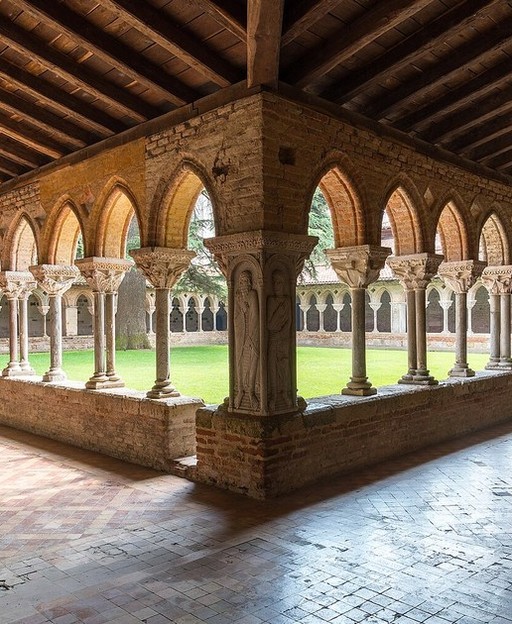
Walk in and the garden court opens up around you. Pairs of slim columns hold up a ring of arches. Each column ends in a carved capital. Together they form a picture book in stone, cut about 900 years ago.
Most visitors drive past on the way to Toulouse or Bordeaux. That is a shame. Moissac gives you the Romanesque age at its most vivid. It asks for no more than a short stop.
A Monastery on the Pilgrim Road
Monks have lived at Moissac for well over a thousand years. The early story is hazy, but the abbey was well established by the 7th century. It stood beside the Tarn river, on a route used by traders and travellers.
Later, pilgrims joined them. Moissac sits on the road that leads to Santiago de Compostela in Spain. The GR65 walking path still passes through town today. Walkers arrive with backpacks and scallop shells, just as their medieval forebears once did.
If this world interests you, you may know Conques abbey and the basilica of Vézelay. Both are pilgrim stops too. Moissac completes the picture in the south-west.
How Cluny Made Moissac Rich
The abbey’s great leap came in 1047. That year, Moissac joined Cluny, the most powerful monastic order in Europe. The man behind the move was Abbot Durand de Bredons.
Durand was also bishop of Toulouse. He had energy, connections and ambition. Under his rule, Moissac gained wealth and new recruits. It won a firm place in the Cluny network.
Money meant building. Around 1100 the monks finished the cloister we see today. An inscription in the stone records the date. It also names the abbot who led the work, Abbot Ansquitil.
A carved figure of Durand stands on one of the corner pillars. It shows him in a calm, upright pose. Few monastic leaders of that age were shown so clearly.
The Cloister: A Bible in Stone
A cloister is a square walkway around a garden. Monks walked it to pray, read and think. At Moissac, the walkway is a work of art.
The arches rest on columns of stone and marble. Some are single and some are paired. Between them stand heavy corner and middle pillars. Many of those carry figures of apostles.
The capitals are the real treasure. There are about 76 of them. Many show scenes from the Bible and the lives of saints. Others show lions, birds, monsters and bold leaf patterns.
Look closely and you will find small stories. A figure bends under a burden. A beast gapes. A saint steps forward with a calm face.
The cloister is built mostly of warm red brick. That is the building style of Toulouse and its region. Brick keeps the court soft and glowing in the afternoon light. It also sets it apart from the grey stone cloisters of the north.
Take your time here. Walk the full square. Then do it again, and look up at the capitals from a new angle. The details are small, so slow steps pay off.
🇫🇷 Enjoying this? France lovers get stories like this every week. Subscribe free →
The South Portal: Christ in Majesty
Step outside the cloister and turn to the abbey church. Its south portal was carved around 1130. Many historians rank it among the great works of Romanesque sculpture.
The top section, called the tympanum, shows a vision from the Book of Revelation. Christ sits on a throne at the centre. He is huge, and he looks calm. Four winged creatures stand around him.
Below him sit 24 crowned elders. They turn their heads to look up at him. Each one holds an instrument or a cup. The crowd of faces gives the scene a sense of movement and awe.
The central post is as famous as the scene above. Pairs of lions cross their bodies in a striking pattern. A thin prophet figure stands on the side of the post. His body twists in a graceful, almost dancing, line.
If you have seen the Last Judgement at Conques, you will spot the link. Both portals use stone to teach. Few people could read in the Middle Ages. Carved scenes did the job of a sermon.
Other panels at the portal show warnings. One shows the rich man who ignored the poor beggar Lazarus. Another shows the sin of lust. The message was plain, and the carvers made it unforgettable.
Why Heritage Travellers Should Stop Here
Moissac is a story about people as much as buildings. Monks, masons, pilgrims and merchants all left a mark. Many French families trace their roots to towns along the Tarn and Garonne rivers. If yours does, a stop here shows you the world they knew.
The abbey also fits well into a wider tour of Romanesque France. Pair it with Saint-Savin abbey and its painted ceilings, or with the quiet Cistercian valley of Fontenay. Each shows a different side of the same medieval age.
Music joined stone in this part of France too. The region gave birth to the troubadours, who sang of love in the language of the south. The same courts and abbeys shaped both arts.
Planning Your Visit to Moissac
Moissac lies about an hour from Toulouse. It sits on the Bordeaux to Toulouse rail line, so you can arrive by train. By car, the town is an easy stop on a road trip through the south-west.
Allow at least two hours for the cloister, the church and the portal. Add more time if you want to stroll along the river and the canal. Both run close to the old town.
The town is also known for Chasselas de Moissac, a sweet table grape with a protected name. Look for it at local markets in the grape season.
For current opening times, prices and guided tours, check the official Moissac tourist office website. Plans change, so confirm before you travel.
Not sure where to base yourself? Our France trip planning hub will help you build a route that fits your time and budget.
Moissac Abbey: Your Questions Answered
What is Moissac abbey famous for?
It is famous for its Romanesque cloister, finished around 1100, and its carved south portal. Both are among the best examples of medieval stone sculpture in France.
Where is Moissac abbey?
It is in the town of Moissac, in the Tarn-et-Garonne area of south-west France. The town lies on the Tarn river, about an hour from Toulouse.
How long should I spend at Moissac?
Plan for two to three hours. That gives you time for the cloister, the church and the south portal. Add extra time to explore the town and river.
Is Moissac on the Camino de Santiago?
Yes. Moissac is on a route that pilgrims use on their way to Santiago de Compostela. The GR65 walking path passes through the town.
You Might Also Enjoy
- Cluny Abbey: The Burgundy Monastery That Shaped Medieval Europe
- Conques Abbey: The Pilgrim Village With a Medieval Last Judgement
- Vézelay: The Hilltop Basilica at the Start of the Pilgrim Road
Plan Your France Trip
Ready to build your route? Start with our Start Here: Planning Your Trip to France guide for tips on regions, timing and getting around.
Join the France Lovers
Every week, get France’s hidden gems, seasonal guides, local stories, and the art of la vie française — straight to your inbox.
Subscribe free — enter your email:
Free forever · One email per week · Unsubscribe anytime
Tours & experiences you might love


Powered by Viator. Some links are affiliate links — we may earn a small commission at no extra cost to you.

Leave a Reply