
Rome was not always the heart of the Catholic Church. For seven decades, the Pope lived in Avignon. Cardinals, ambassadors, and merchants from across Europe came here instead. The city they built to house them still stands, largely unchanged, behind walls that have not fallen since the 14th century.
How Avignon Became the Centre of Everything
In 1309, Pope Clement V made a decision that changed European history. He moved the papacy from Rome to Avignon — a city on the banks of the Rhône in what is now Provence.
Nobody expected this to last. It lasted 67 years.
Seven popes ruled in succession from Avignon. The city transformed almost overnight from a modest river town into one of the most important cities in the Christian world. Ambassadors arrived from England, Germany, Portugal, and Byzantium. Merchants followed. The population exploded.
French king Philip IV pressured Clement V to leave Rome. The reasons were political — Italian feuds, papal debt, and a French pope who felt safer on familiar ground. Whether Clement made the right choice, historians still debate. What he left behind leaves no room for argument.
The Palace That Shows You What Real Power Looks Like
The Palace of the Popes dominates Avignon’s skyline the way Notre-Dame dominates Paris. Builders constructed it in two phases between 1335 and 1364, joining two separate palace complexes into a single enormous building.
It is the largest Gothic building in the world.
Not the largest church. Not the largest palace in France. The largest Gothic building anywhere. Its towers rise 50 metres. Its fortified walls are visible from the vineyards outside the city. Walking through its halls, you understand immediately how much authority Avignon once held.
The Grand Tinel dining hall seated 600 guests. The Pope’s private chapel contains frescoes from the 1340s — painted when the palace was new, and surviving intact to this day. The French Revolution stripped many rooms of their furnishings, and a later military garrison left its mark. But what the walls alone communicate needs no decoration.
Enjoying this? 7,000 France lovers get stories like this every week.
Thinking about it seriously? If you’ve started actually planning a move, our complete our complete Moving to France guide walks through every step, every cost, and the paperwork that catches most people out.
The Bridge That France Never Stopped Singing About
Ask any French child to name a famous bridge and they will sing: “Sur le pont d’Avignon, l’on y danse, l’on y danse…” The song is centuries old. The bridge it celebrates is broken.
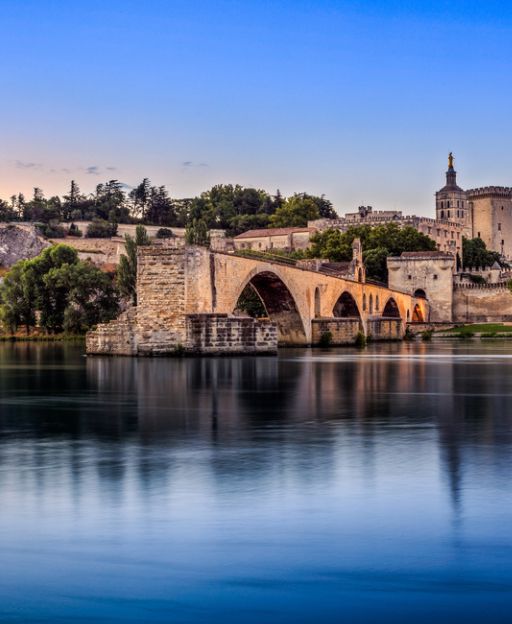
Pont Saint-Bénézet once stretched 900 metres across the Rhône. Builders completed all 22 arches in the 12th century. Floods and neglect destroyed them section by section over the centuries that followed. Today, four arches remain — jutting into the river and stopping abruptly at mid-water.
Medieval legend attributes the bridge to a shepherd boy named Bénézet. According to the story, Bénézet received a divine command to build a crossing across the Rhône. The bishop in Avignon dismissed him. Bénézet then lifted a stone that thirty men could not move and carried it to the riverbank. Construction followed.
Standing on the surviving arches today, you look out at the wide Rhône and the green banks of Villeneuve-lès-Avignon on the far side. The missing arches aren’t there, but you can picture exactly where they once stood. The water moves slowly beneath your feet.
What to See When You Visit Avignon
Avignon still surrounds itself with its original 14th-century walls — 4.3 kilometres of stone fortification encircling the entire old city. Builders finished the walls in the 1360s. The historic centre remains compact and entirely walkable.
Inside the walls: the Palace of the Popes, the Rocher des Doms hilltop garden above the Rhône, the Pont Saint-Bénézet, and a network of squares with cafés, brasseries, and the twice-weekly market on Place Pie.
The Festival d’Avignon runs every July — France’s most important performing arts festival, founded in 1947. During those three weeks, every courtyard, theatre, and public square fills with productions. Book accommodation many months ahead if you plan to visit in July.
Avignon also works beautifully as a base for the surrounding region. The Provence travel guide covers the wider area in depth. And the hilltop villages of the Luberon — 30 minutes east by car — make an excellent day trip from the city. Before planning any trip to France, the France trip planning guide covers everything from when to go to how to get around.
Is Avignon worth visiting?
Yes. Avignon offers one of the most rewarding historical experiences in France. The Palace of the Popes is extraordinary in scale and atmosphere. The walled old town is compact and walkable. Even a single day leaves a lasting impression.
How long do you need in Avignon?
One full day covers the Palace of the Popes, the bridge, and the historic centre comfortably. Two days allow a slower pace and time for the Rocher des Doms gardens and an evening in the city. Three days or more suits travellers who want to use Avignon as a base for the Luberon and wider Provence.
Can you walk on the Pont d’Avignon?
Yes. The surviving four arches open to visitors daily. You walk out over the Rhône and reach the point where the bridge ends abruptly at mid-river. The view back towards the Palace of the Popes from the bridge is one of the finest in the city.
When is the best time to visit Avignon?
Spring (April to June) and autumn (September to October) offer the most comfortable weather and fewer crowds. July brings the Festival d’Avignon — wonderful, but busy. August is hot and heavily visited. Winter is mild and quiet, with the city largely returned to locals.
Avignon rewards those who arrive without expectations. The walls that once enclosed the most powerful court in Christendom now enclose a city that moves at a Provençal pace. The urgent messages have long since gone. What remains are the stones, the Rhône, and four arches of a bridge reaching towards water that never stays still.
Join 7,000+ France Lovers
Three times a week, get France’s hidden gems, seasonal guides, local stories, and the art of la vie française — straight to your inbox.
Subscribe free — enter your email:
📲 Know someone who’d love this? Share on WhatsApp →
Love more? Join 65,000 Ireland lovers → · Join 43,000 Scotland lovers → · Join 29,000+ Italy lovers →
Free forever · Unsubscribe anytime
Frequently Asked Questions
When and how long did the papal seat remain in Avignon?
The Pope moved to Avignon in 1309, and the papal seat remained there for 67 years with seven successive popes ruling from the city before returning to Rome. This period transformed Avignon from a modest river town into one of the most important cities in the Christian world.
Why did Pope Clement V move the papacy to Avignon?
Pope Clement V was pressured by the French king Philip IV to move the papal seat due to Italian feuds, papal debt, and as a French pope he felt safer on familiar French ground. Though intended as a temporary move, the decision shaped European politics for the next seven decades.
What is the Palace of the Popes?
The Palace of the Popes is the largest Gothic building in the world, constructed between 1335 and 1364 by merging two palace complexes. With towers rising 50 meters and fortified walls visible from surrounding vineyards, it dominates Avignon's skyline the way Notre-Dame dominates Paris.
What are the main things to see in the Palace of the Popes?
The palace features the Grand Tinel dining hall, which seated 600 guests, and the Pope's private chapel with 1340s frescoes that have survived intact to the present day. The city walls have stood unchanged since the 14th century, offering a direct view into medieval European power and governance.
🇫🇷 You Might Also Love
Tours & experiences you might love


Powered by Viator. Some links are affiliate links — we may earn a small commission at no extra cost to you.

Leave a Reply