Ask anyone in Saint-Jean-de-Luz if they are French and they will pause before answering. Not out of uncertainty — but because the question feels slightly off. Here, in the far south-western corner of France, people have been calling themselves Basque for longer than France has existed as a nation.
A Language That Nobody Can Explain
Euskara — the Basque language — is one of the great mysteries of European linguistics. It has no known relatives anywhere in the world. No Latin roots. No Germanic branches. Linguists have spent centuries trying to connect it to other languages and failed every time.
In the French Basque Country, you see it everywhere. Shop names, street signs, festival posters. Children learn it alongside French in school. In some villages, it is the language people reach for first.
That stubbornness tells you a great deal about this place.
The Architecture Announces Itself
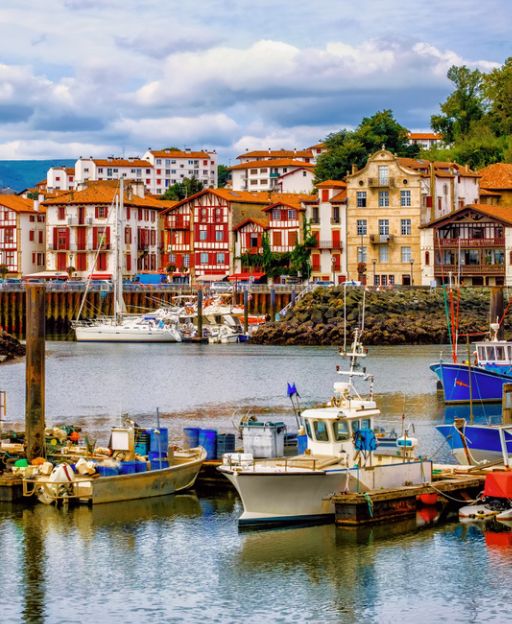
Before you understand the culture, the houses do the explaining. The traditional Basque farmhouse — the etxea — is unmistakable: white walls, heavy timber frames, and shutters painted in a deep russet red. The roofline is broad and low. The whole structure feels anchored to the earth.
In Saint-Jean-de-Luz and Bayonne, rows of these buildings line the harbour and the old town streets. This looks nothing like Normandy, nothing like Alsace, nothing like Provence. It looks entirely like itself.
A Food Culture With Its Own Rules
Basque cooking is internationally recognised as one of the great regional cuisines of Europe — and it knows it. San Sebastián, just across the Spanish border, has more Michelin stars per capita than almost anywhere on earth. The French side does not trail far behind.
The signature flavour is the piment d’Espelette — a mild, aromatic red pepper dried and ground in the village of Espelette, just 15 minutes inland. It goes on eggs, fish, lamb, and cheese. Once you taste food seasoned with it, you understand why it has its own protected designation of origin.
Pintxos — small pieces of bread topped with anchovies, ham, or prawn — have crossed from Spain and are now standard in Bayonne bars. You eat them standing, glass in hand, from roughly 6pm onwards.
Enjoying this? 7,000 France lovers get stories like this every week. Subscribe free →
Three Towns, Three Characters
The French Basque Coast runs for roughly 30 kilometres. Within that small stretch, three towns each tell a different part of the story.
Bayonne is the capital — medieval, slightly austere, famous for its Gothic cathedral and for jambon de Bayonne, a cured ham made here since the Middle Ages. The old town is all narrow arcaded streets and river views.
Biarritz was reinvented in the 19th century when Napoleon III and Empress Eugénie chose it as their summer retreat. British aristocrats and Russian royalty followed. Today it is a surf town. Atlantic waves roll in year-round, and the beach is never empty.
Saint-Jean-de-Luz is the one visitors tend to fall hardest for. A working fishing port with a curved harbour, a 17th-century church where Louis XIV married the Spanish Infanta, and fish-on-the-quayside freshness that makes every lunch feel like a ceremony.
Something Older Than Borders
The French-Spanish border here is almost theoretical. Families cross it to visit cousins. Basque sports — pelota, played against a wall with bare hands or a small racket — happen on both sides. Festivals run across both countries without pause.
The Basque flag — the ikurrina, in green, white, and red — flies from balconies in French towns. It is not a political statement. It is simply an identity that has always been there, running deeper than any line drawn on a map.
If you are planning a trip to south-west France, do not drive through. Stop, and give yourself at least three days. The France trip planning guide can help you build the right itinerary, whether this is your first visit or your fifth.
This is the corner of France that does not perform for you. It simply exists on its own terms — and for many visitors, that is exactly why they keep coming back.
Join 7,000+ France Lovers
Three times a week, get France’s hidden gems, seasonal guides, local stories, and the art of la vie française — straight to your inbox.
Subscribe free — enter your email:
Free forever · Unsubscribe anytime
🇫🇷 You Might Also Love
Tours & experiences you might love


Powered by Viator. Some links are affiliate links — we may earn a small commission at no extra cost to you.

Leave a Reply