
There is a canal in the south of France that changed the country forever. It is 240 kilometres long. It passes through 91 locks, 55 aqueducts, and crosses the watershed between two seas. And it was built by a man who spent everything he had to make it happen — then died six months before the first barge sailed through.
Why the South of France Needed a Canal
In the 1600s, merchants moving goods between the Atlantic and the Mediterranean had two choices. They could load their ships and sail all the way around the Iberian Peninsula — a voyage of weeks through rough and often dangerous water. Or they could unload everything, carry it overland across southern France, and reload it again at the other end.
Neither option was cheap. Neither was fast. For a country as proud of its trade as France, this was a problem that had gone unsolved for centuries.
A tax collector from Béziers believed he had the answer.
The Tax Collector With an Obsession
Pierre-Paul Riquet collected salt taxes for the French Crown — a respectable job, but not an obviously heroic one. He was already in his fifties when the idea took hold. He began studying the landscape of Languedoc, tracking rivers, measuring gradients, working out where the water would come from.
His plan was to build a canal cutting straight across the south of France — from the River Garonne near Toulouse to the Mediterranean coast at Sète. This would allow ships to cross the country without leaving the water.
In 1662, he sent his proposal to Louis XIV’s finance minister, Colbert. Four years later, with royal approval granted, construction began.
The Engineering Problem Nobody Had Solved
To connect two seas, Riquet had to overcome a problem that had stopped engineers for centuries. The canal would need to cross the high ground dividing the Atlantic and Mediterranean drainage basins. Water flows downhill. Getting it to flow in two directions from a single high point seemed impossible.
His solution was the Saint-Ferréol reservoir, completed in 1672. At the time, it was the largest dam in Europe. It gathered rainwater from the Black Mountains and fed it into the summit of the canal, allowing the water to flow east towards the Mediterranean and west towards the Atlantic — simultaneously.
The project employed 12,000 workers. Men and women, digging, hauling stone, and building lock chambers across 240 kilometres of southern France. It took fourteen years. If you are planning to explore this part of France, our complete guide to planning your trip to France covers everything you need to know before you go.
Enjoying this? 7,000 France lovers get stories like this every week. Subscribe free →
The Price He Paid
The royal subsidies were never quite enough. Riquet covered the shortfall himself — year after year, drawing on his own savings, selling land, borrowing money, pledging his children’s inheritance to keep the workers paid and the stone moving.
He died in October 1680. The Canal du Midi officially opened the following May. He never saw a single barge pass through.
His children inherited both the canal and the debt. The French Crown eventually compensated the family, but Riquet himself never knew whether his gamble had paid off.
What the Canal Looks Like Today
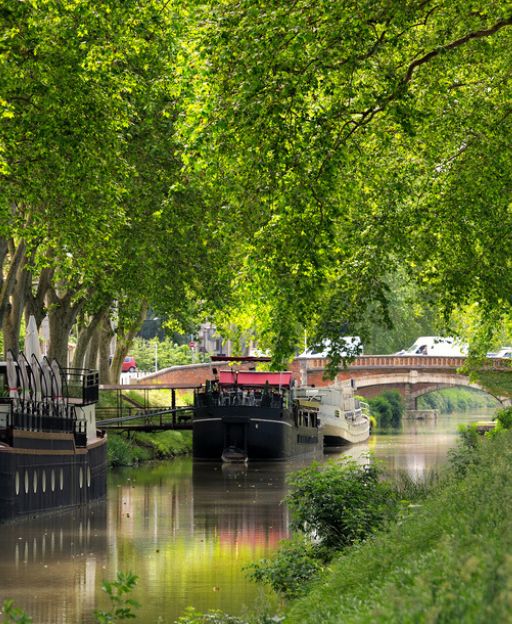
Walk any section of the Canal du Midi today and it feels remarkably unchanged. Hundreds of old plane trees line both banks, their branches arching overhead to form long green tunnels. Lock houses — small, pale-shuttered, their gardens spilling over old stone — sit quietly at the water’s edge.
In summer, the canal fills with slow-moving rental barges. Families drift through Languedoc at the pace of a walking horse, stopping at market towns for wine, cheese, and bread. The lock-keepers still open and close the gates by hand, just as they always have.
UNESCO added the Canal du Midi to its World Heritage list in 1996. The whole route from Toulouse to the sea passes through some of the most quietly beautiful countryside in France — through vineyards, village squares, and the southern corner of France where the culture shifts towards something altogether different. The eastern stretch reaches the edges of Provence, where the landscape opens out and the light changes entirely.
A Canal Built by Belief
Most of history’s great projects were built by empires, armies, or kings with unlimited treasuries. The Canal du Midi was built by one man who was certain the thing could be done, and who kept going even when the money ran low.
He never got to sail through it. But 344 years later, you can rent a barge and do exactly that — drifting through the same landscape, through the same locks, along the same water that Riquet imagined on a piece of paper in Béziers in the 1650s.
Some things are worth the wait.
Join 7,000+ France Lovers
Three times a week, get France’s hidden gems, seasonal guides, local stories, and the art of la vie française — straight to your inbox.
Subscribe free — enter your email:
🇫🇷 Discover the France Most Tourists Never Find
Get our free guide to 25 hidden villages of France — then join 7,000+ readers for weekly stories about places most guidebooks never mention.
Get Your Free Village Guide →Free forever · Unsubscribe anytime
🇫🇷 You Might Also Love
Tours & experiences you might love


Powered by Viator. Some links are affiliate links — we may earn a small commission at no extra cost to you.

Leave a Reply