
Most visitors to France plan Paris, Provence, or the Loire Valley. Very few ever look at the map of central France and ask why those rolling green hills look so perfectly round.
The answer is simple: they are volcanoes. Eighty of them. And they last erupted just 7,000 years ago.
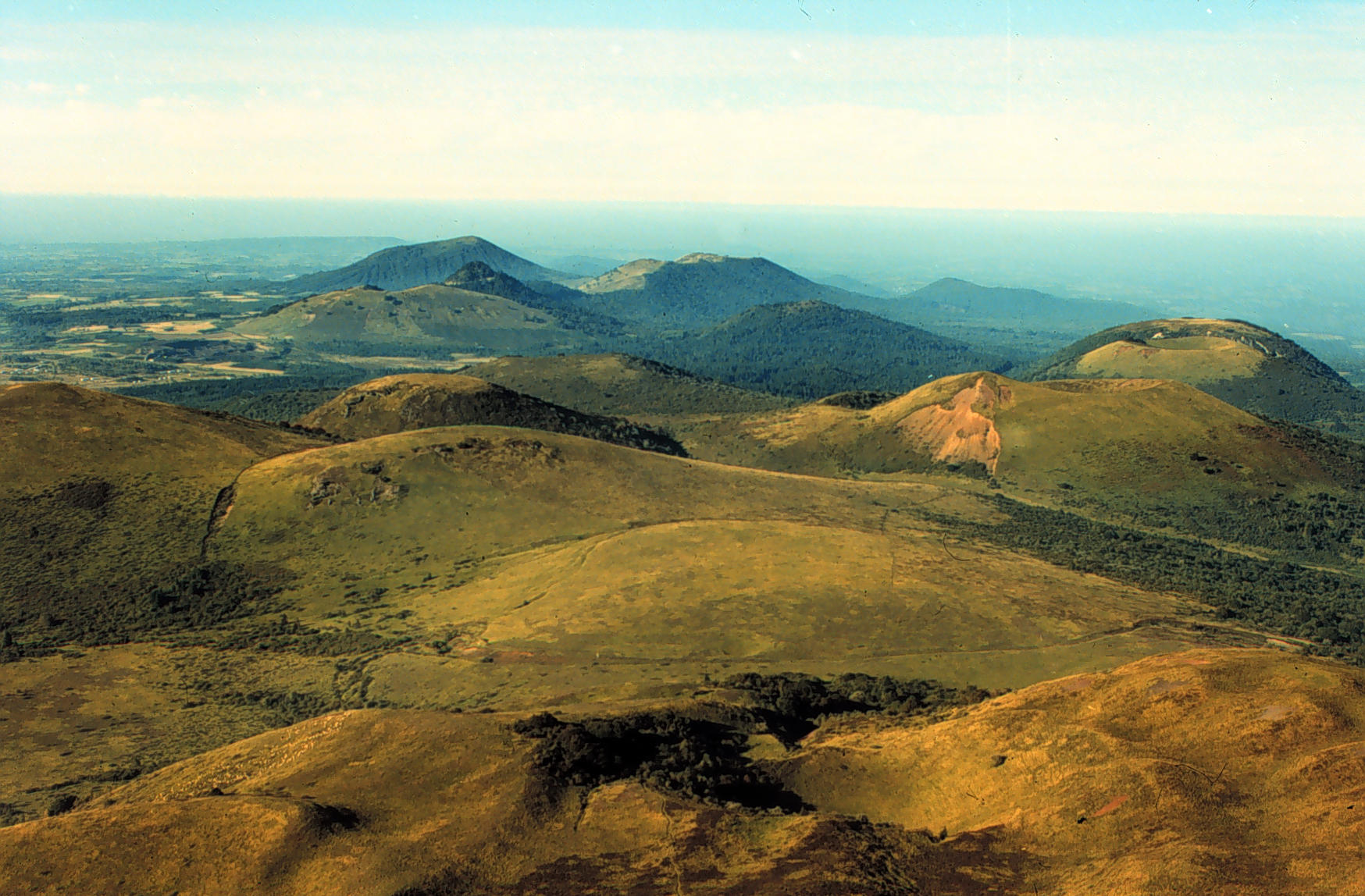
A Landscape That Should Not Exist
The Auvergne region sits in the heart of France, about three hours south of Paris by train. Most people drive straight through it on the way to the Riviera.
What they miss is extraordinary.
A chain of 80 dormant volcanoes stretches across the landscape like green mounds pressed up from below. The French call them puys — from the old Occitan word for mountain peak. Seen from above, they line up in a near-perfect row stretching 40 kilometres north to south.
In 2018, UNESCO added the Chaîne des Puys to its World Heritage List, describing it as “one of the most remarkable volcanic landscapes in Europe.” Most of the French already knew.
The Summit Every French Schoolchild Knows
The highest puy is Puy de Dôme. At 1,465 metres, it rises above a flat plateau like a perfectly shaped dome — which is exactly what it is.
On a clear day, you can see Mont Blanc from the summit. On summer evenings, the horizon turns deep orange and the other puys cast long shadows across the valley floor.
A rack railway — the Panoramique des Dômes — runs to the top along the route of an ancient Roman road. At the summit stand the ruins of a Roman temple dedicated to Mercury. Two thousand years ago, Gallo-Roman pilgrims climbed this same mountain to leave their offerings.
The view they saw was not much different from the one you would see today.
The Villages That Grew from Volcanic Stone
Below the chain of volcanoes, a string of small villages has grown up over centuries. They are built almost entirely from dark volcanic rock — black walls, black churches, black fountains.
Orcival has a Romanesque basilica that draws pilgrims every May. Murol has a medieval castle perched on a volcanic mound. Thiers, higher up, was once France’s knife-making capital, its workshops powered by mountain streams.
These villages look like nowhere else in France. The stone is wrong. The colour is wrong. Everything feels older and stranger than it should.
That strangeness is the point.
🇫🇷 Discover the France Most Tourists Never Find
Get our free guide to 25 hidden villages of France — then join 7,000+ readers for weekly stories about places most guidebooks never mention.
Get Your Free Village Guide →Where Caesar Lost a Battle — and Tried to Forget
The Auvergne is not just volcanic. It is one of France’s oldest inhabited regions.
Near Clermont-Ferrand, the plateau of Gergovie is where the Gallic warrior Vercingetorix defeated Julius Caesar in 52 BC. It was one of Caesar’s only military defeats. The Gauls celebrated for weeks.
A year later, Caesar returned. Vercingetorix surrendered at Alésia, was taken to Rome, and executed after six years of imprisonment.
Gergovie is now a quiet hilltop with a few information panels and a sweeping view across the Auvergne plains. On most days, you will be alone there. Two thousand years of history, and no queue for the car park.
Why So Few Visitors Come Here
The Auvergne has one problem: it does not look dramatic enough for a postcard.
The volcanoes are too old and too worn to look dangerous. The stone villages are too dark and quiet to fill an Instagram feed built around lavender and sunflowers.
This is exactly why the French love it.
The region is one of the most popular holiday destinations for French families. They come for the clean air, the hiking trails, the thermal spa towns, and the cheese — Cantal and Saint-Nectaire both come from here, and both are exceptional.
They also come because it is France in an older, slower form. No crowds. No coach trips. Just 80 dormant volcanoes going green in the morning light.
How to Get There
The best base is Clermont-Ferrand, a city built almost entirely from black volcanic stone — including the cathedral. It is roughly three hours from Paris by TGV and has direct trains from Lyon and Marseille.
The Panoramique des Dômes rack railway runs to the top of Puy de Dôme from spring to autumn. The summit walk takes around 45 minutes if you prefer to climb.
If you are building a broader itinerary, our complete France trip-planning guide covers everything from transport to the best regional bases. And if you enjoy discovering less obvious corners of the country, the Burgundy travel guide is another region that rewards those who take the slow route.
Join 7,000+ France Lovers
Three times a week, get France’s hidden gems, seasonal guides, local stories, and the art of la vie française — straight to your inbox.
Subscribe free — enter your email:
Free forever · · Unsubscribe anytime
Stand on Puy de Dôme as the mist rolls in off the plains below, and you begin to understand why the Romans built a temple here. Some places carry weight. This is one of them.
🇫🇷 You Might Also Love
Tours & experiences you might love


Powered by Viator. Some links are affiliate links — we may earn a small commission at no extra cost to you.

Leave a Reply