Your great-grandparent’s name was Dupont, Delacroix, or Vandenberghe. You grew up hearing that your family “came from France.” But which part of France? And why does your surname sound so different from names in Provence or Brittany?
Northern France is unlike the rest of the country. The Hauts-de-France region — covering Nord, Pas-de-Calais, Somme, Aisne, and Oise — sat at the crossroads of Europe for a thousand years. Flemish traders, Spanish rulers, French kings, and British armies all left their mark. You can still see that history in the surnames that came from this land.
A surname from French Flanders tells a story. It may speak of a Flemish weaver’s trade, a village on the flat northern plain, or a family that survived centuries of changing rulers and kept their name through it all. This guide walks you through the most common surnames of Flanders and northern France, their meanings, and what they reveal about the people who carried them.
What’s your name in French? 🇫🇷
Your French Name — type any first name for the French equivalent, with meaning and regional notes.
A Region Where Languages Crossed
Northern France sits on the border between the Romance and Germanic worlds. For centuries, people here spoke two languages: French to the south and west, and Flemish — a dialect of Dutch — to the north and east.
The city of Lille was once part of the County of Flanders. Flanders itself changed hands many times. It was French, then Flemish-speaking, then under Spanish rule for 150 years, and finally French again after 1668. That complex history shows up clearly in the region’s surnames.
The roots of this complexity go even deeper. The Franks — the Germanic tribe who gave France its name — originally ruled this northern territory. When their empire split, the region became a border zone. That border identity never fully left. Many northern French families carry names that look French but have Flemish roots. Others carry purely French names shaped by the region’s flat geography, textile towns, and trading routes.
🇫🇷 Free Guide: How to Trace Your French Ancestry
Step-by-step: Archives Departementales, etat civil records, parish registers, Acadian roots, DNA testing, and planning a heritage trip to France. Completely free.
Get the Free Guide →
Subscribe free at the guide page to receive weekly France stories
Flemish-Origin Surnames in Northern France
The most distinctive surnames from this region carry clear Flemish roots. Flemish was widely spoken in what is now the French Nord department until the early 20th century. Some villages near Hazebrouck and Bailleul still have elderly speakers today.
Vandenberghe / Vandenbergh — From the Flemish “van den berghe,” meaning “from the hill.” This is one of the most common surnames in both Belgian Flanders and French Flanders. Families with this name lived near a hill — a notable feature on the otherwise flat coastal plain. You will find it spelt Vandenberghe, Vandenbergh, or Van den Berg in older documents.
Desmet / De Smet — From “de smid,” meaning “the blacksmith.” Smiths were needed in every medieval town. Families named Desmet appear in Nord department records from the 14th century onwards. The same family may be listed as Desmet in French documents and as De Smet in Flemish ones.
Declercq / Leclercq — From “de klerk,” meaning “the clerk.” Clerks held key posts in churches, courts, and trading houses. The name crosses into French as Leclercq. You will find both spellings in the same family records, depending on which language the official used.
Dehennin — A surname common in French Flanders, most likely from a medieval personal name, Hennin or Henin. This type of surname is rare outside Nord and Pas-de-Calais, which makes it a useful marker for ancestry research.
Vandermeersch — From “van der meersch,” meaning “from the marsh.” The low-lying land around Dunkerque and the coastal plain was marshy for centuries. Families who lived near these wetlands took the landscape as their name.
Destailleur — From “de tailleur,” meaning “the tailor.” Tailors were respected craftsmen in the textile towns of the north. The “De” prefix here shows the Flemish habit of adding a French article to a trade-based name.
Surnames Born from the Northern Textile Trade
The north of France built its wealth on wool and linen. Towns like Arras, Douai, and Cambrai were famous across medieval Europe for their cloth. This textile economy created dozens of trade-based surnames that are still common in the region today.
Lefebvre / Lefevre — One of the most common surnames in all of France, but especially concentrated in the north. It means “the blacksmith” in Old French, from “faber.” The spelling Lefebvre is a northern form. In the south, the same name often appears as Lefevre or Favre.
Tisserant / Tisserand — From the Old French for “weaver.” In the textile towns of Cambrai and Arras, weaving families took this as their fixed name. Cambrai linen was so famous that the English word “cambric” for fine white linen cloth comes directly from the city’s name.
Boulanger — The baker. Every village had one. The name Boulanger is especially common in the north because of the region’s strong wheat-farming tradition. Families named Boulanger ran the flour mills and bakehouses that fed the great cities of the north.
Deschamps — From “des champs,” meaning “of the fields.” Northern France is farming land — flat, rich, and crossed by rivers. It produced wheat for the mills and hops for the breweries. Families who worked the open fields often took this name.
Delannoy — A distinctive northern name meaning “from the walnut grove” (noyer = walnut tree). You will find Delannoy families clustered in the Nord and Pas-de-Calais departments. It is rare elsewhere in France, which makes it easy to trace to this region.
Place-Based Surnames of the Northern Plain
Many northern French surnames came from the landscape — from rivers, villages, or geographic features. The north has its own set of place names and landscape words that gave rise to family names found nowhere else in France.
Delacourt — From “de la court,” meaning “from the courtyard” or “from the manor.” Families who worked in or lived near a lord’s manor took this name.
Beaumont — This name means “beautiful hill.” Several towns in the Hauts-de-France region carry the name Beaumont. Families who came from one of these places took it as their surname.
Delacroix — “From the cross.” In medieval France, stone crosses marked crossroads, village boundaries, and churchyards. Families who lived near one took this name. The painter Eugene Delacroix carried it, though his family came from a different region.
Dupont — “From the bridge.” One of the most common surnames in France and especially in the north. Rivers and canals cross the flat northern landscape, and almost every town has a bridge. Families who lived near one became Dupont.
Delalande — From “de la lande,” meaning “from the heath” or “from the open land.” The term “lande” describes uncultivated moorland. Several areas in Pas-de-Calais were known for their heathland before drainage and farming changed the landscape.
The 15 Most Common Surnames of French Flanders
Here are the surnames you will most often find in records from the Nord and Pas-de-Calais departments:
- Dupont — From the bridge. The single most common northern French surname.
- Leroy — “The king.” Often given to a servant of the king or someone who acted in a lordly manner.
- Lefebvre — The blacksmith. Old French, concentrated in the north.
- Leclercq / Declercq — The clerk. French and Flemish forms of the same name.
- Delacroix — From the cross. Common across the northern plain.
- Deschamps — From the fields.
- Vandenberghe — From the hill. Flemish origin, found across French Flanders.
- Desmet — The blacksmith, in Flemish. A direct parallel to Lefebvre.
- Boulanger — The baker.
- Delannoy — From the walnut grove. A name that marks a family as northern French.
- Vandermeersch — From the marsh. Coastal Flanders.
- Beaumont — From the beautiful hill.
- Dehennin — Personal name origin. Unique to French Flanders.
- Destailleur — The tailor. Flemish-influenced form.
- Delalande — From the heath or open land.
Where Northern French Families Emigrated
If your family came from northern France, they likely emigrated in one of three major waves.
The Huguenot exodus (1685): When Louis XIV cancelled the Edict of Nantes and banned Protestantism, thousands of Huguenots fled France. Many came from the north and went to England, the Dutch Republic, Prussia, and South Africa. If your name is Duplessis, Lefroy, or Duval, you may have Huguenot roots from this region.
The French-Canadian migration (1600s to 1700s): Many families from northern France sailed for New France — Quebec and Acadia. Their records are well preserved. If your Quebec or Acadian ancestor has a northern French surname, the family likely came from Normandy, Brittany, or the Hauts-de-France. Our article on French-Canadian Surnames traces these connections in full.
The Louisiana connection: French settlers in Louisiana came mostly from Normandy and the north. Surnames like Dupont, Leroy, and Boulanger appear in both French Flanders records and early Louisiana parish registers. The same name may appear in both New Orleans and Lille records, written by different hands across different centuries.
For a deeper look at how northern French surnames spread across the Atlantic, see The Normans Who Changed the World — a story that starts just west of Flanders and ends on three continents.
🇫🇷 Enjoying this? 7,000 France lovers get stories like this every week. Subscribe free →
How to Research a Surname from French Flanders
Tracing a northern French surname is different from searching in other parts of France. Three things matter most.
Records exist in both French and Flemish. A family named Desmet in 1860 may appear as De Smet in records from 1740 and as Lefebvre in records from 1780. These can all refer to the same smithing family, written in different languages by different officials. Search both spellings every time.
The main archives are in Lille. The Archives Departementales du Nord hold records for the Nord department (department number 59). They are among the best-preserved archives in France. Many records are free to search online at the AD59 digital archive. The Archives du Pas-de-Calais (department 62) are held near Arras and also have a strong online collection.
For records before 1792, search parish registers. Civil registration began in France in 1792. Before that date, the Catholic Church kept births, marriages, and deaths. FamilySearch has digitised a large collection of northern French parish records. They are indexed, which makes searching by surname much faster.
Our complete guide to tracing French ancestry walks through each of these archives step by step. It covers the etat civil, parish registers, emigration records, and how to plan a research trip to France.
Visiting French Flanders Today
French Flanders rewards the visitor who looks past the surface. Most tourists pass through on their way south. The region has its own character — brick buildings, belfry towers, and a culture that sits somewhere between France and Belgium.
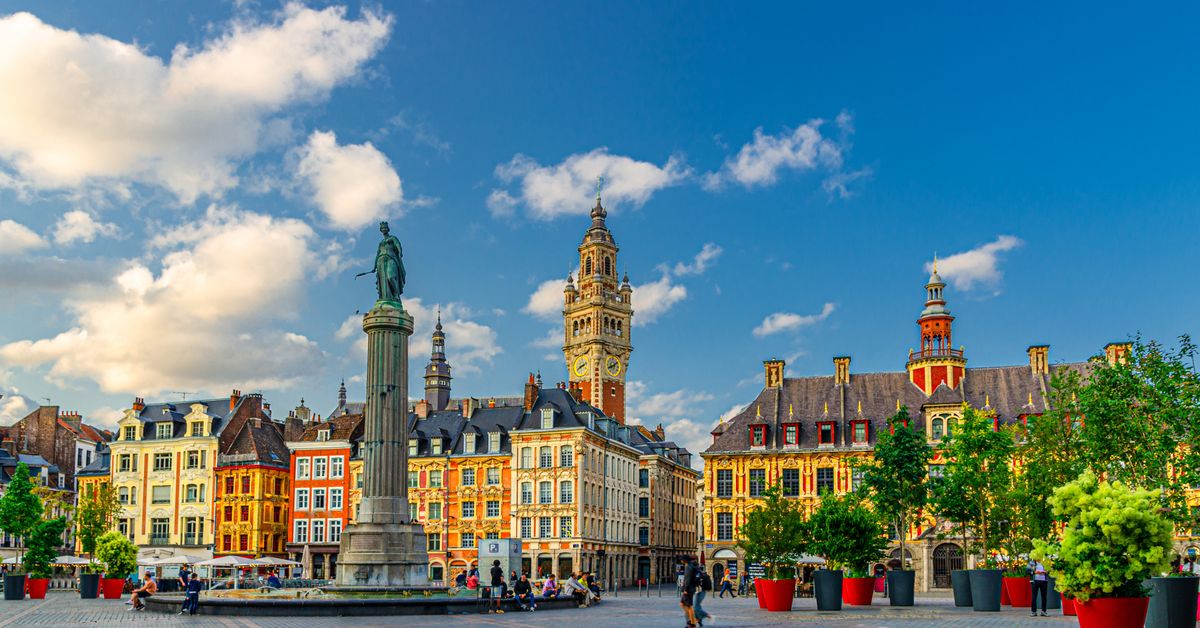
Lille is the capital of French Flanders and one of France’s most vibrant cities. La Grand Place — shown at the top of this article — is lined with Flemish Baroque buildings from the 17th century. The old town (Vieux-Lille) has narrow streets, covered markets, and some of the finest architecture in northern France. If your family name appears in Nord department records, the Archives Departementales are a 20-minute walk from the city centre.
Bergues is a small town near Dunkerque with a medieval belfry and intact ramparts. It became well-known after the 2008 film “Bienvenue chez les Ch’tis” (Welcome to the Sticks), which captured the warmth of northern French culture. The local dialect, Chti, still carries Flemish words in its vocabulary.
Bailleul sits on the Belgian border and has one of the most Flemish appearances of any town in France. The town hall is a near-perfect example of Flemish Renaissance architecture. Bailleul holds a famous carnival each spring with roots in centuries-old Flemish tradition.
Cassel is a hilltop town overlooking the flat Flemish plain. On a clear day you can see three countries from its summit. The town has strong Flemish heritage and sits above the area where many families with surnames like Vandermeersch and Dehennin appear in old records.
If you know the specific commune your family came from, contact the mairie (town hall) directly. Many local archives hold records going back to the 17th century that are not yet online. You might also explore French Surnames of Champagne — the neighbouring region to the south, where many northern families also appear in records after migrating inland.
Frequently Asked Questions
What are the most common surnames in French Flanders?
The most common surnames in French Flanders include Dupont, Leroy, Lefebvre, Leclercq, and Vandenberghe. These names reflect the region’s mix of French and Flemish heritage. Dupont (from the bridge) is found all across northern France, while Vandenberghe is specific to the French-speaking areas of old Flanders.
What does the “Van” or “De” prefix mean in a northern French surname?
The “Van” prefix comes from Flemish and means “from” — as in Vandenberghe (from the hill) or Vandermeersch (from the marsh). The “De” or “Des” prefix is French for “of” or “from.” Many northern French surnames combine both traditions, depending on whether the family used Flemish or French in daily life.
How do I find records for a family from the Nord or Pas-de-Calais departments?
The main archive is the Archives Departementales du Nord in Lille. Many records are free to search online at the AD59 digital archive. The Archives du Pas-de-Calais are held near Arras. FamilySearch also has a large collection of northern French parish records, indexed and searchable by surname and commune.
Did families from northern France emigrate to Canada or the United States?
Yes. Many families from the Hauts-de-France region emigrated to New France (Quebec and Acadia) in the 17th and 18th centuries. Others left during the Huguenot exodus of 1685 and settled in England, Prussia, South Africa, and North America. If your Quebec, Acadian, or Louisiana ancestor has a northern French surname, there is a good chance the family came from this region.
Why do some northern French families have both French and Flemish versions of the same surname?
Northern France was bilingual for centuries. The same family might be recorded as Desmet (Flemish) in one generation and Lefebvre (French) in the next — both mean “the blacksmith.” Officials wrote names in whichever language they used. This is why you must search both the French and Flemish forms of a surname when researching this region.
You Might Also Enjoy
French-Canadian Surnames: Origins, Meanings and Their Roots in Old France — Trace the surnames that crossed the Atlantic from France to Quebec and Acadia.
How to Trace Your French Ancestry — The complete step-by-step guide to French genealogy records for Canadians and Americans.
The Franks: The Warriors Who Gave France Its Name — The history of the Germanic people who ruled this northern territory and shaped the French language.
Plan Your France Trip
Ready to visit French Flanders and trace your heritage in person? Start with our France trip planning hub for practical guides, regional itineraries, and advice on booking your heritage journey.
Join 7,000+ France Lovers
Every week, get France’s hidden gems, seasonal guides, local stories, and the art of la vie francaise — straight to your inbox.
Subscribe free — enter your email:
Love more? Join 64,000 Ireland lovers → · Join 43,000 Scotland lovers → · Join 30,000 Italy lovers →
Free forever · One email per week · Unsubscribe anytime
Tours & experiences you might love


Powered by Viator. Some links are affiliate links — we may earn a small commission at no extra cost to you.

Leave a Reply