
Bordeaux Travel Guide: What to See, Do and Drink in France’s Wine Capital
Bordeaux sits on the Garonne River in south-west France, and it is one of the most rewarding cities on the continent. This is not just France’s wine capital — it is a UNESCO World Heritage city with a spectacular 18th-century centre, one of Europe’s best food markets, and a new high-speed rail link that puts it just two hours from Paris. Whether you plan a long weekend or a full week, a Bordeaux France travel guide needs to cover both the city and the extraordinary countryside surrounding it.
Love France? Join 7,000+ readers on our free newsletter → lovetovisitfrance.substack.com
What Makes Bordeaux Worth Your Time
Many visitors treat Bordeaux purely as a gateway to wine country. That is a mistake. The city centre alone deserves two full days. Bordeaux contains the largest ensemble of 18th-century architecture in Europe outside of Paris — UNESCO added the historic urban quarter to its World Heritage list in 2007. Walk almost anywhere in the old town and the stone buildings, wide boulevards, and ornate façades will stop you in your tracks.
The transformation of Bordeaux over the last 20 years has been remarkable. The city was once grimy and overlooked. Today it has a world-class wine museum, tram lines across the centre, a thriving restaurant scene, and one of the best street food markets in France. Travel writers now regularly include it among Europe’s top city-break destinations.
Then there is the surrounding region. Saint-Émilion is 40 kilometres to the east. The Dune du Pilat — Europe’s tallest sand dune at 107 metres — is 60 kilometres to the west. The Médoc wine route stretches 80 kilometres north through some of the most famous vineyards on earth. Bordeaux gives you access to all of it.
What to See in Bordeaux City
Place de la Bourse and the Miroir d’Eau
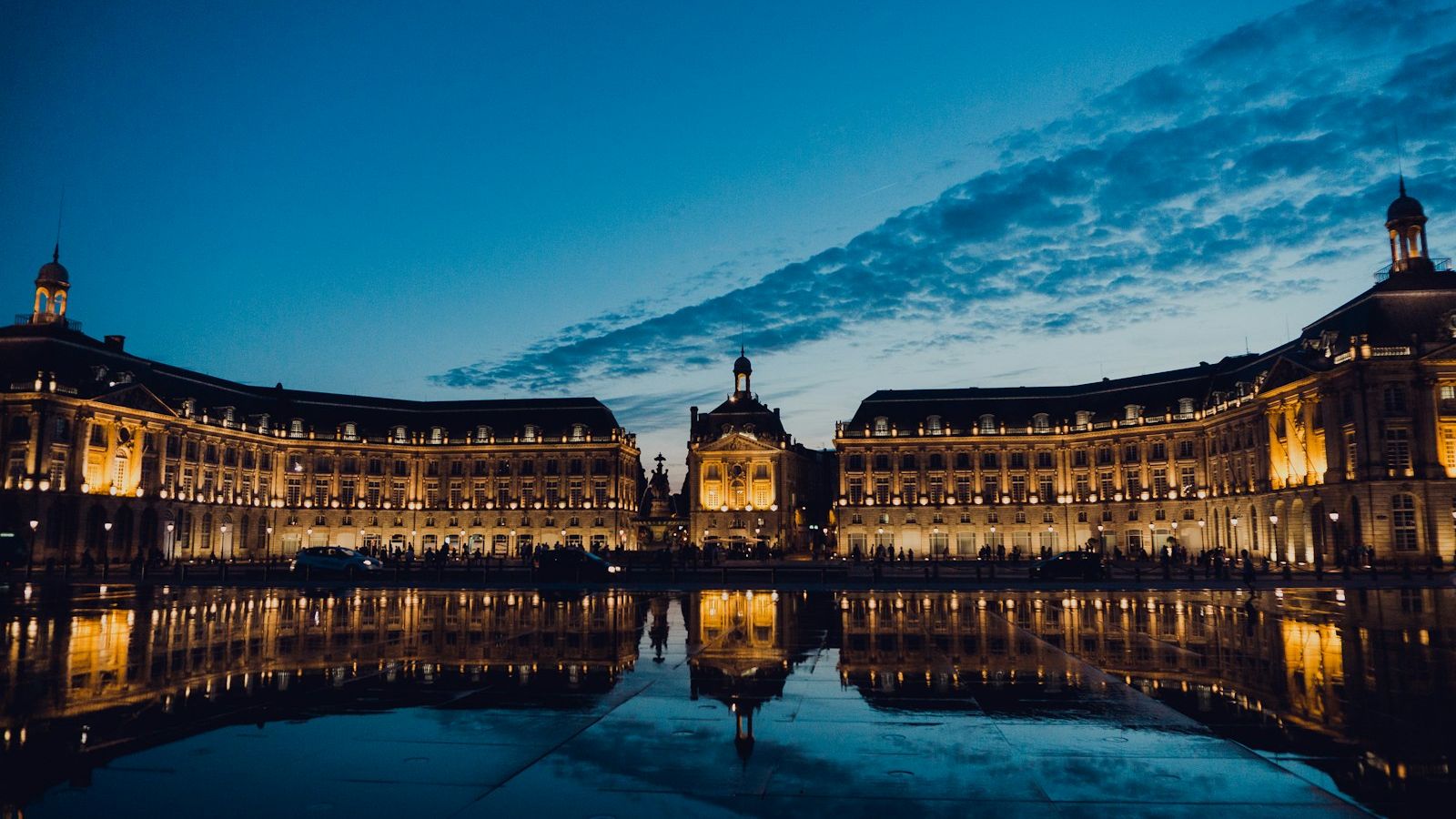
Start at Place de la Bourse, the neoclassical square built between 1730 and 1775. The symmetrical stone façades and central fountain make it one of the finest squares in France. In front of it sits the Miroir d’Eau — a shallow reflecting pool that covers 3,450 square metres of granite. When still, it creates a perfect mirror image of the buildings behind it. When the jets activate and mist rises from the surface, it becomes something genuinely magical. Arrive early morning or evening to see it at its best.
The Historic Centre
The Grand Théâtre, completed in 1780, is one of the great opera houses of Europe. Its 12 Corinthian columns along the exterior inspired Charles Garnier when he designed the Paris Opéra a century later. Book a guided tour if you cannot attend a performance — the interior is extraordinary. Nearby, Rue Sainte-Catherine runs for 1.2 kilometres as one of Europe’s longest pedestrian shopping streets. The Pont de Pierre — the Stone Bridge — stretches across the Garonne on 17 arches (Napoleon reputedly insisted on 17, one for each letter of his name), completed in 1822. Walking across it at sunset, with the limestone buildings glowing amber on the far bank, is one of Bordeaux’s best experiences.
La Cité du Vin
Opened in 2016, La Cité du Vin is a wine museum unlike any other. The building itself is striking — a curved glass and aluminium structure designed to evoke wine swirling in a glass. Inside, interactive exhibits cover 8,000 years of wine history across 20 themed spaces. The permanent collection costs €22 for adults and includes a glass of wine tasting at the Belvédère terrace on the top floor, with panoramic views over the city and the river. Budget at least three hours.
Day Trips from Bordeaux
Saint-Émilion
Saint-Émilion is 40 kilometres east of Bordeaux and takes around 35 minutes by direct train. The medieval village perches on a limestone plateau above its vineyards, and UNESCO lists both the town and its wine-producing landscape as a World Heritage Site — one of the very few places in the world where the cultural landscape of wine production earns that distinction. Walk the cobbled lanes, visit the underground monolithic church carved from solid rock in the 12th century, and taste Merlot-dominant wines from the surrounding châteaux. Come on a Tuesday or Friday when the morning market fills the Place du Marché.
Dune du Pilat
The Dune du Pilat is the tallest sand dune in Europe. It rises 107 metres above the Arcachon Basin, stretches 2.7 kilometres from north to south, and shifts slowly inland by a metre or two every year. From the top you see the Atlantic, the pine forests of Les Landes, and the Arcachon oyster beds below. The effort of climbing it takes about 15 minutes — the view from the summit is completely unlike anything else in France. Most visitors combine it with lunch in Arcachon or a boat trip to the Cap Ferret peninsula across the bay.
The Médoc Wine Route
The D2 road north of Bordeaux runs through the heart of Médoc wine country for roughly 80 kilometres. You will pass the gates of Château Margaux, Château Latour, Château Pichon Baron, and dozens of other famous estates. Many châteaux offer tastings and cellar tours — book in advance for the top names. The town of Pauillac makes a useful base for exploring the northern Médoc and sits right on the Gironde estuary. If you have a car, a half-day on this route is one of the most satisfying drives in France.
When to Visit Bordeaux
Spring — April to June — offers warm days, manageable crowds, and the vines just coming into leaf. September and October bring the harvest season. The Bordeaux Wine Festival takes place in late June in even-numbered years (next in 2026 and 2028), transforming the riverfront into a vast outdoor tasting event that draws several hundred thousand visitors. July and August are the hottest months and the busiest for tourism. If you visit in high summer, book accommodation early and expect queues at Saint-Émilion. November to February is quieter, cheaper, and cooler — fine for city sightseeing but not ideal for vineyard walks.
Getting to and Around Bordeaux
The TGV high-speed train connects Paris Montparnasse to Bordeaux Saint-Jean in around two hours since 2017. Trains run frequently throughout the day, and the journey is more comfortable than flying once you factor in airport transfers. Direct flights serve Bordeaux from London, Dublin, Amsterdam, and other European cities. If you travel across France by train, Bordeaux integrates easily into a wider itinerary connecting Paris, the Loire Valley, or the Pyrenees.
Within Bordeaux, the tram network covers the city centre efficiently. Saint-Émilion is reachable by direct train from Bordeaux Saint-Jean station. For the Médoc wine route and the Dune du Pilat, a hire car gives you the most flexibility — both destinations have limited public transport. Cyclists will find Bordeaux very manageable; the riverfront paths and flat city streets make it one of the better French cities for getting around by bike.
Where to Eat and Drink in Bordeaux
The Marché des Capucins is Bordeaux’s covered food market, open most mornings Tuesday through Sunday. Locals call it “the belly of Bordeaux.” You will find oysters from the Arcachon Basin, charcuterie from Périgord, local cheeses, and the entrecôte bordelaise — a ribeye steak served with a rich shallot and red wine sauce that is Bordeaux’s signature dish. Stalls open early and most close by 1pm, so arrive before noon.
For wine bars, the Saint-Pierre quarter between the market and the river has the highest concentration. La Vinothèque de Bordeaux on Cours du Chapeau Rouge stocks an excellent selection and offers tastings. If you want to drink like a local, order a glass of Entre-Deux-Mers — the dry white wine of the Bordeaux region that rarely makes it onto export lists but pairs beautifully with the local oysters.
The French approach to cheese applies here too. Look for Ossau-Iraty — a firm sheep’s milk cheese from the nearby Basque Country and Béarn — on menus across the city. It appears on cheese boards throughout Bordeaux restaurants and makes an excellent accompaniment to the red wines of the Médoc.
Bordeaux and the Loire Valley: A Classic France Circuit
Many travellers combine Bordeaux with the Loire Valley as part of a two-city France itinerary. The Loire Valley châteaux sit around four hours north by train. You can fly into Paris, take the TGV to Bordeaux, spend three nights, then travel north through Tours and Blois before returning to Paris. This circuit covers two of France’s great wine regions and two very different architectural styles — the port grandeur of Bordeaux and the Renaissance elegance of the Loire.
Frequently Asked Questions About Visiting Bordeaux
How many days do you need in Bordeaux?
Three to four days gives you enough time to explore the city centre properly, take at least one day trip to Saint-Émilion or the Médoc, and visit La Cité du Vin. If you also want to see the Dune du Pilat or drive the full Médoc wine route, allow five days.
Is Bordeaux easy to reach from Paris?
Yes. The TGV high-speed train connects Paris Montparnasse to Bordeaux Saint-Jean in roughly two hours, with frequent departures throughout the day. Booking in advance on the SNCF website or via Trainline typically reduces the fare significantly compared to buying on the day.
What is the best time of year to visit Bordeaux for wine tourism?
September and October are the harvest months, when vineyard activity is at its peak and the surrounding countryside is at its most beautiful. Late June in even-numbered years brings the Bordeaux Wine Festival, a major outdoor tasting event along the riverfront. Spring (April to June) is excellent for vineyard walks without summer crowds.
Do I need a car to visit Bordeaux?
Not for the city itself — the tram network works well and Saint-Émilion is reachable by direct train. You do need a car to explore the Médoc wine route comfortably, or to reach the Dune du Pilat without taking a coach excursion from the city.
You Might Also Enjoy
- The Loire Valley Châteaux: How France’s Kings Built a Royal Playground
- Normandy France Travel Guide: History, Coast and Country
- How to Travel France by Train: The Complete Guide
Plan Your France Trip
Ready to start planning? Our France trip planning hub covers everything from the best regions to visit to how to get around, find accommodation, and make the most of your time. Whether Bordeaux is your first stop or one of many, it is a good place to begin.
Join 7,000+ France Lovers
Every week, get France’s hidden gems, local recipes, and travel inspiration — the kind you won’t find in any guidebook.
Subscribe free — enter your email:
Love more? Join 64,000 Ireland lovers → · Join 43,000 Scotland lovers → · Join 30,000 Italy lovers →
Free forever · One email per week · Unsubscribe anytime
Tours & experiences you might love


Powered by Viator. Some links are affiliate links — we may earn a small commission at no extra cost to you.

Leave a Reply