
The smell hits you first. Salt, seaweed, and something cold and alive from the sea. Then you see the crowd — a dozen people standing at a wooden trestle table, plastic cups of white wine in hand, prying open shells with short thick knives. Nobody sits. Nobody lingers too long. This is how Normandy eats by the water.
The Harbours Nobody Puts on a Postcard
Fécamp, Dieppe, Étretat, Honfleur. The last one gets all the tourists. The others get the fishermen. And if you know where to look, they also get a particular kind of traveller — someone who came for the sea cliffs and left with a story about a zinc counter, a cold bottle of Muscadet, and the best scallops they ever tasted.
Normandy’s fishing villages are not dramatic. That is the point. They are working places. Nets dry on iron railings. Trawlers come in mid-morning and unload into blue plastic crates. The quaysides smell of diesel and brine. These are ports that have looked much the same for a hundred years, and the locals see no reason to change that.
Fécamp sits in a fold of the chalk cliffs, its fishing fleet still the largest in Upper Normandy. Dieppe has a long working harbour lined with fishmongers who open before dawn. Even the harbour towns that tourism hasn’t entirely ruined keep their working cores intact — if you walk past the gallery shops and the crêperies and find the real quayside.
What Life Actually Looks Like Here
By seven in the morning, the fish market in Dieppe is almost done. Buyers from restaurants in Rouen have already collected their orders. Local fishwives — a word that has never died in Normandy — are scrubbing down stalls with seawater and stiff brushes. In an hour, they will be gone.
The real rhythm of these places is fast and practical. Fishermen do not eat breakfast slowly. They come in from the sea, they sell, they eat standing at a counter, and they sleep. The restaurants that serve them are not the ones in the guide books. They open at six, serve coffee with calvados at the bar, and have a daily menu written on a chalkboard that changes with what came off the boats.
Marmite Dieppoise — a cream-rich stew of sole, scallops, mussels, and shrimp — was not invented in a Paris kitchen. It came from this coast, from cooks who used what was available. It is still the dish to order in any restaurant that has been open for more than thirty years. Some serve it in a copper pot. Most serve it in a bowl. All of them make it better than anywhere else.
Enjoying this? 7,000 France lovers get stories like this every week. Subscribe free →
The Fishermen Who Did Not Leave
In the 1970s and 1980s, many French coastal towns lost their fleets. Distant-water fishing collapsed. Younger generations moved inland. Some harbours became marinas. Some fish markets became tourist markets selling fridge magnets and striped Breton tops.
But a handful of Normandy’s ports held on. Fécamp kept its trawlers. Granville, on the western edge of Normandy near the Mont-Saint-Michel bay, kept its scallop fleet — now one of the most tightly regulated and proudly local fisheries in France. The scallop harvest here opens each October with something close to ceremony. Boats line up. Officials check paperwork. The fleet goes out together. It is less a business and more a tradition being deliberately maintained.
These villages did not survive by becoming pretty. They survived by staying useful. That distinction matters enormously when you visit. You feel it the moment you step off the main street and onto the working quay. This is not staged. This is not a heritage attraction. The ropes are heavy and the boots are wet and the cold comes off the Channel in long flat gusts.
What the Coast Looks Like Beyond the Famous Cliffs
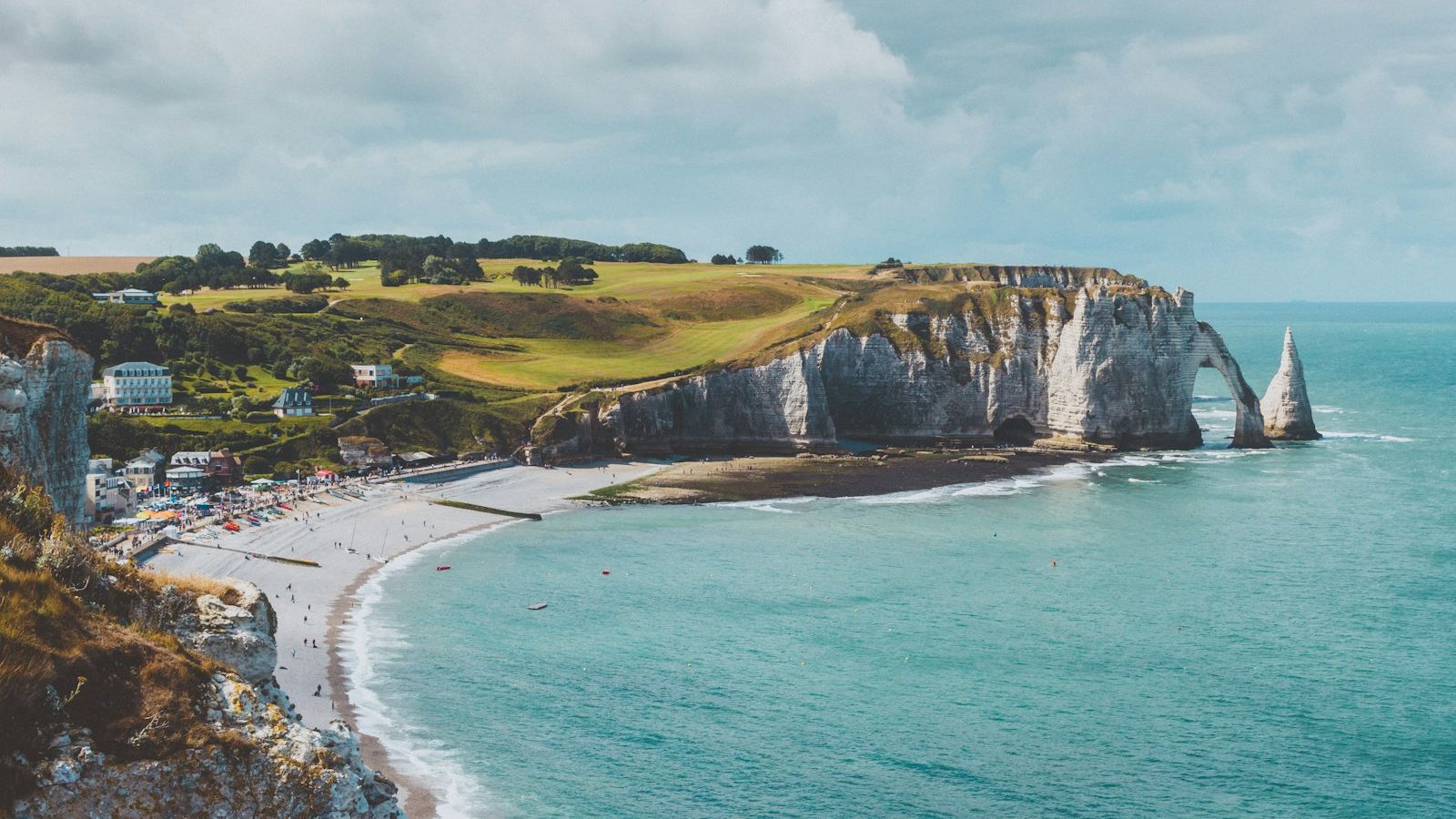
Most visitors to Normandy head straight for Étretat. The arches and needles there are genuinely extraordinary — Monet painted those cliffs over a hundred times and still did not exhaust them. But Étretat is now crowded at weekends and on any day that is even slightly sunny. The real character of this coastline lives ten kilometres in either direction.
Between Étretat and Fécamp, the chalk cliffs continue without the cafés and the souvenir shops. Walking paths cut along the top. Below, small pebble beaches appear at low tide and vanish again when the sea returns. Fishermen use them to launch small boats in the early morning. Nobody else is there. The only sounds are the gulls and the swell hitting the chalk base with a hollow, repeating boom.
Further north, the coast between Dieppe and Le Tréport is the Alabaster Coast — named for the white of its cliffs, though the stone is chalk rather than alabaster. Villages appear every few kilometres. Each has a small harbour, a church, and a bar that opens at seven. Some have a fish smokery. The smoked herring here — hareng saur — is a local obsession that has never made it far beyond the region. It is better for that.
Why This Coastline Still Gets It Right
There is a version of the French coast that exists entirely for visitors. The Riviera in summer. The Île de Ré with its bicycle lanes and white houses. Biarritz with its surf shops and boutique hotels. These places are not wrong. They are just optimised for a different kind of trip.
Normandy’s fishing harbours are optimised for nothing. Nobody planned them as a visitor experience. The fish markets happen at the time they happen because that is when the boats come in. The bars serve calvados because that is what the fishermen drink. The restaurants close at two and reopen at seven because there is no demand to stay open in between.
That is exactly what makes them worth visiting. You are not watching a performance of Norman coastal life. You are standing inside it, getting cold, smelling the sea, and eating something pulled out of the Channel this morning. For anyone planning their time in the north, the France trip planning guide covers everything from transport to the best times to visit this region.
The Channel is grey and cold and the wind rarely stops. But the boats keep going out, the fish keeps coming in, and the harbours keep smelling of salt and diesel and possibility. That is the version of France that most people never find. It is worth finding.
Join 7,000+ France Lovers
Three times a week, get France’s hidden gems, seasonal guides, local stories, and the art of la vie française — straight to your inbox.
Subscribe free — enter your email:
Free forever · Unsubscribe anytime
🇫🇷 You Might Also Love
Tours & experiences you might love


Powered by Viator. Some links are affiliate links — we may earn a small commission at no extra cost to you.

Leave a Reply