
Most visitors to southern France head straight for the French Riviera or Provence. They miss Languedoc. That is a significant mistake. Languedoc — now officially part of the Occitanie region — stretches across a vast arc of southern France, from the Rhône delta in the east to the foothills of the Pyrenees in the west. It has Roman ruins older than the Colosseum, a medieval fortress that inspired J.R.R. Tolkien, sun-baked wine country producing some of France’s best value bottles, and a coast where the crowds thin out dramatically. This Languedoc France travel guide covers everything you need to plan your visit.
Love France? Join 7,000+ readers on our free newsletter → lovetovisitfrance.substack.com
Where Exactly Is Languedoc?
Languedoc sits between Provence to the east and the Basque Country to the west. Its southern edge runs along the Mediterranean coast for roughly 180 kilometres. The major cities are Montpellier, Nîmes, Narbonne, and Béziers. Further inland, the terrain rises through wine villages and garrigue-covered hills towards the Cévennes mountains and the Massif Central.
The region takes its name from the Occitan language — oc was the word for “yes” in the old southern tongue, as opposed to oïl (which became oui) in the north. This linguistic and cultural divide ran deep for centuries. Languedoc has always felt distinct from Paris, and it still does. The pace is slower. The food is earthier. The wine is honest.
In 2016, the French government merged Languedoc-Roussillon with the neighbouring Midi-Pyrénées to form the administrative region of Occitanie. Most people still use Languedoc informally when referring to the coastal and lowland areas. Do not let the administrative name change confuse you — this guide covers the classic Languedoc heartland.
Why Languedoc Beats the Crowds
The French Riviera draws around 11 million visitors a year. Languedoc draws a fraction of that. The beaches are comparable — long stretches of sandy shore, backed by lagoons called étangs — but the resorts are less polished and considerably less expensive. A hotel room in Sète or Cap d’Agde costs roughly half what you would pay in Nice or Cannes for a similar standard.
Languedoc wine tells the same story. This is France’s largest wine-producing region by volume, accounting for about a third of all French wine. For decades, it had a reputation for bulk, anonymous production. That has changed. A younger generation of winemakers now produces exceptional bottles — Picpoul de Pinet alongside the oyster beds at Bouzigues, earthy Faugères from the schist-covered hills, robust Minervois from the village-studded plateaus above Narbonne. Prices remain far below comparable quality from Bordeaux or Burgundy.
Read our French Riviera travel guide if you want to compare the two coasts — but Languedoc offers something the Riviera increasingly struggles to: breathing room.
The Must-See Places in Languedoc
Carcassonne
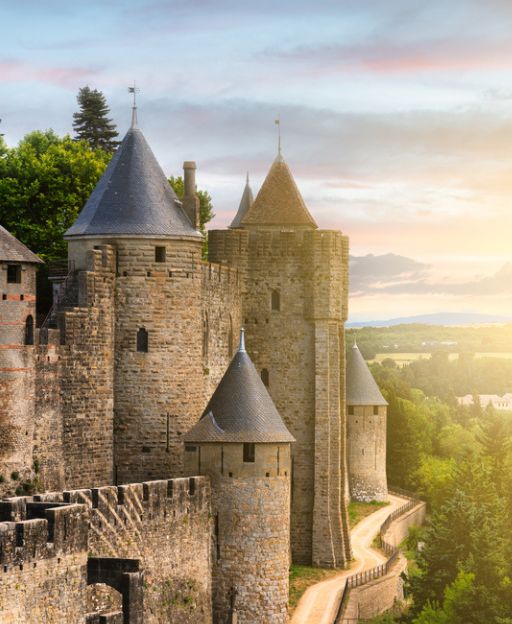
No visit to Languedoc is complete without Carcassonne. The medieval walled citadel rising above the Aude plain is one of the best-preserved fortified towns in Europe. It has 52 towers and almost 3 kilometres of double outer walls. Building began in the 3rd century under the Romans. The Visigoths expanded it. The French crown completed it. When Eugène Viollet-le-Duc restored it in the 19th century, he saved it from demolition. Today it is a UNESCO World Heritage Site and one of France’s most visited monuments outside Paris — but the lower town, La Bastide Saint-Louis, remains surprisingly quiet and genuinely liveable. Visit in late afternoon, after the coach parties leave. The citadel at dusk is extraordinary.
Our full Carcassonne travel guide covers how to visit, where to stay, and how to avoid the busiest hours.
Montpellier
Montpellier is France’s fastest-growing city. Its medieval university, founded in 1160, made it a centre of medicine and learning centuries before many European capitals had universities at all. Today it is young, energetic, and student-dominated — about a quarter of its 300,000 residents are students. The old town, the Écusson, is a maze of narrow streets, excellent restaurants, and independent shops. The Place de la Comédie is the natural gathering point: a grand 19th-century square anchored by the opera house. From there, the tramway runs efficiently to the beach at Palavas-les-Flots in around 35 minutes.
Nîmes and the Pont du Gard
Nîmes contains two of the best-preserved Roman monuments in the world. The Maison Carrée is a temple completed around AD 4 — Thomas Jefferson visited it in 1787 and described it as one of the most beautiful buildings he had ever seen. The arena, the Arènes de Nîmes, is a complete Roman amphitheatre seating 24,000 people, still in use for concerts and bullfights today. Entrance to both costs under €10.
Twenty-five kilometres north of Nîmes, the Pont du Gard stands as perhaps the greatest Roman engineering achievement still visible in France. It is a three-tiered aqueduct bridge, 49 metres high and 275 metres long, built in the 1st century AD to carry water 50 kilometres from the spring at Uzès to the city of Nîmes. Stand beneath it in early morning, before the day-trippers arrive, and the scale is staggering.
Collioure and the Côte Vermeille
The Côte Vermeille — the Vermillion Coast — sits at the southern end of Languedoc where the Pyrenees meet the Mediterranean. The town of Collioure anchors it. The harbour, the painted boats, and the Château Royal above the waterfront made it a favourite of the Fauvist painters in the early 20th century. Henri Matisse and André Derain worked here in the summer of 1905, producing the bold-coloured canvases that gave Fauvism its name. The light is remarkable — intense, crystalline, utterly different from the softer light of Provence. The town has a small permanent population, excellent anchovies (a local speciality for centuries), and wine from the surrounding Banyuls vineyards.
Narbonne
Narbonne was the first Roman colony in Gaul, founded in 118 BC. At its peak it was a city of 100,000 people and the capital of the province of Gallia Narbonensis. Today it is a pleasant market town of 55,000, somewhat overlooked, with a remarkable half-finished Gothic cathedral. The building project halted in the 14th century when the city refused to allow the demolition of the city walls — so the choir and transept were built, but the nave never was. Walk inside the soaring Gothic choir and you will find one of the tallest church interiors in France: 41 metres. Narbonne also sits on the Canal du Midi, the 17th-century canal connecting the Atlantic to the Mediterranean. Hire a boat or simply walk the towpath.
The Languedoc Coast
The Mediterranean coast of Languedoc stretches from the Camargue marshes near Montpellier in the east to Collioure in the south. It differs from the Riviera in one key respect: much of it backs onto shallow lagoons separated from the open sea by narrow barrier spits. These lagoons — the Étang de Thau, the Étang de l’Or, the Étang de Bages — create distinctive landscapes and exceptional seafood. Bouzigues on the Étang de Thau produces oysters and mussels farmed directly in the lagoon. Eating them at a waterside restaurant with a carafe of local Picpoul de Pinet white wine is one of the region’s defining experiences.
The resort towns — La Grande-Motte, Palavas-les-Flots, Cap d’Agde, Valras-Plage — were largely built in the 1960s and 1970s and lack the charm of older coastal towns. Sète is the exception. It sits on a narrow peninsula between the Étang de Thau and the sea, threaded with canals, and has a distinct maritime character. The writer Paul Valéry and the singer Georges Brassens were both born here. It is the kind of town that rewards a slow afternoon and a bowl of tielle sétoise, the local octopus pie.
Languedoc Wine: What to Drink and Where
Languedoc is France’s wine country without the price tag. The region produces more wine than Australia. Most of it leaves in bulk. But within that enormous output, there are extraordinary appellations worth knowing.
- Picpoul de Pinet — A dry, crisp white made from the Picpoul grape on the shores of the Étang de Thau. Pairs perfectly with local oysters. Look for producers such as Château de Floris or Domaine Azan.
- Faugères — A red appellation in the hills north of Béziers, grown on schist soils that give the wines a mineral, earthy quality. Often described as Languedoc’s equivalent of the Rhône’s Crozes-Hermitage at a fraction of the price.
- Minervois — Stretching north of Narbonne, Minervois produces robust reds from Grenache, Syrah, and Carignan, often with garrigue herbs — thyme, rosemary, wild lavender — on the nose. The village of Minerve, perched on a rock above two river gorges, is worth visiting regardless of the wine.
- Banyuls — A fortified red dessert wine from the slopes above Collioure, made from Grenache Noir. Rich, oxidative, and uniquely suited to chocolate desserts. One of France’s most distinctive wines, virtually unknown outside the region.
Getting Around Languedoc
A hire car is the most practical way to explore Languedoc. The major cities — Montpellier, Nîmes, Narbonne, Béziers — connect well by train. For the wine villages, Carcassonne’s surrounding countryside, and the coast between the lagoons, a car is essential. Roads are good, traffic is manageable outside peak summer, and parking rarely presents problems except in central Montpellier.
Montpellier has an international airport with direct flights from London and several other European cities. Nîmes airport is small but handles Ryanair routes from the UK and Ireland. Most visitors flying from North America connect through Paris, Lyon, or Marseille.
The TGV serves Montpellier and Nîmes directly from Paris (around three hours). Regional TER trains connect the coastal cities. If you plan to base yourself in one city and day-trip around the region, train travel is entirely viable — read our guide to travelling France by train for full details on passes, booking, and tips.
When to Visit Languedoc
The best months are May, June, and September. Temperatures sit between 20°C and 28°C, the crowds are manageable, accommodation prices drop, and the light is exceptional. Avoid August if you can — it is peak French holiday season, coastal roads congest, and prices rise sharply.
July is hot (regularly above 35°C inland) but alive. The wine villages hold festivals, the beaches fill, and Carcassonne marks Bastille Day on 14 July with an extraordinary fireworks display over the citadel.
October and November bring the vendange (grape harvest) and the olive harvest. Walking in the Cévennes or the Minervois hills in autumn is excellent — the colours rival anything Provence offers, without the crowds.
Winter is quiet. Many small restaurants and hotels close between November and March. Montpellier, Nîmes, and Narbonne remain open year-round, and the Roman monuments look particularly dramatic on a clear winter’s day.
Where to Stay in Languedoc
Montpellier suits travellers who want an urban base with good transport links. The old town has a range of hotels from budget to boutique. Carcassonne divides neatly between the medieval citadel (where a handful of hotels charge a premium for the address) and the lower town (where the same money goes much further). For the coast, Sète or Collioure make far more characterful bases than the planned resort towns.
Self-catering gîtes are plentiful in the wine villages of the Minervois and Faugères appellations — staying in a village among vineyards for a week, with a car and a cellar door or two to visit each day, is one of the better ways to experience the real rhythm of the region.
What is the best time to visit Languedoc, France?
May, June, and September are the best months for most visitors. The weather is warm and sunny, the crowds are smaller than in August, and accommodation costs less. July and August are the hottest and busiest months — still enjoyable, but plan accommodation and popular attractions in advance.
How far is Languedoc from Paris?
Montpellier is approximately 750 kilometres from Paris by road, around 3 hours and 15 minutes by TGV. Nîmes is slightly closer. Flying from Paris to Montpellier takes just over an hour. The TGV is generally the most comfortable and convenient option for independent travellers.
Is Languedoc or Provence better for a first visit to southern France?
Both regions are excellent, but they offer different things. Provence has more famous landmarks (the Pont du Gard aside), more lavender, and more well-known wine appellations. Languedoc is less expensive, less crowded, and contains some of the most extraordinary Roman and medieval heritage in France. For first-time visitors who want value alongside history and beaches, Languedoc makes a strong case. Many visitors find they prefer it once they arrive.
You Might Also Enjoy
- Carcassonne Travel Guide: How to Visit France’s Greatest Medieval Fortress
- French Riviera Travel Guide: What to Know Before You Go
- Bordeaux Travel Guide: What to See, Do and Drink in France’s Wine Capital
Plan Your France Trip
Heading to France and still working out the details? Our France trip planning hub brings together everything you need — from the best time to visit and how to get around to where to eat, what to book in advance, and how to make the most of every region.
Join 7,000+ France Lovers
Every week, get France’s hidden gems, local recipes, and travel inspiration — the kind you won’t find in any guidebook.
Subscribe free — enter your email:
Love more? Join 64,000 Ireland lovers → · Join 43,000 Scotland lovers → · Join 30,000 Italy lovers →
Free forever · One email per week · Unsubscribe anytime
Tours & experiences you might love


Powered by Viator. Some links are affiliate links — we may earn a small commission at no extra cost to you.

Leave a Reply