
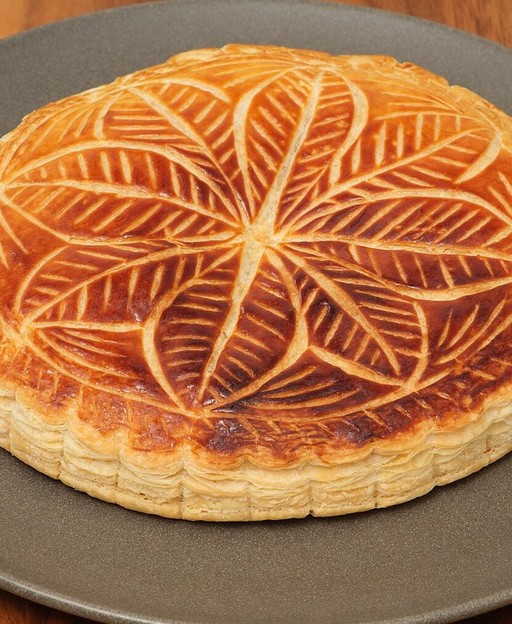
The galette served each January at the Élysée is deliberately made without a bean inside it — because a republic does not crown a king, not even for an afternoon. That single missing charm says a great deal about a tradition that began with the three Magi and a Roman midwinter game of chance, and which today sends French bakeries through their busiest fortnight of the year. This is Guide № 013 in The Love France Guide series.
A Cake for the Three Kings
The galette belongs to Épiphanie, the Christian feast marking the visit of the Magi — Melchior, Gaspard and Balthazar — to the infant Jesus. The feast falls on 6 January, the twelfth day after Christmas, though in France the Catholic Church transfers the celebration to the first Sunday of the month, which is why families eat galette across the whole of January rather than on one fixed date.
The custom of baking a lucky token into a cake is older than the Christian feast attached to it. It is commonly traced to the Roman festival of Saturnalia, when a bean drawn by lot decided who would be “king” of the banquet for a day. The Church absorbed the game into Epiphany, and the broad bean — the fève — kept its name even after it changed shape entirely.
Two Cakes, One Feast
There is no single national galette. In Paris and the north, “galette des rois” means a flat disc of puff pastry filled with frangipane and scored with a glazed fan or spiral on top. In Provence, the southwest and much of the Mediterranean, the Epiphany cake is instead a gâteau or couronne des rois: a ring of brioche scented with orange-blossom water, crowned with candied fruit and pearl sugar, closer to a sweet bread than a pastry.
Frangipane itself is often misunderstood. In its traditional form it is not pure almond cream but a blend — crème d’amande combined with a smaller measure of crème pâtissière — which keeps the filling rich without turning dense. A plainer, unfilled version of puff pastry, the galette sèche, is still sold for those who prefer the butter and lamination to the almond.
The Bean That Became a Collectible
For centuries the hidden token really was a dried broad bean. From the late nineteenth century, porcelain figurines began to replace it, and the fève grew into an object collected for its own sake. Enthusiasts are known as fabophiles, and series now range from nativity figures and fairy-tale characters to film and cartoon tie-ins issued fresh each year.
The devotion has its own museum. The Musée de la fève, des crèches et traditions populaires at Blain, in Loire-Atlantique, shares a building with the local tourist office and holds one of Europe’s largest collections of these porcelain charms, from nineteenth-century pieces to modern pop-culture sets.
Under the Table: How the Ritual Works
Cutting the galette is a small piece of theatre with strict rules. The youngest child at the table traditionally crawls underneath it and, unable to see the slices, calls out which person each portion should go to — a method meant to guarantee that nobody rigs who gets the fève. This is called tirer les rois, “drawing the kings.”
Whoever bites down on the charm becomes king or queen for the day and wears the paper crown — the couronne en carton doré — that bakeries supply with every cake. Custom then obliges the newly crowned ruler to buy or bring the next galette, which is one reason the eating stretches comfortably across several weeks.
The Republican Galette
Each January the Confédération Nationale de la Boulangerie-Pâtisserie Française presents an oversized galette to the President of the Republic. The Élysée version is served with neither a fève nor a crown — a practice generally dated to the mid-1970s — on the logic that the head of a republic cannot be seen handing out a royal title, even in jest. The palace tends to call it simply a galette rather than a galette des rois.
For the home table, France’s leading pâtissiers release their own versions, often with a commissioned fève. Houses such as Lenôtre, Pierre Hermé, Ladurée, Fauchon and Dalloyau all sell seasonal galettes, and many of the country’s most awarded chefs belong to the Relais Desserts association. A good neighbourhood boulangerie, however, will match most of them at a fraction of the price.
How to Make a Galette des Rois at Home
You can bake the Paris-style galette in your own kitchen with two sheets of store-bought puff pastry. We make the filling the traditional way, almond cream with a spoonful of pastry cream folded in, so it stays soft. Hide a bean inside, find a paper crown, and send the youngest under the table.
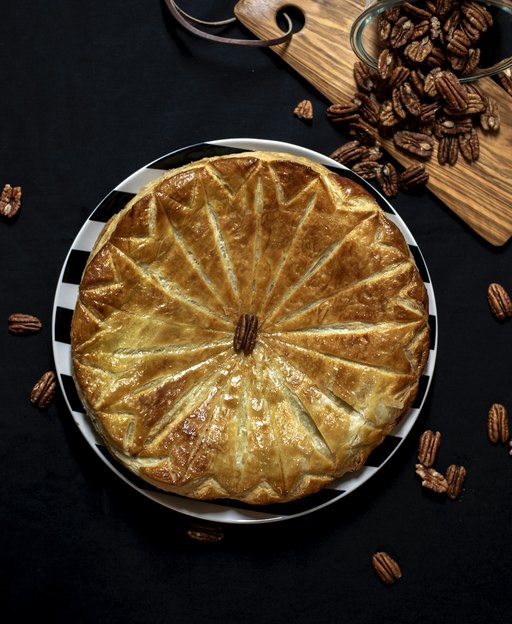
Galette des Rois (French King Cake with Frangipane)
Ingredients
Equipment
Method
- Pastry cream: warm the milk in a small saucepan until it steams. In a bowl, whisk the egg yolk, sugar and cornstarch together, then pour in the hot milk while whisking. Pour it all back into the pan.
- Cook over medium heat, whisking all the time, until it thickens and starts to bubble, then keep whisking for 1 minute more. Take it off the heat, stir in the vanilla, press plastic wrap onto the surface and leave to cool completely.
- Almond cream: beat the soft butter and sugar together until creamy. Beat in the egg, then stir in the ground almonds and the rum.
- Whisk the cold pastry cream into the almond cream until smooth. This mix is the frangipane. Cover and chill for about 30 minutes so it firms up.
- Cut two rounds of chilled puff pastry about 23 cm (9 in) across, about 3 mm (⅛ in) thick; a plate makes a good guide. Lay one round on a baking sheet lined with parchment.
- Brush a border about 2.5 cm (1 in) wide around the edge with the egg glaze. Spread the frangipane inside the border and press the fève into the filling.
- Lay the second round on top and press the edges together firmly to seal. Crimp the edge all the way round with the back of a knife.
- Brush the top with the egg glaze. With the tip of a knife, score curved lines or spokes from the centre to the edge without cutting through, and prick 4 or 5 small holes in the top. Chill for 30 minutes.
- Heat the oven to 200°C / 180°C fan / 400°F / gas 6. Bake for 30 to 35 minutes, until deep golden and puffed. Lift the edge with a spatula: the base should be cooked and crisp.
- For a shiny top, brush the hot galette with the sugar syrup as soon as it comes out of the oven. Leave to cool for at least 30 minutes and serve warm or at room temperature. Tell everyone there is a fève inside before they bite.
Notes
Myths Worth Retiring
Myth: Épiphanie is always 6 January. In France the celebration is usually moved to the first Sunday of the month, and galettes are sold and eaten throughout January rather than on a single day.
Myth: frangipane is just almond cream. Traditional frangipane is a mixture of crème d’amande and crème pâtissière; pure almond filling is crème d’amande on its own, which is a different thing.
Myth: the fève has always been a porcelain figure. It was a genuine dried broad bean for most of the tradition’s history; porcelain and later plastic figurines only took over from the late nineteenth century.
Frequently Asked Questions
Why does the youngest child hide under the table?
Because they cannot see the slices, their call on who receives each portion is impartial. It is a built-in safeguard so that no adult can steer the fève — and the crown — to a chosen person.
What is the difference between the northern and southern cakes?
The northern and Parisian galette is puff pastry filled with frangipane. In Provence and much of the south, the Epiphany cake is a ring of orange-blossom brioche topped with candied fruit and sugar, called a gâteau or couronne des rois.
Is the galette a religious ritual today?
Its roots are in the feast of the Magi and an older Roman custom, but for most French families it is now a secular, sociable habit — a reason to gather, share a cake and crown someone king or queen for the afternoon.
More The Love France Guides
The Love France Guide is a numbered series — one tightly focused subject at a time, each with its own downloadable collectible edition. Guide № 001 is The Croissant, Guide № 002 is Bastille Day, Guide № 003 is The Béret, Guide № 004 is French Wine & Terroir, Guide № 005 is Café & Bistro Etiquette, Guide № 006 is French Slang & Verlan, Guide № 007 is Cognac & Armagnac, Guide № 008 is Chanson Française — The French Song Tradition, Guide № 009 is The Breton Stripe (Marinière), Guide № 010 is French Folklore & Ghost Stories, Guide № 011 is French Sayings & Proverbs, Guide № 012 is The French Breakfast, This is Guide № 013. More editions are on the way.
🇫🇷 Join the France Lovers
Every weekday, a free story from France: the people, places and history behind it, from people who live and love it.
Subscribe free — enter your email:
Tours & experiences you might love


Powered by Viator. Some links are affiliate links — we may earn a small commission at no extra cost to you.

Leave a Reply