
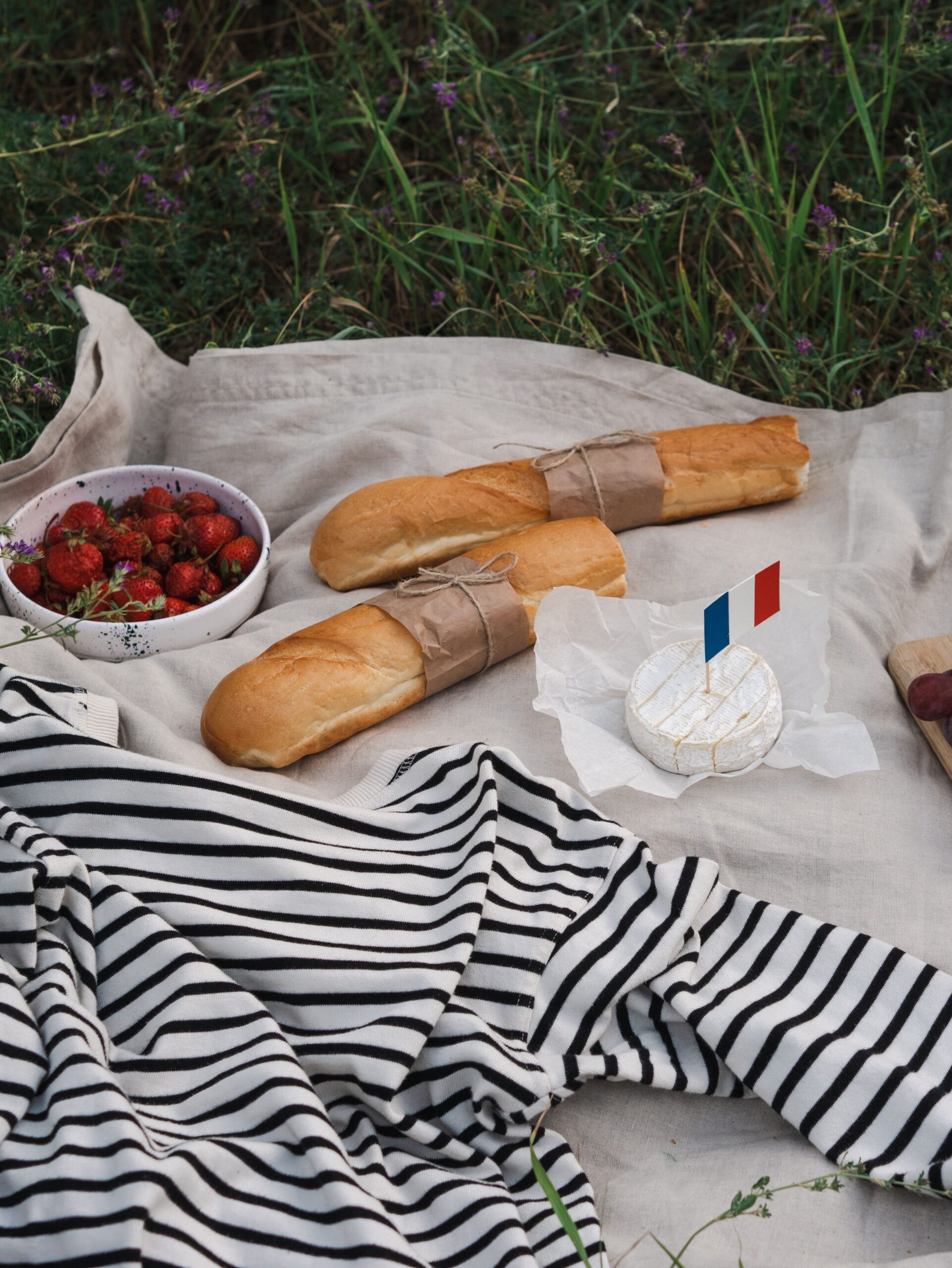
An 1858 French Navy regulation turned a humble knitted undershirt into a national icon: it set out a blue-and-white striped top for seamen along the Channel and Atlantic coasts, the idea being that a man overboard would show up against grey water far better in stripes than in plain navy. That piece of workwear is the marinière, and it has since travelled from the rigging to the runway without ever quite losing its salt. This is Guide № 009 in The Love France Guide series.
From Naval Kit to National Emblem
The marinière began life as regulation naval clothing for sailors working in Brittany and the north of France. The mid-nineteenth-century standard described a knitted cotton body in indigo and white horizontal bands, a close weave to hold warmth under an oilskin, and a cut loose enough to pull on quickly on a pitching deck. Because it was issued kit rather than fashion, the early versions were purely practical: hard-wearing, cheap to replace, and instantly recognisable as the uniform of the lower deck.
The garment is closely tied to the identity of Brittany, the region whose weather and maritime trades made it practical in the first place; the regional Brittany Tourism board still treats the stripe as part of the area’s visual signature. What started as anonymous workwear became, over a century, shorthand for a whole stretch of French coast.
How a Real Marinière Is Made
A traditional marinière is knitted rather than woven, which gives it stretch and that slightly dense, springy handle. The classic features are consistent: a wide boat neck (bateau) that sits across the collarbones, set-in or three-quarter sleeves, and horizontal stripes of roughly equal spacing running around the body. The authentic colourway is off-white with marine blue, though makers now produce the stripe in reds, blacks and other shades for the fashion market.
Weight matters more than people expect. A genuine heavy-cotton version is warm and holds its shape for years; lighter high-street copies in thin jersey tend to curl and fade. The best way to judge one is to feel the knit and check whether the stripes line up cleanly at the shoulder seams — a sign the panels were cut and matched with care rather than stamped out at speed.
Coco Chanel and the Leap to Fashion
The marinière crossed from the docks into the wardrobe largely thanks to Chanel. Coco Chanel, who kept a boutique on the Normandy coast at Deauville, folded the sailor’s stripe into her nautical-themed collection around 1917, dressing fashionable women in borrowed workwear at a moment when women’s clothing was loosening up for good. From there the shirt became a fixture of twentieth-century style, worn by Picasso in his studio, by Brigitte Bardot and Jean Seberg on screen, and later rebuilt as a signature by designer Jean Paul Gaultier, who has treated the stripe almost as a personal uniform.
Where It’s Still Made
Three French makers anchor the real thing. Saint James, founded in 1889 in the Normandy town of the same name near the Brittany border, still knits its marinières in France and is the name most often cited for the heavyweight original. Armor-Lux, established in Quimper in Brittany in 1938, is the other heavyweight of the category and also supplies striped kit used by the French Navy. Orcival, founded in 1939, is prized for a particularly dense, warm knit once favoured by fishing crews.
If you want to see where the stripe came from rather than buy one, the Musée national de la Marine in Paris sets naval uniform in the wider story of French seafaring, which is the context that makes the marinière make sense.
Buying One That Lasts
Look for the words tricoté en France (knitted in France) and a stated cotton weight; a proper marinière feels substantial in the hand. Sizing runs close to the body in the traditional cut, so many people size up for the relaxed, sailor-ish drape. Expect a genuine French-made shirt to cost considerably more than a fast-fashion lookalike — you are paying for the knit and the finishing, and a good one is still wearable long after the cheap version has gone out of shape.
Myths Worth Retiring
Myth: the 21 stripes commemorate Napoleon’s 21 victories. This is a popular tale with no documentary basis. Stripe counts on old naval garments varied, and the pleasing “one stripe per battle” story appears to be a later invention rather than anything in the original regulations.
Myth: “Breton stripe” and “marinière” mean different garments. They are the same thing — marinière is the French name, Breton stripe the common English label, both describing the blue-and-white striped top rooted in the French Navy and in Brittany.
Myth: Coco Chanel invented it. She did not design the stripe; it already existed as naval workwear. What she did was lift it into high fashion, which is a different and arguably larger achievement.
Frequently Asked Questions
Is it called a Breton stripe or a marinière?
Both are correct. Marinière is the French word, literally tying the shirt to sailors (marin), while English speakers often say “Breton stripe” after Brittany, the region most associated with it. They refer to the same striped top.
Why stripes rather than plain fabric?
The usual explanation is visibility: a sailor who fell into the water was easier to spot in bold horizontal bands than in solid dark cloth. Whether or not that was the sole reason, the stripe quickly became the defining mark of French naval clothing.
Can you still buy a French-made one?
Yes. Houses such as Saint James, Armor-Lux and Orcival continue to knit marinières in France, and many of their shirts carry clear “made in France” labelling. These are the versions to seek out if you want the traditional weight and construction rather than a thin imitation.
More The Love France Guides
The Love France Guide is a numbered series — one tightly focused subject at a time, each with its own downloadable collectible edition. Guide № 001 is The Croissant, Guide № 002 is Bastille Day, Guide № 003 is The Béret, Guide № 004 is French Wine & Terroir, Guide № 005 is Café & Bistro Etiquette, Guide № 006 is French Slang & Verlan, Guide № 007 is Cognac & Armagnac, Guide № 008 is Chanson Française — The French Song Tradition, This is Guide № 009. More editions are on the way.
🇫🇷 Join 7,000+ France Lovers
Every week, get hidden stories, local secrets, and travel inspiration from people who live and love it.
Subscribe free — enter your email:
Tours & experiences you might love


Powered by Viator. Some links are affiliate links — we may earn a small commission at no extra cost to you.

Leave a Reply