
What’s your name in French? 🇫🇷
Your French Name — type any first name for the French equivalent, with meaning and regional notes.
If your family tree runs back to Québec, Acadia or Cajun Louisiana, there is a good chance it passes through one small corner of western France. Poitou-Charentes sits on the Atlantic between the Loire and Bordeaux. Its four departments are Charente, Charente-Maritime, Deux-Sèvres and Vienne. From its harbours and farm villages came about one in five of the French pioneers who married and settled in Canada under French rule.
That is why so many surnames you hear in Montréal, Moncton or Lafayette still have a cousin in a Poitou village: Boudreau, Thériault, Charest, Fréchette, Babin. In this guide we walk through the region’s story, explain how its family names were formed, and give you the meaning and origin of 28 surnames with deep roots here. At the end you will find the official archives where your own ancestors’ baptisms and marriages are waiting.
Every meaning below comes from a French surname dictionary or an official genealogy source, listed at the end. Where a meaning is uncertain, we say so.
Four Departments, Four Old Provinces
Poitou-Charentes was the name of a French region from the 1960s until 2016, when it became part of the larger Nouvelle-Aquitaine. For family history, the older map matters more. Before the French Revolution, this land was split into four provinces, and your ancestors’ records will often name them.
- Poitou covered today’s Vienne and Deux-Sèvres, and the Vendée too.
- Aunis and Saintonge, the two coastal provinces, together became the department of Charente-Maritime, with La Rochelle as its great port.
- Angoumois became the department of Charente, whose archives sit in Angoulême.
When an old Québec record says a pioneer came from Aunis, Saintonge, Poitou or Angoumois, this is the corner of France it means.
La Rochelle: The Protestant Port on the Atlantic
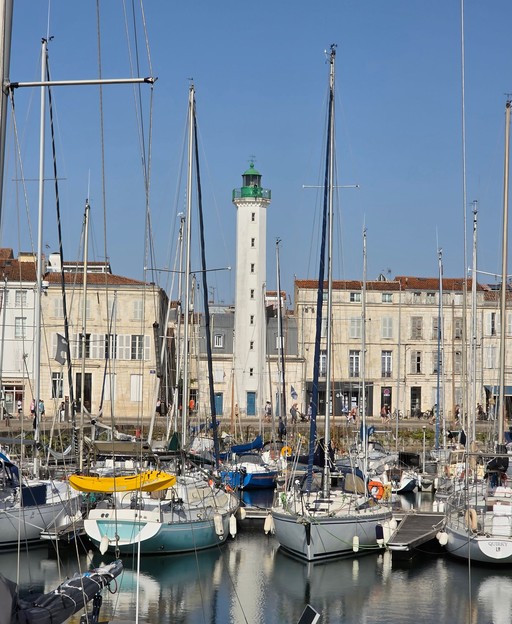
La Rochelle was a busy Atlantic port that had become largely Protestant. To the royal government, a Protestant harbour open to an English landing looked like a threat. Cardinal Richelieu laid siege to the city in 1627, and La Rochelle surrendered in 1628 after a long and famous resistance. You can read the full story in our guide to La Rochelle and its siege.
The Protestant past left a mark on the records too. The departmental archives in La Rochelle hold registers of Protestant baptisms, marriages and burials from 1561 to 1793. If your family were Huguenots, these pastoral registers can reach back further than you might expect.
The same coast gave Canada its founder. Samuel de Champlain called himself “of Brouage”, a small port in Saintonge less than half a day’s sailing from La Rochelle, and the Dictionary of Canadian Biography says he was probably born there. A 1574 baptism in the register of La Rochelle’s Protestant church of Saint-Yon may be his, though that is not proven.
Why One in Five New France Pioneers Came From Here
The historian and genealogist Marcel Fournier has counted 9,346 French pioneers, men and women, who settled by marriage in Canada between 1617 and 1759. His 2026 tables for the Fichier Origine break them down by department:
- Charente-Maritime (Aunis and Saintonge): 1,142
- Vienne (Poitou): 274
- Charente (Angoumois): 256
- Deux-Sèvres (Poitou): 199
Together that makes 1,871 pioneers, about one in five of the whole group. Charente-Maritime alone sent more than the city of Paris, which Fournier counts at 889. La Rochelle’s archives still keep contracts of the “engagés”, the workers who signed on to sail for the Americas between 1606 and 1758.
So when you find a Québec ancestor with a name ending in -eau or -ault, the west of France is a sensible first place to look. Our guide to French-Canadian surnames covers the wider picture, and our Anjou and Perche surnames guide covers the neighbouring provinces.
The Acadian Question: Did Acadia Begin Near Loudun?
Many Acadian families have long believed their roots lie in Poitou, and the story is worth telling carefully. Isaac de Razilly, governor of Acadia from 1632 to 1635, and Charles de Menou d’Aulnay, who governed from 1642 to 1650, were both born in Touraine but owned land in the Loudunais, the small district around Loudun in the north of today’s Vienne. The linguist Geneviève Massignon, author of a 1962 study of Acadian French, argued that young farmers from villages there (Martaizé, Aulnay, Angliers, La Chaussée and Guesnes) followed them to Acadia. Names linked to this idea include Babin, Brault, Bourg, Gautreau, Landry, Savoie, Belliveau, Dupuis, Girouard, LeBlanc, Thériault, Blanchard and Gaudet.
It is a lovely theory, built on real similarities between Acadian speech and the old Loudun dialect. But a Université Laval research page on French in North America points out that historians and genealogists have found no French record (baptism, notary act or ship list) proving these families left from the Loudunais. Perhaps twenty families came from there; nobody can yet show it. What is certain, the same source says, is that the centre-west of France gave the largest share of New France settlers whose origin is known.
If your family is Acadian, or Cajun by way of Acadia, our stories on the Acadians and the Cajuns of Louisiana follow them from Nova Scotia to the bayou.
How Poitou-Charentes Surnames Were Formed
Read a list of Poitou family names aloud and you will hear the same endings again and again: -eau, -aud, -ault. Several patterns explain them.
Old Germanic first names. Many Poitou names go back to Germanic personal names ending in -wald (“one who governs”). Over the centuries those endings came out as -aud, -ault or -eau: Hariwald gave Airault, Warinwald gave Garnaud, and Ratwald probably gave Rateau.
Pet forms of saints’ names. Families often took a short or loving form of a father’s first name: Naud from Arnaud or Renaud, Pairault from Pierre, Thériault from Thierry, Guillon from Guillaume.
Trades and nicknames. A weaver became Texier or Tesseron. A man who loved a joke became Goguet.
Places. Many names simply say where a family lived: by a small wood, a ravine or an ash grove.
Spelling was never fixed. Airault, Airaud and Aireau are all found in the same region, and names changed again in North America: the La Rochelle name Chauré became Choret in Québec. Always search for the variants.
French Surnames of Poitou-Charentes: 18 Names Still Rooted in the Region
These family names are still most common in Poitou-Charentes and the neighbouring Vendée. The department numbers in brackets are the ones French genealogists use: 16 Charente, 17 Charente-Maritime, 79 Deux-Sèvres, 86 Vienne.
1. Airault / Airaud
From the old Germanic personal name Hariwald, made of “hari” (army) and “wald” (one who governs). It is borne mostly in Poitou and the Vendée. Variants such as Airaud and Aireau belong to the same area.
2. Babin
A name found mostly in Poitou and the Vendée. It comes from a sound-word and may first have described someone who pouted or stammered. It is also one of the Acadian family names linked to the Loudunais theory above.
3. Texier
One of the many French names for a weaver. It is widespread in Limousin and in Poitou.
4. Tesseron
Another weaver’s name, a pet form of Tessier. It is most common in Charente-Maritime, and its cousins Tessereau, Tesserault and Tesserot belong to the same part of western France.
5. Brunet
A pet form of Brun, which can describe someone with brown hair or come from the Germanic name Bruno. Brunet is found all over France, but with a very large number of bearers in Poitou.
6. Coutant
The local form of the first name Constant, and very frequent in Poitou-Charentes. The women’s form Coutance (Constance) also became a family name.
7. Garnaud
From the Germanic personal name Warinwald, “protection” and “one who governs”, or possibly a pet form of Garnier. It is borne mostly in Vienne and Charente, where the spelling Garnault is also found.
8. Guignard
Probably from the Germanic name Winhard, “friend” and “hard”. An Old French word for someone who winks is another possibility. The name is most widespread in Deux-Sèvres, the Indre and the Vendée.
9. Bonneau
A pet form of Bon, a nickname for a good or brave person that was also used as a first name. Bonneau is frequent in Deux-Sèvres.
10. Massé
Frequent in Poitou-Charentes, this is probably a place name. In this region it is most likely a form of Massais, a village in Deux-Sèvres, and so first meant “the family from Massais”.
11. Naud
A short, affectionate form of first names such as Arnaud or Renaud. It is frequent in the Charentes, the Vendée and Maine-et-Loire.
12. Mesnard
The Charente spelling of Ménard, from the Germanic Maginhard: “magin” (strength) and “hard” (hard, strong).
13. Raby
Borne mostly in Charente. It is most likely a place name meaning a ravine: there is a hamlet called le Raby at Bouteville, in Charente.
14. Rateau
Mostly found in the Charentes and Haute-Vienne. It may have described a man who worked with a rake, but it is more likely the Germanic name Ratwald, “counsel” and “to govern”.
15. Goguet
Found mostly in the Vendée and Poitou-Charentes, this was a nickname for someone who loved a joke, from the Old French “gogue” (fun, teasing). The same word gave French “goguenard” (mocking).
16. Pairault
A pet form of Pierre (Peter), borne in the Vendée and Poitou-Charentes, with spellings such as Pairaud and Paireault.
17. Guillon
A pet form of Guillaume (William), very widespread in the west of France, especially Vienne and Charente-Maritime.
18. Boutin
A pet form of the Germanic personal name Bod, “messenger”. It is very frequent in the west, especially Vienne and Deux-Sèvres.
Ten Names That Sailed From Poitou-Charentes to Québec and Acadia
Some family names did better in North America than at home. These ten are now more familiar in Canada (and, through the Acadians, in Louisiana) than in the villages they came from.
19. Boudreau
In France the name is borne mostly in Deux-Sèvres, and it is probably a pet form of Boudier. In Acadia it appears early in the 1600s: a Michel Boudrot is named in a 1639 act written at Port-Royal, and he seems to have come from near La Rochelle.
20. Thériault
A pet form of Thierry, mostly found in Québec today. Its -ault ending and the oldest mentions of the name place its origin, with little doubt, in Poitou-Charentes. Thériault is also one of the Acadian names in the Loudunais story.
21. Fréchette
Common in Québec, the name has died out in France, where it was once found mostly in Poitou-Charentes. It is most likely a place name meaning an ash wood.
22. Charest
Found in Canada, and once borne mostly in Poitou-Charentes. It seems to be a form of Charet, a place name for a rocky summit. There is a hamlet called le Charet at Adriers, in Vienne.
23. Gobeil
Present in Québec but no longer borne in France, the name came from Poitou. It seems to come from the old word “gobel”, a drinking cup or goblet, so it may first have named a cup maker or seller.
24. Choret
Mostly found in Québec, the name came from La Rochelle and was first written Chauré. It may mean “the family from Chauray”, a village in Deux-Sèvres.
25. Dazé
Once written D’Hazé, Dasay or Dazey. The first bearer in Québec came from Loudun, in Vienne. The name means someone from Azay or Azé, the name of many French villages.
26. Filteau
Borne today in Charente and also present in Québec. It is probably a shortened form of Filleteau, a pet form of “fillet”, a young son.
27. Gladu
Much more common in Québec than in France. The oldest known mentions place it in Charente, and it probably goes back to the Old French “glandus”, from the word for an acorn.
28. Cossette
The Québec form of Cosset, a name of the Vendée and Poitou-Charentes. In Poitou a “cosse” was the stump of a tree or vine, so it is probably a place name, though a grower of pod vegetables is another possibility.
How to Trace Your Poitou-Charentes Family Records
The good news is that the departmental archives here have put their old registers online, so much of the search can start from your kitchen table at home. Here is the order we suggest.
1. Start on the Québec side with the Fichier Origine. If your ancestor settled in Québec before 1865, check the Fichier Origine, run by the Fédération québécoise des sociétés de généalogie. It lists the baptism or family record found in France for each pioneer, with the parish, and its stated aim is to make this information available free to every researcher. Find your pioneer there and you have the French village to search next.
2. Charente-Maritime (Aunis and Saintonge). The Archives départementales de la Charente-Maritime have parish, Protestant and civil registers online, plus three collections worth knowing: the Protestant registers (1561-1793 and 1806-1831), the contracts of engagés who signed on for the Americas (1606-1758), and even the parish register of Beaubassin in Acadia (1712-1748).
3. Deux-Sèvres and Vienne (Poitou). These two departments share one website, the Archives départementales des Deux-Sèvres et de la Vienne. Look under “état civil” to search the registers of both departments.
4. Charente (Angoumois). The Charente archives’ portal is called La Source. Look in its collections for the parish and civil registers (series 3 E).
5. Read the old registers. Before 1792 you are reading parish registers of baptisms, marriages and burials (or the Protestant pastors’ registers), and they rarely have an index. From 1792 the civil registers were kept by the mayor of each commune, and the “tables décennales”, ten-year name indexes made since 1792, help you find a record fast. Our step-by-step guide to tracing your French ancestry shows how to read them.
Our free French Family Records Checklist puts all seven steps on one page, with each official site linked.
Visiting the Land of Your Ancestors
Once you know the village, the trip almost plans itself. Stand on the old harbour of La Rochelle, whose archives keep the contracts of engagés bound for the Americas. Visit Brouage, where Champlain was probably born. Drive the lanes of the Loudunais, through Martaizé, Aulnay, Angliers, La Chaussée and Guesnes, and wonder whether an Acadian story began there.
The departmental archives also have reading rooms: the Charente-Maritime archives at La Rochelle and Jonzac, the Charente archives in Angoulême, and the Deux-Sèvres and Vienne archives, which list their sites on their shared website. Check opening hours on each archive’s own website before you go. Our heritage trip planning guide shows you how to plan a visit to your ancestral village.
Frequently Asked Questions
What are common surnames from Poitou-Charentes?
Names still strongly tied to the region include Airault, Babin, Texier, Tesseron, Brunet, Coutant, Garnaud, Guignard, Bonneau, Massé, Naud, Mesnard, Raby, Rateau, Goguet, Pairault, Guillon and Boutin. Many end in -eau, -aud or -ault.
Why do so many Poitou names end in -eau or -ault?
Many come from old Germanic first names ending in -wald, which wore down into -aud, -ault or -eau in the west of France (Hariwald became Airault). Others are pet forms of saints’ names, such as Thériault from Thierry.
How many New France settlers came from Poitou-Charentes?
Marcel Fournier counts 1,871 pioneers from Charente-Maritime, Vienne, Charente and Deux-Sèvres among the 9,346 French men and women who settled by marriage in Canada between 1617 and 1759: about one in five. Charente-Maritime alone sent 1,142.
Did the Acadians come from Poitou?
Possibly in part. The linguist Geneviève Massignon linked early Acadian families to villages around Loudun, in Vienne, but historians have found no French record that proves it. What is certain is that the centre-west of France gave the largest share of settlers whose origin is known.
Where can I search Poitou-Charentes records online?
Start with the Fichier Origine for Québec pioneers, then the departmental archives: Charente-Maritime (archives.charente-maritime.fr), Deux-Sèvres and Vienne (one shared site, archives-deux-sevres-vienne.fr) and Charente (the La Source portal at lasource.archives.lacharente.fr).
Sources
- Jean Tosti, Dictionnaire des noms de famille (meanings and regional spread of all 28 surnames; letter pages A to T).
- Marcel Fournier, Les pionniers et pionnières de la Nouvelle-France originaires de France 1617-1759 (PDF, Fichier Origine, 15 June 2026).
- Fédération québécoise des sociétés de généalogie, Fichier Origine: about the directory.
- Université Laval, CEFAN, Les origines françaises des Acadiens.
- Musée protestant, Siege of La Rochelle.
- Dictionary of Canadian Biography, Champlain, Samuel de.
- FranceArchives, Les registres paroissiaux et d’état civil.
- Archives départementales de la Charente-Maritime: archives en ligne.
- Archives départementales des Deux-Sèvres et de la Vienne.
- La Source, portail des Archives de la Charente.
Checked November 2026.
You Might Also Enjoy
- French Surnames of Anjou and Perche: the neighbouring provinces that helped build New France.
- French Surnames of Bordeaux and Aquitaine: the names of Poitou-Charentes’ southern neighbour.
- The Acadians: Expelled from Nova Scotia, Forever French.
- The Filles du Roi: The 800 French Women Who Built Canada.
Tours & experiences you might love


Powered by Viator. Some links are affiliate links — we may earn a small commission at no extra cost to you.

Leave a Reply