Napoleon Bonaparte changed France. He changed Europe. He changed the law, the map, and what it meant to be French. No other figure in modern history remade so much so fast.
Napoleon’s France was not just a country. It was an empire stretching from the Atlantic coast to the borders of Russia. He ruled it with a military and political genius that still amazes historians today.
This is the story of how a young man from Corsica became the most powerful person on earth — and why his shadow still falls across France today.
Born on the Edge of France
Napoleon was born on 15 August 1769 in Ajaccio, Corsica. That date matters. France had bought Corsica from the Republic of Genoa just one year earlier. By birth, he was barely French.
His family were minor nobility. They were not rich. His father Carlo secured him a scholarship to a French royal military school on the mainland. Napoleon left Corsica aged nine. He spoke French with a heavy Corsican accent.
His classmates at Brienne-le-Château mocked his accent and his origins. He ignored them and read everything — military strategy, mathematics, history, geography. He completed the two-year programme at the elite École Militaire in Paris in a single year.
He was 16, and already in a hurry.
Corsican heritage shaped him. If your family has roots in the island, you can explore French Corsican surnames and their origins here.
From Artillery Officer to Emperor
The French Revolution of 1789 created chaos. It also created opportunity. France needed officers who could win wars. Napoleon could win wars.
He saved the young republic at the Siege of Toulon in 1793. He was 24. The government promoted him to brigadier general on the spot.
Five years later, he returned from Egypt, where he had led a campaign to cut Britain’s trade routes to India. The mission failed militarily. It succeeded politically. He came back famous.
In 1799, he seized power in a coup. He became First Consul. In 1802, Consul for Life. In 1804, he declared himself Emperor of the French.
At the coronation in Notre-Dame Cathedral, he lifted the imperial crown from Pope Pius VII’s hands and placed it on his own head. The message was clear: he answered to no one.
The Code That Changed the World
Napoleon’s greatest achievement was not on any battlefield. It was written on paper.
The Code Civil — known as the Napoleonic Code — came into force on 21 March 1804. It replaced the tangle of feudal customs, royal decrees, and regional laws that had divided France for centuries. Every French citizen lived under the same rules for the first time.
The Code rested on four principles. The law treated all citizens equally. The law protected property rights. Civil marriage replaced church marriage in legal matters. Church and state separated.
Napoleon’s armies carried the Code across Europe. Belgium, the Netherlands, parts of western Germany, northern Italy, and Spain all adopted versions of it. The framework spread as far as his soldiers marched.
The Code crossed the Atlantic too. Louisiana still bases its civil law on the Code Civil today. Quebec uses a closely related system. If your French-Canadian or Cajun ancestors kept detailed legal records — births, marriages, land transfers — they lived under Napoleon’s rules. Those records can still help you trace your French ancestry today.
🇫🇷 Enjoying this? 7,000 France lovers get stories like this every week. Subscribe free →
The Battles That Remade the Map
Napoleon fought more than 60 battles. He won most of them.
Austerlitz on 2 December 1805 was his masterpiece. He defeated the combined armies of Tsar Alexander I of Russia and Emperor Francis II of Austria in a single day. Military historians study the battle plan to this day.
After Austerlitz, he ordered the construction of the Arc de Triomphe on the Champs-Élysées, to honour his soldiers. He never lived to see it finished. France completed it in 1836, fifteen years after his death.
Jena in 1806 crushed Prussia in two hours. Napoleon occupied Berlin. He then abolished the Holy Roman Empire — an institution that had existed for a thousand years.
In 1803, he sold Louisiana to the United States for 60 million francs. He needed the money for war. The Louisiana Purchase doubled the size of the young American republic and changed the entire course of North American history.
By 1812, the French Empire covered territory from Spain to Poland. Napoleon had placed his brothers on the thrones of Holland, Spain, and Westphalia. He had remade the map of Europe more thoroughly than anyone since Charlemagne.
Joséphine and the Private Man
Napoleon loved Joséphine de Beauharnais with an intensity that fills his surviving letters. He married her in 1796. She was a widow from Martinique, six years his senior. He wrote from every battlefield — hundreds of letters, many still preserved today.
He bought her the Château de Malmaison, a country house west of Paris. She transformed the grounds into one of the finest rose collections in the world. At her peak, Malmaison held over 250 rose varieties — including breeds brought from England by botanists who crossed enemy lines during wartime to deliver plants.
Napoleon divorced her in December 1809. She had not given him an heir, and he needed one for the dynasty. The decision was political. It damaged both of them deeply.
He married Marie-Louise of Austria in 1810 and had a son, Napoleon II. But on St Helena, in his final years, he spoke of Malmaison constantly. He called it the only place he had been truly happy.
Joséphine died in May 1814, just weeks after his first abdication. She never saw Waterloo. Malmaison still stands today, open as a museum. Her rose garden blooms every June.
The Fall — Elba, Waterloo, and St Helena
Russia broke Napoleon.
In June 1812, he marched over 600,000 men east to force Tsar Alexander into peace. He reached Moscow in September. The Russians burned the city and retreated deeper into their territory. He had no supply lines, no winter quarters, no way forward. He turned back.
The retreat killed the Grande Armée. Historians estimate losses of 400,000 to 500,000 men. Cold, hunger, and disease killed more than any battle.
Austria, Prussia, Russia, and Britain united against him. He fought with all his old skill on the battlefields of 1813. But he faced too many enemies on too many fronts. The armies of Europe closed in.
He abdicated at Fontainebleau on 11 April 1814. He said farewell to his Old Guard in the Horseshoe Courtyard. Some veterans wept openly. He embraced their eagle standard and went into exile on the island of Elba, off the Tuscan coast.
He escaped after ten months. He landed in the south of France and marched north. Troops sent to arrest him joined him instead. He entered Paris on 20 March 1815 to cheering crowds.
The Hundred Days ended at Waterloo on 18 June 1815. Wellington and Prussian general Blücher defeated him in the fields of present-day Belgium. He surrendered to the British.
This time they sent him to St Helena — a volcanic island in the South Atlantic, 1,800 miles from the nearest shore. He died there on 5 May 1821. He was 51.
France brought his body home in 1840. His tomb sits beneath the golden dome of Les Invalides in Paris. It is one of the grandest burial sites in the world, and it draws millions of visitors every year.
Napoleon’s Legacy Across France Today
Napoleon left his mark on Paris more than any ruler since Louis XIV.
The Arc de Triomphe stands at the top of the Champs-Élysées. He ordered it built after Austerlitz. France finished it in 1836. It is now the most visited triumphal arch on earth.
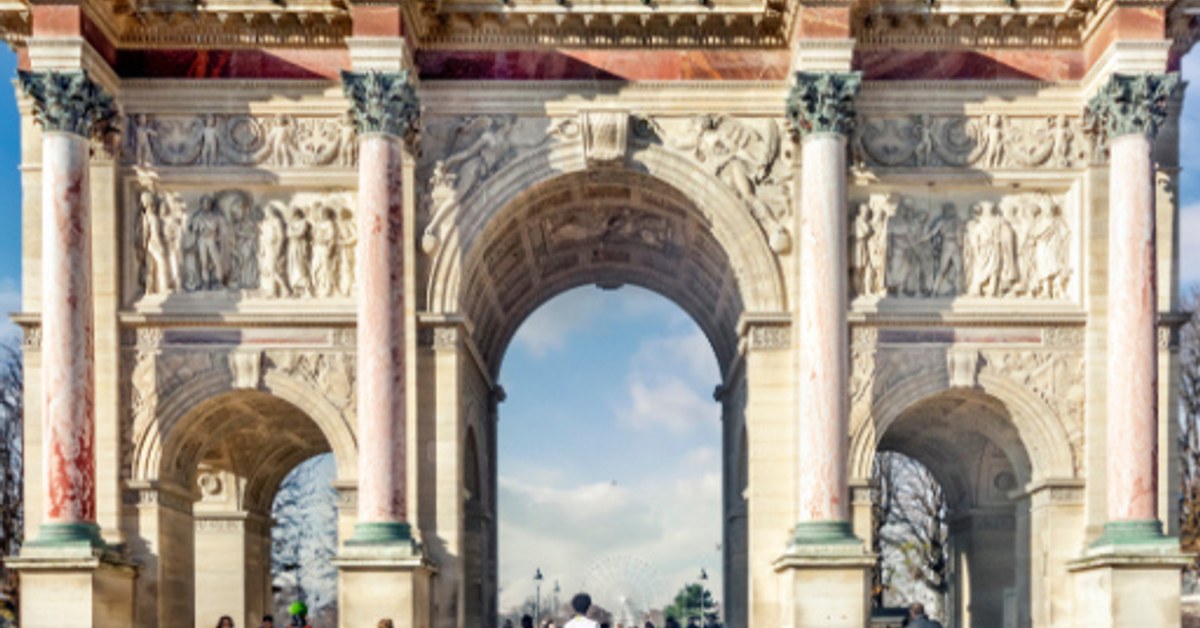
The Arc de Triomphe du Carrousel stands at the entrance to the Louvre Gardens. Workers completed it in 1808, during his reign. It celebrates the victories of the Grande Armée. The photograph at the top of this article shows it as it looks today.
He expanded the Louvre into the museum it is today. He built the Rue de Rivoli along the Tuileries Gardens. He rebuilt Paris’s water supply and sewer system. He founded the Bank of France.
The metric system spread across Europe because of his armies. France had adopted it during the Revolution. His campaigns carried it south, east, and west. Most of the world uses it today.
The Code Civil, in its original or adapted form, now shapes the legal systems of around 60 countries.
Historians estimate he is the subject of more books than any historical figure except Jesus Christ. In France, he remains a touchstone in every debate about national ambition and the cost of power. France does not fully celebrate him. It does not fully condemn him. It cannot let him go.
Where to Follow Napoleon’s Story in France
| Place | Location | What to See |
|---|---|---|
| Les Invalides | Paris 7th arrondissement | Napoleon’s tomb + Musée de l’Armée |
| Arc de Triomphe | Paris 8th arrondissement | His greatest monument, completed posthumously |
| Arc de Triomphe du Carrousel | Paris 1st arrondissement | Finished 1808, celebrates the Grande Armée |
| Château de Malmaison | Rueil-Malmaison, near Paris | Joséphine’s home and famous rose garden |
| Château de Fontainebleau | 1 hour south of Paris | Where Napoleon signed his abdication in 1814 |
| Maison Bonaparte | Ajaccio, Corsica | His birthplace, now a national museum |
France’s history is full of stories like this — individuals and movements that shaped the continent and left their mark on millions of people across the world. If Napoleon’s era interests you, the religious upheaval that preceded him is equally dramatic. Read about the Huguenots — France’s great religious exodus and its global legacy.
Frequently Asked Questions About Napoleon’s France
Where was Napoleon born?
Napoleon was born in Ajaccio, Corsica, on 15 August 1769. France had acquired Corsica from Genoa just one year before his birth, making him one of the first generation of French Corsicans. He left the island aged nine to study in mainland France and never truly returned.
What is the Napoleonic Code?
The Napoleonic Code, officially the Code Civil, was a unified French civil law system that came into force in 1804. It replaced hundreds of local legal customs with a single framework based on equal rights, property protection, and civil marriage. It still forms the basis of French law today and has shaped legal systems in Louisiana, Quebec, Belgium, and around 60 other countries.
Where is Napoleon buried?
Napoleon lies in a sarcophagus of red quartzite beneath the gilded dome of Les Invalides in Paris. France returned his body from St Helena in 1840, nineteen years after his death. Les Invalides is open daily and draws around three million visitors each year.
What happened between Napoleon and Joséphine?
Napoleon married Joséphine de Beauharnais in 1796 and loved her deeply throughout their marriage. In 1809, he divorced her because she had not produced an heir — a political necessity for the dynasty. Joséphine retired to the Château de Malmaison near Paris, where she died in May 1814. On St Helena, Napoleon named Malmaison the place where he had been happiest.
Can you visit places connected to Napoleon in France today?
Yes — Paris has many Napoleonic landmarks. Les Invalides houses his tomb and the Musée de l’Armée. He commissioned the Arc de Triomphe, and the Arc de Triomphe du Carrousel dates from his reign. Outside Paris, Fontainebleau (one hour by train) is where he signed his abdication in 1814. In Corsica, Maison Bonaparte in Ajaccio is his birthplace and now a national museum open to visitors.
You Might Also Enjoy
- The Cathars of Languedoc: France’s Forgotten Heresy
- The Huguenots: France’s Great Exodus and Its Global Legacy
- Two Weeks in France: The Best Itinerary for First-Time Visitors
Plan Your France Trip
Ready to follow Napoleon’s trail through France? Our complete travel planning hub covers getting from Paris to Fontainebleau, visiting Les Invalides, and exploring Corsica. Start planning your France trip here →
Join 7,000+ France Lovers
Every week, get France’s hidden gems, seasonal guides, local stories, and the art of la vie française — straight to your inbox.
Subscribe free — enter your email:
Free forever · One email per week · Unsubscribe anytime
Tours & experiences you might love


Powered by Viator. Some links are affiliate links — we may earn a small commission at no extra cost to you.

Leave a Reply