
Joan of Arc was a farm girl who led an army at 17. Within two years she was dead. Yet more than 590 years later, France still honours her every spring in the city of Orléans.
This guide tells her story in plain terms. It also shows you where to follow her footsteps across France.
Who Was Joan of Arc?
Joan was born around 1412 in Domrémy, a village in north-eastern France. Her family farmed the land. She never learned to read or write.
France was in a dark place. The Hundred Years’ War had dragged on since 1337. English armies held Paris and much of the north. The French crown was in crisis.
Joan said she heard voices from the age of 13. At 16 she set out to find the French heir, Charles. She wanted to see him crowned king.
Why Orléans Mattered
In October 1428, English forces besieged Orléans. The city sits on the Loire. Whoever held it controlled the way to central France.
The siege lasted months. Food ran low. Morale fell. Many believed the city would soon surrender.
Joan arrived in late April 1429. She wore armour and carried a banner. Soldiers who had lost hope began to fight again.
The English lifted the siege on 8 May 1429. The date still marks the city’s biggest festival. Locals call her “la Pucelle d’Orléans”, the Maid of Orléans.
From Orléans to the Coronation
Victory at Orléans changed everything. Joan pushed on through the Loire Valley. The French won at Patay in June 1429. The road to Reims lay open.
Charles VII was crowned in Reims Cathedral on 17 July 1429. Joan stood beside the altar with her banner. French kings had been crowned in that cathedral for centuries.
That day gave the French cause new legitimacy. Many ordinary people began to believe France could win.
Want to see the region where the campaign unfolded? Our Loire Valley road trip guide covers the route in detail. The Loire châteaux story shows who ruled the valley after her.
🇫🇷 Enjoying this? 7,000 France lovers get stories like this every week. Subscribe free →
Capture, Trial and Death
Her luck ran out in May 1430. Burgundian troops captured her near Compiègne. Burgundy was a French duchy allied with England.
The Burgundians sold her to the English. A church court tried her in Rouen. The trial ran from January to May 1431.
The judges questioned her for weeks. She answered with sharp wit, despite her age and lack of schooling. Many records of those exchanges survive today.
The court condemned her. On 30 May 1431 she was burned in the Old Market Square of Rouen. She was about 19.
Did you know? A second trial in 1456 reviewed her case and cleared her name, 25 years after her death.
How France Remembers Joan Today
The Catholic Church named her a saint in 1920. France made her a national figure long before that. Writers, painters and sculptors have kept her story alive for centuries.
Today she is a heritage story that belongs to the whole country. Schools teach it. Towns mark it. Visitors travel to see it.
Why Her Story Still Matters
Joan’s life lasted under 20 years. Yet it shaped how the French see courage. Her story shows what one young person can do with nothing but belief.
It also shows how fragile fame can be. The same people who needed her turned away when she fell. Only later did France fully claim her.
Many visitors say the places feel more alive once they know the story. A quiet square in Orléans becomes the scene of a turning point. A grey market square in Rouen becomes a place to pause.
Travel to these towns with her story in mind. You will see France through a different lens.
Where to Follow Joan’s Footsteps
You can trace her life across five places. Each one adds a chapter.
Domrémy-la-Pucelle
This small village in the Vosges is her birthplace. Visit her family house and the nearby basilica. The countryside around it feels quiet and unchanged.
Orléans
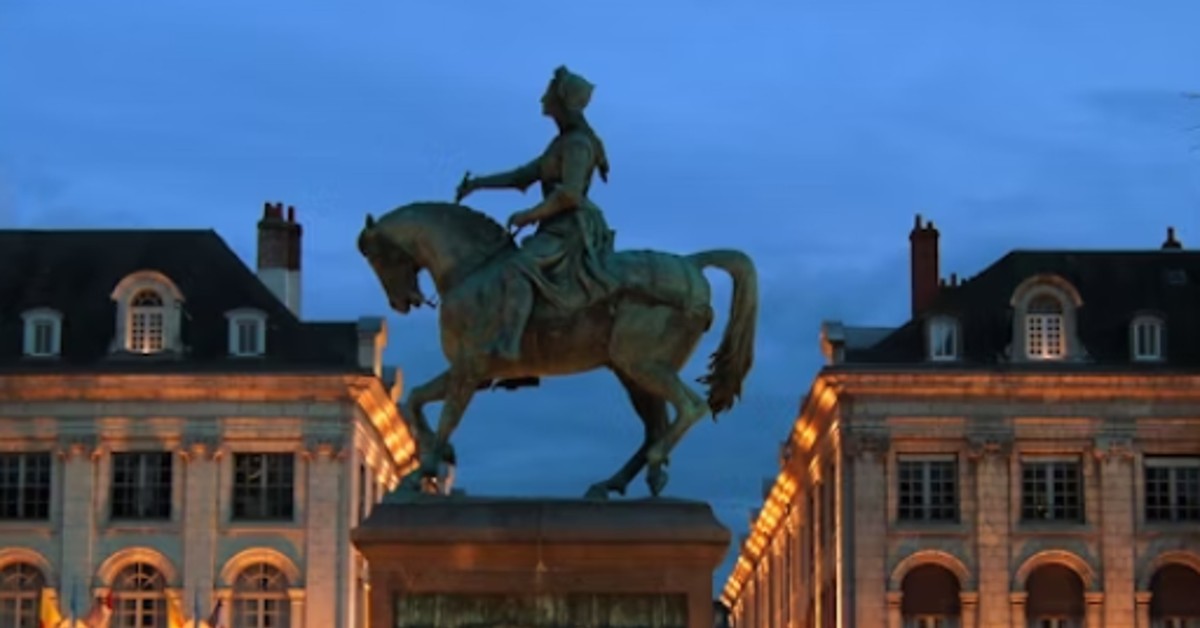
This is the heart of the story. Start in Place du Martroi, where her gilded bronze statue sits above the square. It dates from 1855. The statue looks best at dusk, when the lights come on.
Visit on 7 and 8 May for the Fêtes Johanniques. The city holds a parade, a ceremony and a medieval market. Details are on the official Orléans tourism site.
Reims
See the cathedral where Charles VII was crowned. Joan’s statue stands outside it. Reims is also the heart of Champagne country.
Rouen
Walk to the Old Market Square. A modern church and a memorial mark the spot of her death. The old city around it is full of half-timbered houses.
Paris
A second golden statue of Joan stands in Place des Pyramides. It is a short walk from the Louvre. Many visitors pass it without a glance.
Plan a Joan of Arc Heritage Trip
A simple route links Paris, Orléans and Reims in four or five days. Add Rouen for a deeper trip. The distances are short, and trains connect each city.
Spring is the best season for Orléans. Autumn is lovely for Reims and the vineyards. Our France trip planning hub will help you build the rest of the journey.
If you love stories about people who shaped France, read about Charlemagne. You might also like our look at how France honours its ancestors.
Frequently Asked Questions
How old was Joan of Arc when she died?
Joan was about 19 when she died on 30 May 1431. She was born around 1412, but the exact date is not known.
Where can I see Joan of Arc statues in France?
You can see them in Orléans, Paris, Reims and Rouen. The best known stands in Place du Martroi in Orléans. A golden one rides in Place des Pyramides in Paris.
When is the Joan of Arc festival in Orléans?
The Fêtes Johanniques run each year around 29 April to 8 May. The main ceremonies take place on 7 and 8 May. The date marks the end of the 1429 siege.
Why is Orléans so important to her story?
Orléans was her first great victory. She helped lift the English siege on 8 May 1429. It turned the war and led to the coronation at Reims.
Can I visit her birthplace?
Yes. Her family house in Domrémy-la-Pucelle is open to visitors. It lies in the Vosges, in north-eastern France.
You Might Also Enjoy
- Loire Valley Road Trip: The Complete Guide for US Visitors
- Charlemagne: The King Who Made Europe
- The Cathars of Languedoc: France’s Forgotten Heresy
Plan Your France Trip
Ready to build your journey? Our France planning hub covers regions, seasons and routes.
Join 7,000+ France Lovers
Every week, get France’s hidden gems, seasonal guides, local stories, and the art of la vie française — straight to your inbox.
Subscribe free — enter your email:
Love more? Join 64,000 Ireland lovers → · Join 43,000 Scotland lovers → · Join 30,000 Italy lovers →
Free forever · One email per week · Unsubscribe anytime
Tours & experiences you might love


Powered by Viator. Some links are affiliate links — we may earn a small commission at no extra cost to you.

Leave a Reply