
On 12 October 1793, workmen with picks and crowbars walked into the royal church of France. They smashed a marshal’s tomb, broke through a wall into the vault of the Bourbon kings and pulled out the coffin of Henri IV. Then they kept going. Within two weeks, the kings and queens of France were out of their coffins and lying in two pits in the old monks’ cemetery beside the church.
That church is the Basilica of Saint-Denis, just north of Paris. We think it tells one of the strangest stories in French history, and you can still walk through it, effigy by effigy, today.
Why the Kings Were Here at All
The church stands over the grave of Saint Denis, a bishop who died around the year 250. A legend, retold in a life of the saint rewritten by an abbot of Saint-Denis in the 800s, says Denis picked up his own head at Montmartre and walked north, praying, until he fell on this spot.
Frankish nobles soon wanted to lie near him. So did a queen, Aregund, a daughter-in-law of Clovis, buried here around 580. Meet her people in our story of the Franks.
From the death of King Dagobert in 639 until the 1800s, the church received 40 kings, 26 queens and about ten servants of the crown. A chronicler of the 1200s called it “the cemetery of kings”. A new church was consecrated here in 775 in the presence of Charlemagne.
Around 1265, Louis IX, the future Saint Louis, ordered sixteen carved effigies of his ancestors. Fourteen of them still lie in the transept. They were once painted in bright colours.
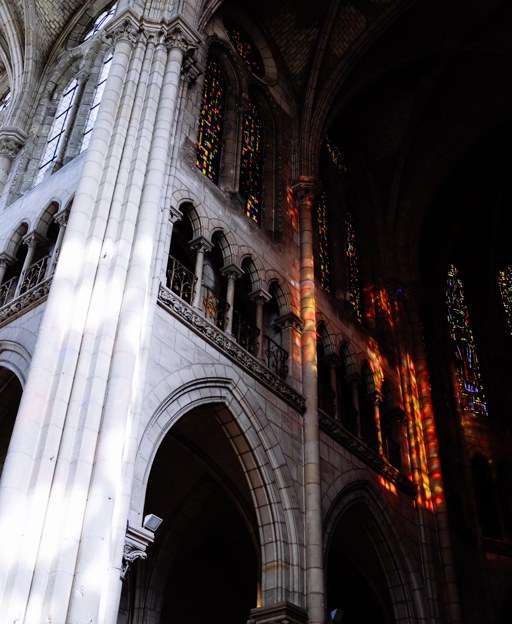
A word on the building itself, as background. In the 1100s, Abbot Suger, adviser to Louis VI and Louis VII, rebuilt the church with rib vaults and great windows of coloured glass. Louis VII and Queen Eleanor of Aquitaine came to see the new east end consecrated on 11 June 1144. It is counted among the cradles of Gothic art, a story we told in our piece on Sens Cathedral.
Summer 1793: The Order to Destroy
The French Revolution closed the abbey in 1792, and the monks had to leave. France was at war and needed metal. The royal coffins were made of lead, and lead made bullets.
On 1 August 1793, the National Convention decreed that the tombs and mausoleums of the former kings at Saint-Denis, and across the Republic, would be destroyed on 10 August. Between 6 and 8 August, workers smashed the monuments of the earliest kings.
This was not an angry mob. The government hired a contractor and his workers to take the tombs apart.
October 1793: The Coffins Are Opened
The workers came back on Saturday, 12 October. The first monument to fall was that of Turenne, the marshal of France killed by a cannonball in 1675. Then they broke into the Bourbon vault.
Henri IV’s coffin was the first they attacked in the vault. He had died in 1610, yet his body was so well preserved that it was stood upright in the church for days. Curious passers-by came to look at the old king.
On 14 October the real work began. The workers opened the coffins of Marie de’ Medici, Henri’s second wife, and Anne of Austria. Then came Louis XIII and Louis XIV. Louis XIV was found “as black as ink”. Louis XV seemed whole in his linen wrappings, until the body was lifted and fell apart.
On 16 October alone, twenty-one coffins were broken open. Onlookers grabbed souvenirs: a tooth, a lock of hair, a fingernail. In all, more than 170 bodies went into two pits in the monks’ cemetery north of the church, one for the Bourbons and one for the older dynasties. Quicklime and soil went on top.
Someone wrote it all down. Dom Poirier, a former Benedictine monk of the abbey, kept the official record. A manuscript copy of a journal of the exhumations, “begun 12 October 1793”, still sits in the municipal library of Nantes.
The church fared no better. In 1794 the lead was stripped from its roof. Rain came in. For years the empty building served as a store for flour and wheat, and even as a theatre.
1815 and 1817: Bringing the Kings Home
Napoleon decided to restore the church early in his empire. The kings, though, had to wait for a Bourbon to return to the throne.
On 21 January 1815, the anniversary of his brother’s execution, Louis XVIII had the remains of Louis XVI and Marie Antoinette carried with great ceremony from the old Madeleine cemetery in Paris to Saint-Denis. The same day, the first stone of the Chapelle expiatoire was laid on the cemetery site.
In 1817 Louis XVIII ordered a search for the rest. After a week of digging, workmen found the pits. The quicklime had done its work, and no one could tell one king from another. The mixed bones were gathered in January 1817 and laid in an ossuary in the crypt, once the burial vault of Turenne. Two marble plaques list the names.
So here is the twist. The carved kings you see on the tombs lie over empty ground. Their bones rest together in the crypt below. Louis XVIII himself was the last king buried at Saint-Denis, in 1824.
The Heart in the Crystal Vase
One more royal came home much later. Louis-Charles, the young son of Louis XVI and Marie Antoinette, was recognised by Europe’s royal courts as Louis XVII. He died in 1795, still a boy.
The surgeon Philippe-Jean Pelletan is said to have secretly removed his heart the day after he died. It was kept in a crystal vase and passed from hand to hand. It has been in the basilica since 1975. On 8 June 2004, the anniversary of the boy’s death, what is believed to be his heart was placed in the Bourbon chapel, under a medallion with his portrait.
What You Can See Today
- More than 70 effigies and tombs. Look for Saint Louis’s medieval kings in the transept, the marble effigies of Charles VI and Isabeau of Bavaria, and Charles V, carved in his lifetime as a real portrait. Every effigy has its eyes open, a sign of faith in the Resurrection.
- The Renaissance tombs. Louis XII and Anne of Brittany, Francis I and Claude of France, Henri II and Catherine de’ Medici. Below, the royal couple lie dead. Above, the same couple kneel in prayer.
- The missing Bourbons. Henri IV and Louis XIV were buried here but never had carved tombs. Their vault in the crypt is marked by six marble slabs.
- The ossuary. In the crypt you can still read the long list of the kings and queens of Saint-Denis.
- Louis XVI and Marie Antoinette. Louis XVIII ordered two funeral statues of his brother and sister-in-law.
- The heart of Louis XVII, in the Bourbon chapel.
The visitor route has displays in the crypt on the Revolution, and digital labels beside the tombs tell you who each king or queen was. The north side looks different from the south for a reason. Its 90-metre spire was hit by lightning in 1837 and taken down in 1846 and 1847. The first stone of a rebuild of the north tower and spire was laid on 14 March 2025, and the official site explains how to visit the worksite, called the Fabrique de la flèche.
Getting There and Planning Your Visit
Take Metro line 13 to the Basilique de Saint-Denis station. The church is about 100 metres away. The station has no lift, so plan for stairs.
The royal tombs sit inside a working cathedral, so they close for services and on some holidays. Check the official Saint-Denis basilica website for hours, tickets and closures close to your trip. Audioguides come in English.
To follow the story to its end, visit the Chapelle expiatoire in Paris, where Louis XVI and Marie Antoinette were first buried. For another royal chapel of Saint Louis, see our guide to the Sainte-Chapelle.
Frequently Asked Questions
Are the kings of France still buried at Saint-Denis?
Yes, but not under their tombs. In 1793 the bodies were thrown into two pits beside the church. In 1817 Louis XVIII had the mixed remains gathered into an ossuary in the crypt.
Who is buried in the Basilica of Saint-Denis?
From Dagobert in 639 to Louis XVIII in 1824, the church received 40 kings, 26 queens, many princes and princesses and about ten servants of the crown. Louis XVI and Marie Antoinette were brought here in 1815.
Why were the royal tombs opened in 1793?
The National Convention ordered the royal tombs destroyed, and France at war wanted the lead of the coffins for bullets.
How do I get to the Basilica of Saint-Denis from Paris?
Take Metro line 13 to Basilique de Saint-Denis, about 100 metres from the church. Check the official website for hours and tickets before you go.
Sources
Checked November 2026.
- Centre des monuments nationaux: Basilique cathédrale Saint-Denis, Histoire du monument
- Centre des monuments nationaux: Les gisants de la basilique
- Centre des monuments nationaux: Inhumer un roi de France, mode d’emploi
- Centre des monuments nationaux: Le berceau de l’art gothique
- Centre des monuments nationaux: Nouveau parcours de visite
- Centre des monuments nationaux: Reconstruction de la tour et de la flèche nord
- Centre des monuments nationaux: Informations pratiques (access)
- Centre des monuments nationaux: Histoire de la Chapelle expiatoire
- Bibliothèque nationale de France: Violation des tombes royales de Saint-Denis (1793-1794)
- Catalogue collectif de France (BnF): Journal d’exhumation des corps de la ci-devant abbaye de Saint-Denis commencée le 12 octobre 1793 (Bibliothèque municipale de Nantes)
- Seine-Saint-Denis Tourisme: Destruction of the Royal Tombs in Saint-Denis Basilica
- Seine-Saint-Denis Tourisme: History of Saint-Denis Basilica during the Revolution
- Seine-Saint-Denis Tourisme: Louis XVIII and the return of the monarchy
- Seine-Saint-Denis Tourisme: The heart of Louis XVII
Tours & experiences you might love


Powered by Viator. Some links are affiliate links — we may earn a small commission at no extra cost to you.

Leave a Reply