
French Pyrenees Travel Guide: Mountains, Villages and What to See
The French Pyrenees travel experience is one of the most underrated in all of Europe. This mountain range — stretching 430 kilometres from the Atlantic coast to the Mediterranean — gives you dramatic gorges, medieval villages, wild national parks, and thermal spa towns, all without the queues you find in the Alps. Whether you are walking a section of the famous GR10 trail, exploring Cathar castle ruins on rocky hilltops, or settling into a Basque farmhouse for a week, the French Pyrenees rewards slow travel more than almost anywhere else in France. I have walked the Ariège valleys, swum in the Lac de Gaube above Cauterets, and eaten garbure stew in a mountain auberge with a ceiling so low you had to duck to reach your table. This guide covers everything you need to plan your visit.
Love France? Join 7,000+ readers on our free newsletter → lovetovisitfrance.substack.com
Why Visit the French Pyrenees?
Most travellers to France choose Provence, Normandy or the Loire Valley. That is understandable. But the French Pyrenees offers something those regions cannot: genuine wildness. The Parc National des Pyrénées, established in 1967, covers 45,700 hectares of protected mountain terrain. Brown bears still roam the forests of the Ossau valley. Lammergeier vultures circle above the Cirque de Gavarnie, a natural amphitheatre that drops 1,400 metres in a single sweep. UNESCO listed Gavarnie as a World Heritage Site in 1997.
The French side of the Pyrenees also carries a weight of history that feels different from the rest of France. This was Cathar country. It was a land of smugglers’ routes and Resistance escape lines during the Second World War. The bastide towns built here in the 13th century still hold their weekly markets in the central squares exactly as they did 700 years ago.
And the food? The French Pyrenees has three distinct culinary traditions pulling at it: Gascon (duck confit, magret, Armagnac), Basque (peppers, salt cod, Bayonne ham), and Catalan (anchovies, olive oil, brandade). You eat well here. Very well.
🇫🇷 Free: The Perfect Provence & South of France Road Trip
A free 10-day itinerary covering Avignon, the Luberon villages (Gordes, Roussillon, Bonnieux), Marseille, Cassis, Aix-en-Provence, and the Camargue — with practical route notes most travel guides leave out.
The Best Areas to Visit in the French Pyrenees
The French Pyrenees divides neatly into three zones from west to east. Understanding the differences saves you from driving six hours in the wrong direction.
The Basque Pyrenees (Pyrénées-Atlantiques West)
This is the Atlantic end of the range — green, misty, and drenched in Basque identity. The village of Saint-Jean-Pied-de-Port sits at the foot of the Col de Roncevaux pass and marks the traditional starting point of the Camino de Santiago. Every morning, pilgrims gather outside the pilgrim office on the Rue de la Citadelle before beginning their journey to Spain. Even if you are not walking the Camino, the medieval walled town is worth a visit. The market on Monday mornings draws farmers from valleys you will never find on a tourist map. The Basque corner of France has its own language, architecture, and cuisine — and the Pyrenean foothills here feel distinctly different from the rest of the range.
The High Pyrenees (Hautes-Pyrénées)
This is the dramatic heart of the range and the area most visitors mean when they say “the Pyrenees.” Lourdes, the famous pilgrimage town, sits at the foot of the mountains here — 6 million visitors come every year to the Sanctuary of Our Lady of Lourdes. From Lourdes, the road climbs south 30 kilometres to Cauterets, a spa town at 932 metres altitude with access to the Pont d’Espagne waterfall and the Lac de Gaube above it. The Cirque de Gavarnie is the crown jewel: a natural rock amphitheatre 3 kilometres wide at the base, with the Grande Cascade de Gavarnie tumbling 422 metres — the tallest waterfall in France. Drive 50 kilometres east from Gavarnie and you reach the Cirque de Troumouse, which is quieter and, many walkers argue, even more spectacular.
The Ariège and Cathar Pyrenees (Eastern Foothills)
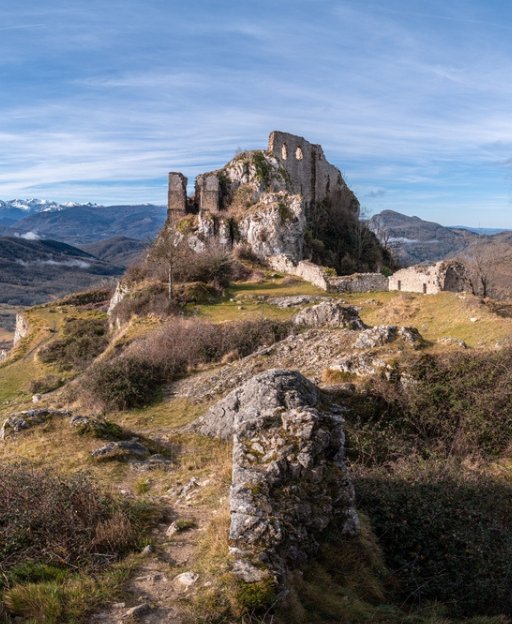
The eastern section of the French Pyrenees is the least visited and the most historically layered. This is the Ariège — a department of cave art, Cathar ruins, and traditional country life that has not changed much in three generations. The Grotte de Niaux contains some of the finest prehistoric cave paintings in Europe, dating back 14,000 years, and you can still walk into the cave chamber where they are painted. The Cathar castles of Montségur, Roquefixade, and Puilaurens perch on summits that seem designed to terrify would-be attackers — which was, of course, exactly the point. The bastide market towns of the region have been running the same weekly markets since the 13th century.
💌 Join 7,000+ France Lovers
Get hidden gems, travel tips, and local stories — free, every week.
Getting to the French Pyrenees
The nearest airports are Toulouse-Blagnac (for the eastern and central Pyrenees), Pau-Pyrénées (for the Hautes-Pyrénées), and Biarritz-Anglet-Bayonne (for the Basque Pyrenees and Atlantic end). All three have connections from major European hubs. From the UK, direct routes operate to Toulouse and Biarritz.
If you are travelling from Paris by train, the French TGV network gets you from Paris Montparnasse to Toulouse in just under 4 hours 15 minutes. Bayonne is about 2 hours from Paris by high-speed rail. From Toulouse or Bayonne, local trains and buses serve the valley towns, though a hire car is essential if you want to explore the mountain villages properly. The D918 road along the Pyrenean foothills — the Route des Cols — is one of the most beautiful drives in France.
When to Go
The French Pyrenees is a year-round destination, but the season shapes the experience entirely. June to September is walking and outdoor season — the high mountain passes are clear of snow and the GR10 trail is fully accessible. July and August bring French holidaymakers in number, especially to Lourdes, Cauterets, and the popular valleys. September is the finest month: the crowds thin, the light turns golden, and the forests begin to colour.
Winter (December to March) is ski season. The Pyrenean ski stations — Grand Tourmalet, Cauterets, Font Romeu, Ax-les-Thermes — are smaller and considerably cheaper than the Alps. A week’s ski holiday in the Pyrenees costs roughly 30 to 40 per cent less than an equivalent holiday in the Alps.
What to See and Do in the French Pyrenees
The Cirque de Gavarnie
The Cirque de Gavarnie is non-negotiable. The walk from the village of Gavarnie to the base of the cirque takes about 90 minutes on a well-marked path. When you arrive at the foot of the walls — 3 kilometres wide and rising nearly 1,500 metres above you — the scale is simply overwhelming. The Grande Cascade de Gavarnie, at 422 metres, is the tallest waterfall in France. Go early in the morning to beat the day-trippers who arrive by the coachload from Lourdes after 10am.
The Grotte de Niaux
The cave of Niaux, in the Ariège near Tarascon-sur-Ariège, contains one of the most complete groups of Upper Palaeolithic paintings in France. The famous Salon Noir is a chamber 800 metres inside the cave where bison, horses, and ibex were painted with extraordinary skill on the rock walls 14,000 years ago. Entry requires a guided tour and visitor numbers are strictly limited — book well in advance. The sense of entering that deep, dark space still carries a weight that no reproduction or museum exhibit can match.
The GR10 Walking Trail
The GR10 runs the full length of the French Pyrenees, from Hendaye on the Atlantic coast to Banyuls-sur-Mer on the Mediterranean — 866 kilometres in total. Most people walk sections rather than the complete route, which takes 50 to 60 days. The Hautes-Pyrénées section between Cauterets and Barèges is particularly popular and includes the Lac de Gaube, the Vignemale (3,298 metres, the highest peak on the French side of the range), and the Hourquette d’Ossoue pass. Mountain refuges along the route provide food and dormitory accommodation — book ahead in July and August.
Thermal Spa Towns
The Pyrenees has been a spa destination since the Roman period. The thermal springs at Bagnères-de-Luchon — known simply as Luchon — have been in continuous use for more than 2,000 years. Ax-les-Thermes, in the Ariège, has outdoor pools fed by natural hot springs where you can soak year-round. Entry costs around €8 to €12 and the pools are open until late evening.
Where to Stay in the French Pyrenees
The Pyrenees has a wide range of accommodation, from gîtes (self-catering rural cottages) to four-star spa hotels. In high season, book at least three months ahead for popular locations.
Lourdes as a Base
Lourdes has more hotels per square kilometre than anywhere in France except Paris — over 200 of them. This makes it surprisingly affordable, even in peak summer. Most non-pilgrimage visitors use Lourdes as a base for day trips into the mountains, taking advantage of the low hotel rates and good road connections south.
Foix for the Ariège
Foix, the prefecture of the Ariège (population 10,000), sits beneath a dramatically positioned château at the confluence of two rivers. It is the ideal base for exploring Cathar castle country, the cave of Niaux, and the upper Ariège valley. The town has a lively Saturday market and excellent restaurants serving traditional Ariège cooking.
Frequently Asked Questions
Is the French Pyrenees worth visiting compared to the Alps?
Absolutely — the Pyrenees offers comparable mountain scenery with far fewer crowds and significantly lower prices. The landscape is wilder, the cultural heritage is richer, and the food traditions are more varied across Gascon, Basque, and Catalan influences.
Do I need a car to explore the French Pyrenees?
A car is strongly recommended for exploring mountain villages and the high passes. The main valley towns are served by trains and buses from Toulouse, Bayonne, and Pau, but the remote cirques and Cathar castle sites require your own transport to reach comfortably.
When is the best time to visit the French Pyrenees for walking?
June through September is ideal for walking, with July and August being the busiest months. September offers the best combination of good weather, accessible trails, and fewer crowds — making it the favourite month for serious walkers and hikers.
You Might Also Enjoy
- Why the Basque Corner of France Feels Like Nowhere Else on Earth
- Why Toulouse Has Never Quite Forgiven Paris for What It Did
- The Medieval City France Tried to Demolish — and How One Man Stopped It
Plan Your France Trip
Ready to start planning? Our complete France trip planning guide covers everything from visas and budgets to the best regions and when to go.
Join 7,000+ France Lovers
Every week, get France’s hidden gems, local recipes, and travel inspiration — the kind you won’t find in any guidebook.
Subscribe free — enter your email:
Love more? Join 64,000 Ireland lovers → · Join 43,000 Scotland lovers → · Join 30,000 Italy lovers →
Thinking about it seriously?
If you’ve started actually planning a move, our complete our complete Moving to France guide walks through every step, every cost, and the paperwork that catches most people out.
Free forever · One email per week · Unsubscribe anytime
Tours & experiences you might love


Powered by Viator. Some links are affiliate links — we may earn a small commission at no extra cost to you.

Leave a Reply