
Walk into almost any of France’s roughly 35,000 town halls and you will meet the same woman: a sculpted bust of Marianne, often crowned with a soft, forward-flopping red cap. She has no birth certificate and never lived, yet she appears on coins in your pocket, on the stamps on your letters, and on the logo at the top of every government website. This is Guide № 014 in The Love France Guide series, and we are going to meet the Republic’s most famous face.
Who Marianne Actually Is
Marianne is an allegory — a personification of the French Republic and of the values it claims for itself, chiefly liberty and reason. She is deliberately not a portrait of any real person. The name is simply “Marie-Anne,” one of the most ordinary feminine first names in eighteenth-century France, which is rather the point: she stands for the common people rather than a queen or a saint. The name attached itself to the Republic around 1792, and for a long time it carried a faintly mocking, popular edge before becoming entirely official.
Her status is set out plainly by the state. The French government treats Marianne, the tricolour flag, the Marseillaise and the motto “Liberté, Égalité, Fraternité” as the national emblems of the Republic, and the Marianne profile sits at the heart of the official state logo you see on ministries and on the site of the Présidence de la République.
The Red Cap, and Where It Comes From
Marianne’s headgear is the bonnet phrygien, the Phrygian cap. Revolutionaries borrowed it from Roman iconography, where a similar soft felt cap, the pileus, was given to enslaved people when they were freed — so by the 1790s it read instantly as a sign of liberty. It is worth noting that the ancient Phrygian cap and the Roman liberty cap were historically two slightly different things that later ages merged into one symbol. The cap had such a strong grip on the French imagination that a stylised Phrygian cap, “Les Phryges,” was chosen as the mascot of the Paris 2024 Olympic and Paralympic Games.
Marianne in Paint, Bronze and Metal
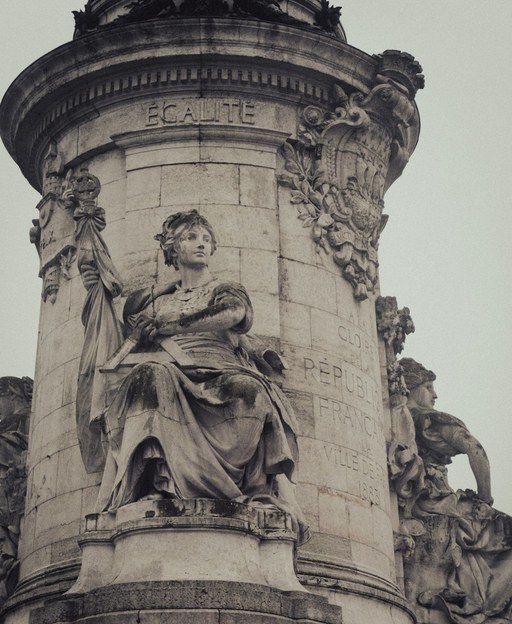
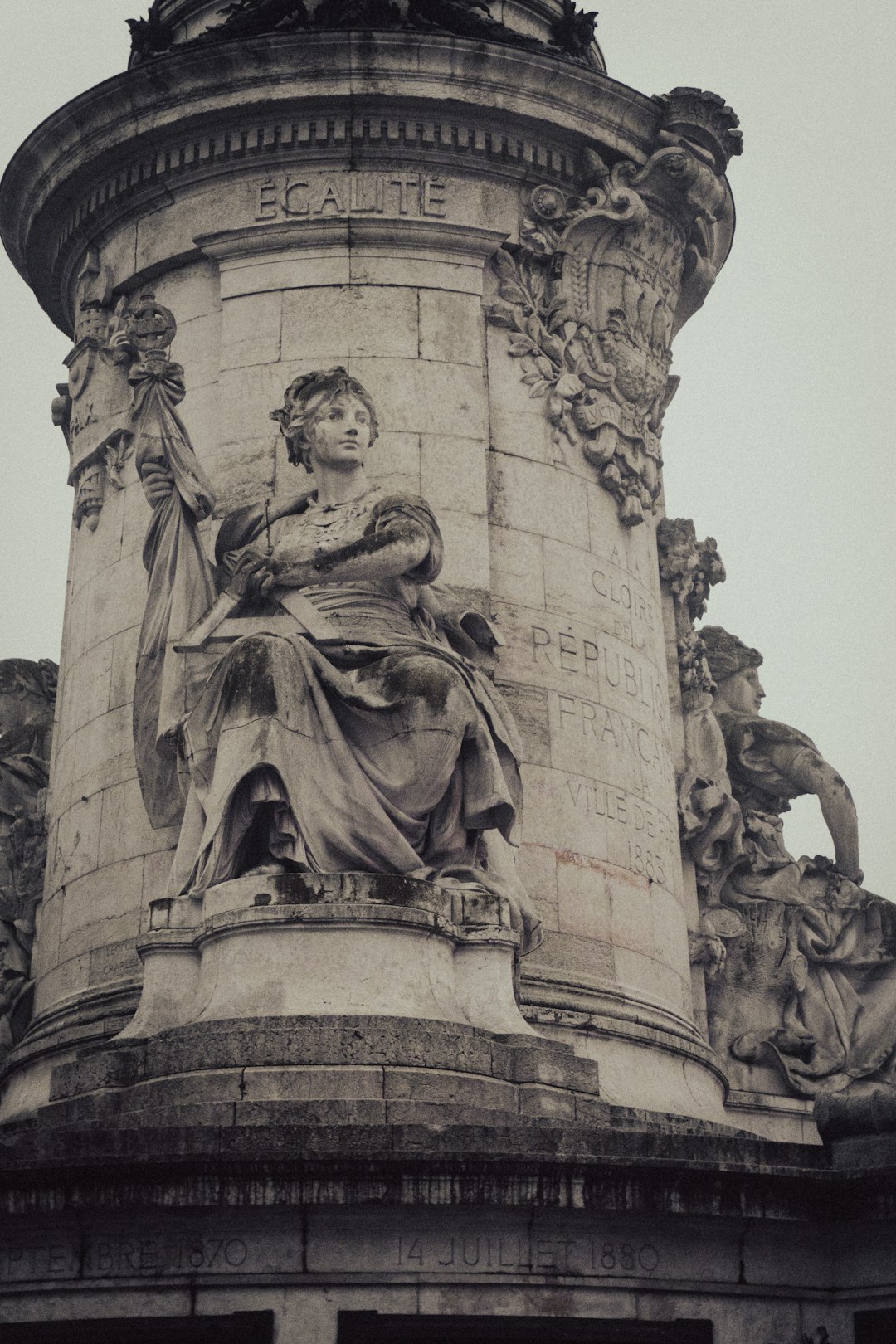
You can trace Marianne through France’s great collections. Eugène Delacroix’s Liberty Leading the People (1830), one of the most recognisable paintings in the Louvre, shows a bare-breasted woman in a Phrygian cap carrying the tricolour — strictly she is “Liberty,” but she has become inseparable from the Marianne idea. At the Musée d’Orsay you can see Honoré Daumier’s unfinished The Republic (1848), a calmer, maternal image. In bronze, the vast statue by the Morice brothers (1883) on the Place de la République has anchored Parisian gatherings for well over a century.
She is also money and post. The Monnaie de Paris, the national mint, has struck her likeness for generations, and a Marianne appears on the smaller French euro cent coins. La Poste has issued a long run of definitive “Marianne” stamps, each redesign quietly marking a change of era. The Musée Carnavalet in Paris, which tells the city’s history, holds revolutionary-period objects where these symbols first took hold.
The Famous Faces Behind the Bust
Here is where Marianne turns surprisingly modern. From 1969, the sculpted town-hall bust was periodically modelled, informally, on well-known living French women. Brigitte Bardot is widely cited as an early inspiration, and over the decades Mireille Mathieu, Catherine Deneuve, Inès de la Fressange, Laetitia Casta and others have lent their features to new versions. The choice has often been linked to mayors and to the Association des Maires de France, and each new model has reliably set off a good-natured national debate about what the Republic’s face should look like.
Where You Will See Her Today
Beyond the mairie, Marianne is woven through official life. Her profile is part of the state’s standard logo; she appears on the national seal; and busts stand in the chambers of the Sénat and other public institutions. For a visitor, the easiest sightings are the cheapest: look at the design on a French postage stamp, or at the engraving on a 1, 2 or 5 euro cent coin minted in France. You are, in a small way, holding the Republic in your hand.
Myths Worth Retiring
Myth: Marianne was a real revolutionary heroine. She was never a living person. She is an allegory, and the name “Marie-Anne” was chosen precisely because it was so common and so ordinary.
Myth: The woman in Delacroix’s painting is officially Marianne. Delacroix titled her as Liberty guiding the people. The figure and Marianne have merged in the popular mind, but they began as distinct ideas.
Myth: There is one fixed, official Marianne face. There is no single legally fixed portrait. The town-hall bust has been reinterpreted many times, which is why your local Marianne may look nothing like the one in the next village.
Frequently Asked Questions
Why is she called Marianne?
“Marianne” combines Marie and Anne, two of the most widespread women’s names in eighteenth-century France. Using such an everyday name signalled that this figure represented ordinary people rather than royalty, and the name became firmly attached to the Republic from around 1792.
What does the red cap mean?
It is the Phrygian cap, a symbol of freedom that French revolutionaries adapted from Roman imagery, where a soft felt cap was associated with people who had been granted their freedom. On Marianne it reads as liberty, which is why it recurs on so many Republican emblems.
Can I see Marianne when I visit France?
Easily. Step inside any town hall to see the bust, visit the Louvre for Delacroix or the Musée d’Orsay for Daumier, stand beneath the statue on the Place de la République in Paris, or simply look closely at a French stamp or a euro cent coin.
More The Love France Guides
The Love France Guide is a numbered series — one tightly focused subject at a time, each with its own downloadable collectible edition. Guide № 001 is The Croissant, Guide № 002 is Bastille Day, Guide № 003 is The Béret, Guide № 004 is French Wine & Terroir, Guide № 005 is Café & Bistro Etiquette, Guide № 006 is French Slang & Verlan, Guide № 007 is Cognac & Armagnac, Guide № 008 is Chanson Française — The French Song Tradition, Guide № 009 is The Breton Stripe (Marinière), Guide № 010 is French Folklore & Ghost Stories, Guide № 011 is French Sayings & Proverbs, Guide № 012 is The French Breakfast, Guide № 013 is Galette des Rois & Épiphanie, This is Guide № 014. More editions are on the way.
🇫🇷 Join 7,000+ France Lovers
Every weekday, a free story from France: the people, places and history behind it, from people who live and love it.
Subscribe free — enter your email:
Tours & experiences you might love


Powered by Viator. Some links are affiliate links — we may earn a small commission at no extra cost to you.

Leave a Reply